Affiliate Disclosure: This post contains affiliate links. If you purchase through these links, Survival Place Blog may earn a commission at no additional cost to you. As an Amazon Associate I earn from qualifying purchases.
A survival emergency can develop faster than most people expect. A wrong turn on a trail, sudden weather change, vehicle breakdown in a remote area, injury, equipment failure or unexpected night outdoors can quickly turn an ordinary trip into a serious situation.
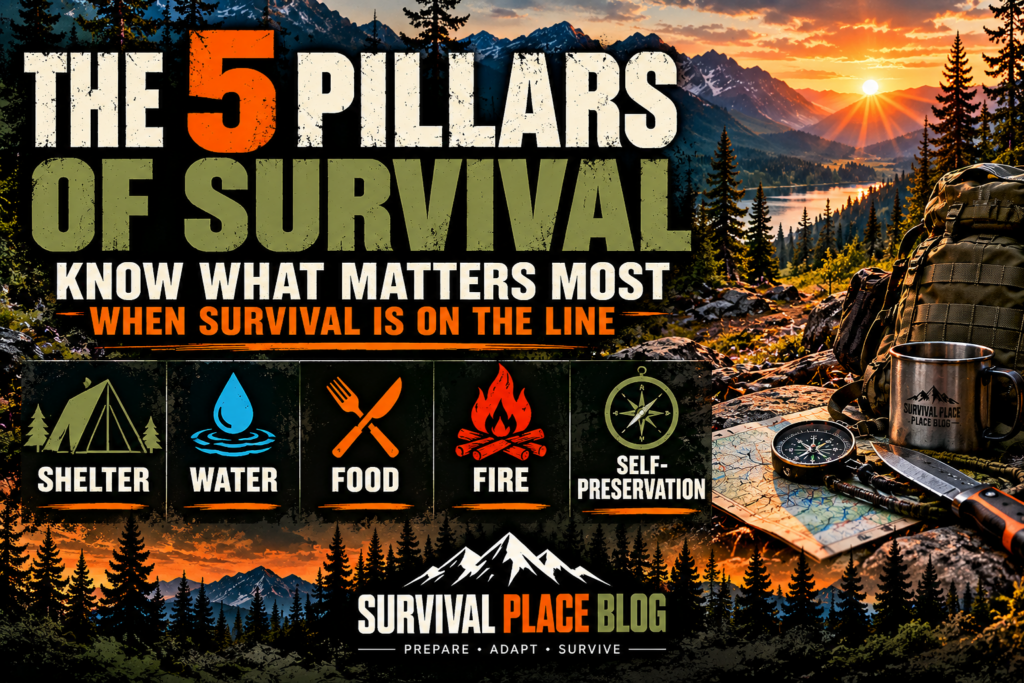
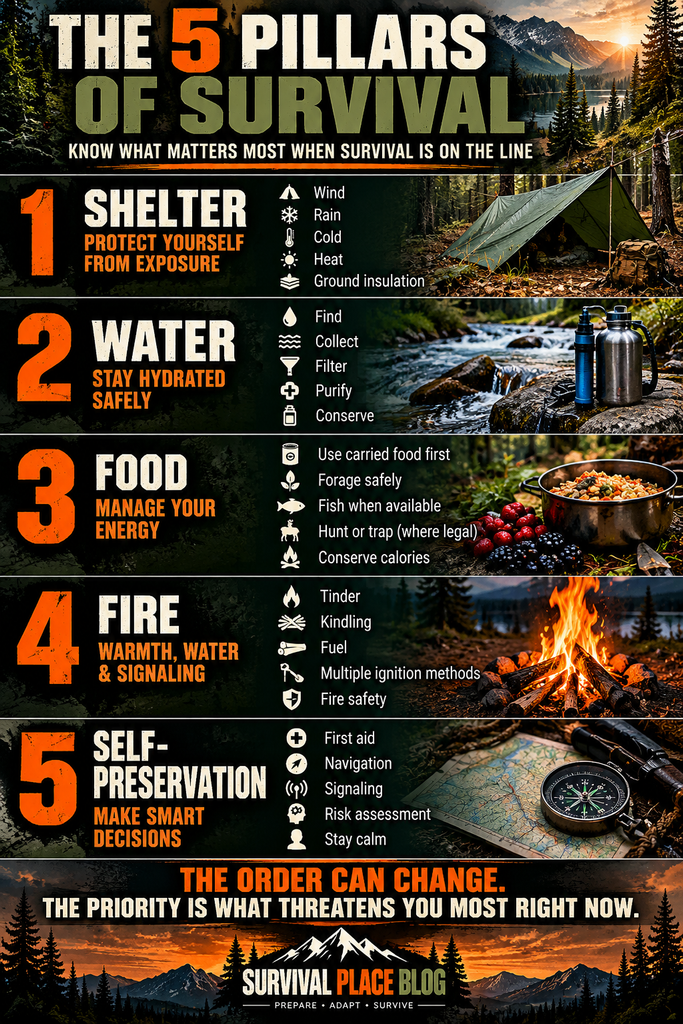
The 5 pillars of survival—shelter, water, food, fire and self-preservation—provide a practical framework for understanding what your body needs and what actions may improve your chances of getting through an emergency.
But survival priorities aren’t a rigid checklist.
A person exposed to freezing rain may need shelter immediately. Someone injured in a fall may need first aid before anything else. In extreme heat, water and shade may become urgent. If you’re already safe and rescuers know where you are, staying visible and conserving energy may be more important than traveling in search of resources.
The real skill is understanding the five pillars well enough to recognize which one matters most right now.
Survival skills help you respond once an emergency is happening, while preparedness can reduce the problems you face before it begins. For the preparedness side of the equation, see our guide, The 5 Pillars of Prepping.
The 5 Pillars of Survival at a Glance
The five pillars are:
- Shelter — Protection from environmental exposure.
- Water — Maintaining hydration and obtaining safe drinking water.
- Food — Providing energy when an emergency becomes prolonged.
- Fire — Supporting warmth, water treatment, cooking and signaling when conditions allow.
- Self-Preservation — Protecting your physical condition, judgment, navigation, first aid and ability to make good decisions.
These priorities overlap.
Shelter can help prevent hypothermia. Fire may help you stay warm. Water supports physical and mental performance. Food becomes increasingly important as an emergency continues. Self-preservation influences every decision you make.
Survival isn’t about mastering one spectacular skill. It’s about solving problems in the right order while avoiding decisions that make the situation worse.
Survival often comes down to making good decisions before a difficult situation becomes worse. The National Park Service Outdoor Emergency Plan provides guidance on what to do if you become lost or injured outdoors, including assessing your situation, seeking help, staying put when appropriate and conserving energy
Pillar 1: Shelter — Protect Yourself From Exposure
In many wilderness emergencies, exposure can become a serious problem long before hunger does.
Cold temperatures, wind, rain, snow, intense sun and excessive heat can all interfere with your body’s ability to regulate temperature. Your clothing is your first layer of shelter, followed by natural protection, tents, tarps or an emergency shelter you construct.
The objective isn’t necessarily to build an impressive wilderness shelter.
The objective is to reduce exposure while conserving time and energy.
Choose the Location Before Building the Shelter
A poorly located shelter can create additional danger.
Before settling in, look around for hazards such as:
- Dead or unstable trees and branches
- Falling rocks
- Flood-prone depressions and washes
- Rising water
- Avalanche or slide terrain
- Strong wind exposure
- Insect nests
- Animal activity
- Unstable ground
A location that offers natural protection from wind and precipitation may reduce the amount of work required to create an effective shelter.
Use What You Already Have First
Before cutting branches or attempting a complicated shelter, take inventory.
You may already have:
- A tent
- Tarp
- Emergency bivvy
- Rain gear
- Groundsheet
- Paracord
- Backpack
- Extra clothing
- Emergency blanket
Using equipment you already carry is generally faster and more energy-efficient than constructing something entirely from natural materials.
When you need more than the gear you’re carrying, knowing how to choose a safe location and create protection from the elements becomes an important survival skill. For more detailed guidance, see our guide, Emergency Outdoor Shelter: How to Choose, Build, and Survive the Night.
Insulation Matters Above and Below You
One of the most overlooked shelter considerations is the ground.
Cold or wet ground can draw heat away from your body. Leaves, pine needles, a sleeping pad, dry vegetation or other appropriate insulating material can create separation between you and the ground.
Your shelter should ideally help protect you from:
Wind + precipitation + ground contact + temperature extremes.
A small, effective shelter that accomplishes those goals can be more valuable than a large structure that consumes hours of energy to build.
A compact emergency bivvy can provide another layer of protection from wind, cold and changing weather when an unexpected night outdoors becomes necessary. The S.O.L. Survive Outdoors Longer 90% Emergency Bivvy with Survival Whistle & Tinder Cord is designed as a lightweight emergency shelter option that can be carried in a survival or outdoor kit.
Pillar 2: Water — Hydration Without Creating Another Problem
Water is essential, but desperation can lead people to make poor choices.
The old survival saying that humans can survive “three days without water” should not be treated as a countdown timer. Hydration needs vary considerably depending on temperature, exertion, health, altitude and other conditions.
Instead, treat dehydration as a developing threat and manage it early.
Finding Water
Possible wilderness water sources include:
- Springs
- Streams
- Rivers
- Lakes and ponds
- Collected rainwater
- Snow or ice in appropriate conditions
Finding water is only part of the problem.
Natural water that appears clear can still contain microorganisms capable of causing illness.
Drinking untreated water may exchange an immediate hydration problem for vomiting, diarrhea or another medical problem that makes survival considerably more difficult.
Treat Water Whenever Possible
Common treatment options include:
- Boiling
- Filtration
- Chemical disinfection
- Appropriate purification systems
Different treatment methods have different strengths and limitations, so understanding your equipment before an emergency is important.
Finding water is only part of the challenge—you also need to know how to make it safer to drink. For more detailed guidance on locating and treating natural water sources, see our guide, Wilderness Water: How to Find, Filter and Purify Water Safely.
A compact water filter can provide another treatment option without requiring you to carry all of your water from the beginning of a trip.
For outdoor emergencies where you may need to treat water from a natural source, the Sawyer MINI Water Filtration System provides a compact filtration option that can be carried in a backpack, emergency kit or survival kit.
Conserve Water by Conserving Energy
Finding water doesn’t mean you should unnecessarily increase your activity.
Traveling during the hottest part of the day, carrying unnecessary weight or repeatedly climbing difficult terrain can increase fluid loss.
Sometimes the best water-conservation strategy is simply to slow down, find shade and stop wasting energy.
Pillar 3: Food — Important, but Usually Not the First Priority
Food receives enormous attention in survival entertainment, but in many short-term wilderness emergencies it isn’t the first problem you need to solve.
If you’re cold, injured, dehydrated or lost, immediately spending hours hunting or foraging can waste energy and move you farther from the location where rescuers expect to find you.
Food becomes increasingly important as an emergency continues.
It provides energy for:
- Maintaining body temperature
- Traveling when movement is necessary
- Gathering water
- Building shelter
- Performing physical tasks
- Maintaining concentration and decision-making
But obtaining food should make sense from an energy-versus-reward perspective.
Use the Food You Already Have
Start with your existing supplies.
Energy bars, trail mix, nuts, dried fruit, jerky and other calorie-dense foods can provide useful energy without cooking or preparation.
Ration intelligently, but don’t become so obsessed with preserving food that you refuse to eat while performing necessary physical work.
Foraging Requires Knowledge
Wild edible plants can supplement food supplies, but plant identification is a skill that should be learned before an emergency.
Never eat a wild plant, berry or mushroom based on guesswork, resemblance or an unreliable identification.
Some toxic plants resemble edible species, and mushroom identification can be particularly unforgiving.
Wild food can become useful in a prolonged emergency, but safe identification and realistic expectations are essential. For a more detailed look at plants, fishing, trapping, hunting and other wilderness food options, see our guide, Foraging for Survival: Finding Food Safely in the Wilderness.
Fishing, Trapping and Hunting
Depending on location, regulations, available equipment and the expected duration of an emergency, fishing or other food-gathering methods may eventually become useful.
But these methods require knowledge and can consume considerable time and calories.
In a short-term emergency where rescuers are already searching for you, wandering miles in pursuit of food may be exactly the wrong decision.
Survival means managing your energy budget as carefully as your food supply.
Pillar 4: Fire — Warmth, Water, Signaling and Morale
Fire can be one of the most useful tools in a survival situation, but it isn’t automatically necessary or safe in every environment.
When conditions permit, fire can provide:
- Warmth
- Light
- Water boiling
- Food preparation
- Gear drying
- Emergency signaling
- Psychological comfort
But fire also creates risk.
Dry vegetation, strong wind and seasonal fire restrictions can turn a survival fire into a wildfire.
Understand the Fire Triangle
A sustainable fire needs three basic elements:
Heat + Fuel + Oxygen
Your fire materials can generally be divided into:
Tinder
Fine, dry material that catches the initial flame or spark.
Kindling
Small sticks and other material that ignite from the tinder.
Fuel
Larger pieces that sustain the fire once it is established.
The common mistake is attempting to ignite large fuel before establishing enough heat.
Carry More Than One Ignition Method
A survival kit shouldn’t depend entirely on one lighter.
Useful options may include:
- Lighter
- Waterproof matches
- Ferrocerium rod
- Prepared tinder
- Backup ignition source
Carrying reliable ignition tools is important, but knowing how to use them under difficult outdoor conditions matters just as much. For more detailed guidance on ignition methods, tinder preparation and responsible fire use, see our guide, Wilderness Fire Starting: Methods, Tinder and Fire Safety.
Primitive friction methods such as bow drills are valuable skills to understand and practice, but they require technique, suitable materials and considerable effort.
They’re skills to learn before you need them, not something you want to attempt for the first time while cold and exhausted.
Primitive fire-making skills are worth learning and practicing before an emergency, especially if you want to understand how fire can be created without depending entirely on modern ignition tools. For a closer look at these techniques, see our guide, Starting a Fire Using Primitive Fire-Starting Methods.
Know When Not to Build a Fire
Don’t assume survival circumstances automatically justify unsafe fire use.
Avoid building a fire when conditions, restrictions or surroundings make it dangerous.
If fire isn’t safe, rely on shelter, insulation, clothing and other available methods of conserving body heat.
The goal isn’t to prove you can start a fire.
The goal is to survive without creating a larger emergency.
Pillar 5: Self-Preservation — The Pillar That Holds Everything Together
Shelter, water, food and fire are physical resources.
Self-preservation determines how effectively you use them.
This pillar includes:
- Situational awareness
- First aid
- Navigation
- Emergency signaling
- Risk assessment
- Energy conservation
- Stress management
- Decision-making
- Knowing when to stay put
- Knowing when movement is necessary
A person with excellent equipment can still make dangerous decisions. Someone with modest equipment but strong judgment may avoid the mistakes that create an emergency in the first place.
Stop Before Making the Situation Worse
If you realize you’re lost or uncertain of your location, resist the urge to immediately start walking faster.
Stop.
Observe your surroundings.
Think about your last known location.
Check your map, compass, GPS or phone.
Consider whether anyone knows your route and expected return time.
Moving without a plan can increase the search area and make rescue more difficult.
If you realize you’re lost, the decisions you make during the first few minutes can affect everything that follows. For a step-by-step look at when to stay put, when movement may be necessary and how to improve your chances of rescue, see our guide, Lost in the Woods? How to Survive and Get Rescued.
First Aid Comes Before Wilderness Projects
If someone is injured, address immediate medical problems before worrying about elaborate shelters, food gathering or other survival projects.
Control serious bleeding, protect the injured person from additional hazards and determine whether movement is safe.
Even relatively minor injuries can become significant when you’re miles from professional medical care.
First-aid knowledge becomes especially important when professional medical help may be hours away. For practical guidance on assessing injuries and responding to common outdoor medical emergencies, see our guide, Wilderness First Aid: Essential Skills for Outdoor Emergencies.
Navigation Is a Skill, Not an App
Phones and GPS devices are extremely useful, but batteries die, electronics fail and terrain can interfere with reception.
Knowing how to use a map and compass—and understanding terrain—is still valuable.
Electronic navigation is useful, but basic map, compass and terrain-reading skills provide an important backup when batteries, devices or reception fail. For more detailed guidance, see our guide, Wilderness Navigation: How to Navigate Without GPS.
Make Yourself Easier to Find
Survival isn’t only about meeting physical needs.
If rescuers are searching for you, helping them locate you may be one of your highest priorities.
Depending on circumstances, signaling tools may include:
- Whistle
- Signal mirror
- Bright clothing
- Flashlight or headlamp
- Emergency beacon
- Phone
- Visible ground signals
- Fire or smoke when safe and appropriate
Three repeated signals are commonly recognized as a distress pattern, but don’t rely on only one method.
A whistle is a simple signaling tool that can carry farther than your voice while requiring far less energy. The LuxoGear Emergency Whistles with Lanyard, Plastic 2 Pack can be kept with your hiking, camping or survival equipment as a lightweight emergency signaling option.
The Five Pillars Are Not a Fixed Order
One of the biggest survival misconceptions is that every emergency follows the same sequence.
It doesn’t.
Consider several situations:
Cold Rain and Falling Temperatures
Shelter and preventing heat loss may immediately become your highest priorities.
Extreme Heat
Shade, reduced exertion and hydration may come first.
Serious Injury
First aid and emergency communication may outrank everything else.
Lost but Uninjured
Stopping, assessing your location and making yourself findable may be more important than traveling.
Safe Shelter but Limited Water
Water becomes the developing priority.
Multi-Day Emergency
Food and long-term resource management become increasingly important.
The five pillars give you a framework.
Your environment determines the order.
Survival Begins Before the Emergency
The best time to learn survival skills isn’t when you’re cold, wet, injured or lost.
Practice beforehand.
Learn how to:
- Set up emergency shelter
- Treat water
- Start a fire safely
- Navigate with a map and compass
- Use your first-aid supplies
- Signal for help
- Recognize local environmental hazards
- Identify safe food sources if you choose to learn foraging
- Operate every important item in your survival kit
Practicing survival skills is important, but carrying basic emergency equipment gives you more options when something goes wrong. The RIKOJUXI 262-Piece Survival Kit with First Aid Kit Pouch and Crossbody Bag combines survival equipment and first-aid supplies in a portable kit.
This is also where survival and preparedness meet.
Preparedness reduces the number of problems you have to solve during survival.
Carrying appropriate equipment, checking weather, leaving a trip plan, knowing your route and developing practical skills can turn a potentially serious emergency into a manageable inconvenience.
Before heading into the backcountry, create a trip plan and leave it with someone you trust. The National Park Service recommends sharing important trip details with a trusted contact so someone knows where you’re going and when you expect to return.
Build a Survival Kit Around the Five Pillars
A survival kit should support your actual environment and activities rather than simply contain as many gadgets as possible.
A practical kit might include equipment for:
Shelter
Emergency bivvy, tarp, cordage and appropriate clothing.
Water
Water container, filter or treatment method.
Food
Compact emergency calories appropriate for the activity.
Fire
Multiple ignition methods and protected tinder.
Self-Preservation
First aid, navigation, signaling, illumination and communication equipment.
Survival equipment should be selected around the conditions and activities you expect to encounter. The National Park Service recommends the Ten Essentials as a foundation for outdoor preparedness, including navigation, illumination, first aid, fire, shelter, food and water.
No survival kit replaces judgment or skills.
The equipment gives you options.
Training helps you know which option to use and when to use it.
Survival Is a Decision-Making Problem
It’s easy to imagine survival as a collection of wilderness tricks.
Build a shelter. Start a fire. Find water. Catch food.
Those skills matter, but real survival is often about decisions:
Should I move or stay put?
Do I need shelter before water?
Is building a fire safe here?
Will searching for food burn more calories than it provides?
Can I safely travel with this injury?
How can I make myself easier for rescuers to locate?
The person who continually asks those questions is thinking like a survivor.
Good survival judgment also means minimizing unnecessary damage to the environment while you solve the problems in front of you. The Leave No Trace Seven Principles provide practical guidance for responsible outdoor travel, campsite use, waste disposal, wildlife interactions and fire practices.
Final Thoughts: Master the Five Pillars Before You Need Them
The 5 pillars of survival—shelter, water, food, fire and self-preservation—aren’t a rigid sequence. They’re a framework for recognizing problems and setting priorities when normal systems and conveniences are no longer available.
Shelter protects you from exposure.
Water keeps your body functioning.
Food provides energy as an emergency continues.
Fire can provide warmth, water treatment, cooking and signaling when conditions allow.
Self-preservation ties everything together through first aid, navigation, awareness, signaling and sound decision-making.
You don’t need to become an expert in every primitive survival technique overnight.
Start with the fundamentals. Practice using your equipment. Learn the hazards in the places you travel. Develop basic first-aid and navigation skills. Build confidence through practice rather than assumption.
Because when an emergency happens, the most valuable survival tool isn’t the most expensive piece of equipment in your pack.
It’s the ability to recognize what matters most right now—and act accordingly.