Affiliate Disclosure: This post contains affiliate links. If you purchase through these links, Survival Place Blog may earn a commission at no additional cost to you. As an Amazon Associate I earn from qualifying purchases.
Foraging Safety Notice: Never eat a wild plant, mushroom, berry or other natural food unless you can positively identify it and know that the edible portion is safe to consume and properly prepare. Some toxic species closely resemble edible ones, and cooking does not make every poisonous species safe. When in doubt, leave it alone.
The idea of living off the land has a powerful appeal. Find a few edible plants, catch a fish, set a trap and suddenly the wilderness becomes your grocery store.
Real survival usually isn’t that simple.
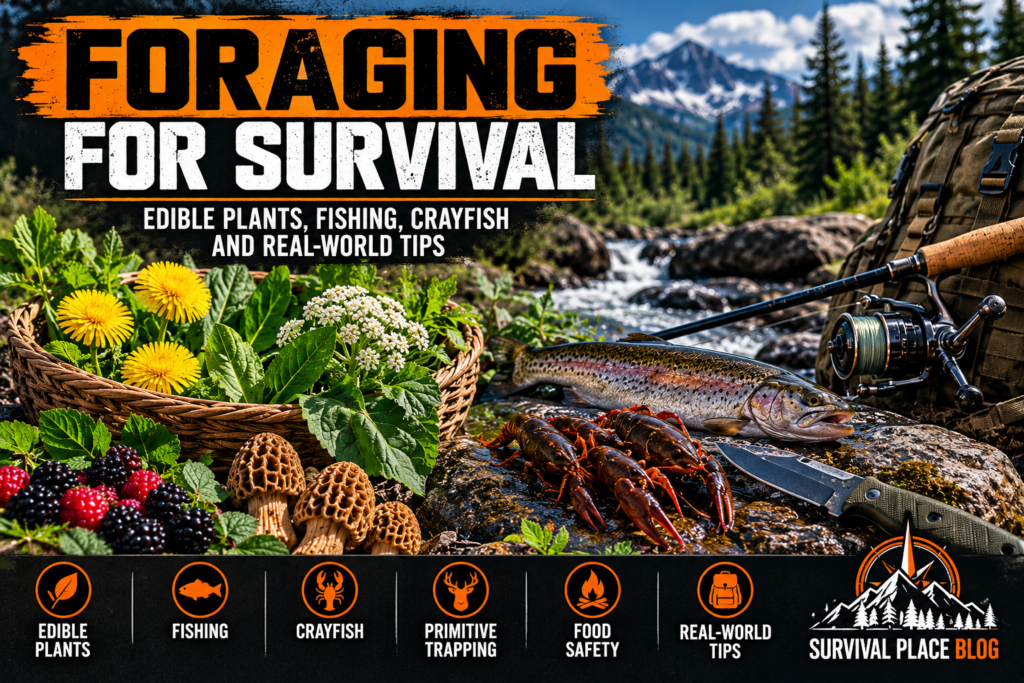
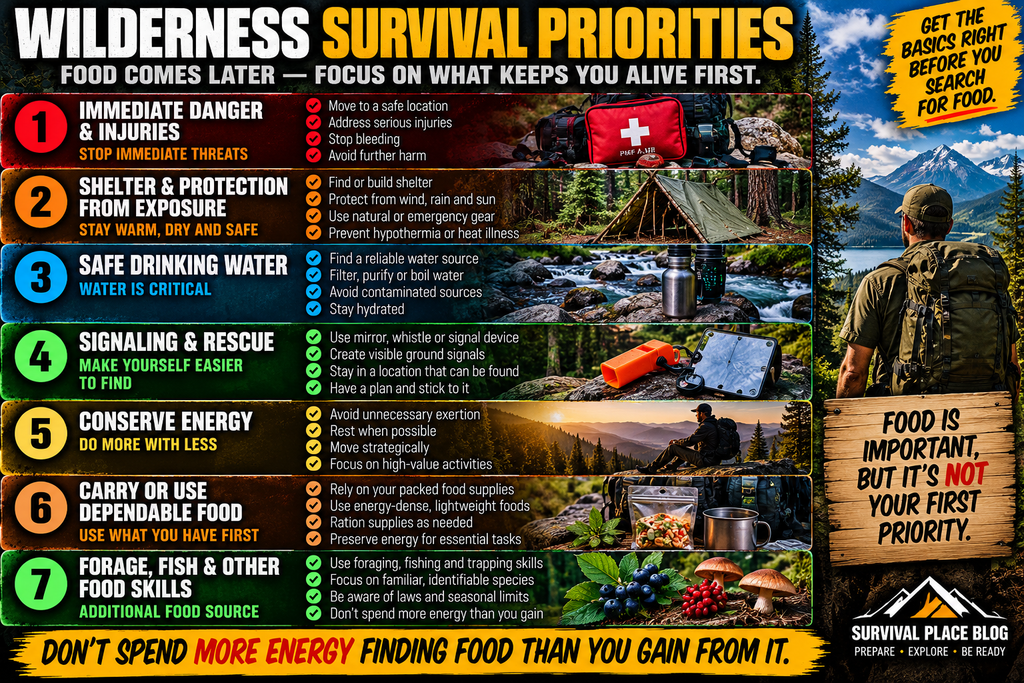
Foraging for survival can provide additional food during a prolonged emergency, but finding calories generally comes after more immediate concerns such as injuries, exposure, shelter, signaling and safe drinking water. Searching for food can also consume valuable time and energy while exposing you to falls, weather, getting farther from your last known location or eating something that makes an already difficult situation worse.
That doesn’t make wild-food skills unimportant. Learning to identify edible plants, catch fish, collect crayfish and understand traditional trapping methods can make you more capable outdoors.
The key is learning those skills before you need them.
Before worrying about finding food, it helps to understand the larger survival picture. Start with Outdoor Survival Basics: The Rule of Threes and What to Prioritize First to see how shelter, water, signaling and other immediate needs fit together.
Where Food Fits in a Wilderness Emergency
A common survival myth is that finding food should immediately become one of your first priorities.
For most short-term wilderness emergencies, it shouldn’t.
If you’re cold and wet, shelter matters more.
If you’re injured, first aid matters more.
If nobody knows where you are, signaling and rescue planning may matter more.
If you’re becoming dehydrated, safe water matters more.
Food becomes increasingly important as an emergency stretches from hours into days, but rushing into food gathering can cause you to burn more energy than you obtain.
Before searching for food, ask:
- Am I protected from the weather?
- Do I have safe drinking water?
- Have I addressed injuries?
- Have I made myself easier for rescuers to find?
- Would leaving this location reduce my chances of rescue?
- Will obtaining this food likely provide more benefit than the energy and risk involved?
Those questions can be more important than knowing a hundred edible plants.
Conserve Calories Before Trying to Find Them
Food gathering has an energy cost.
Walking several miles looking for berries, repeatedly checking fishing spots or pursuing animals can consume significant energy without producing anything.
In a genuine survival situation, efficiency matters.
That doesn’t mean remaining completely inactive. It means avoiding unnecessary effort and focusing on activities with a reasonable chance of improving your situation.
If you already know that an edible plant grows near your shelter or a stream beside your location contains fish, that’s very different from wandering through unfamiliar terrain hoping to discover dinner.
Knowledge of the local environment changes the equation.
Safe Foraging Starts Before the Emergency
The best time to learn wild edible plants isn’t when you’re hungry.
Learn them while you’re comfortable, have reliable reference material and can verify what you’re looking at.
Start with a small number of distinctive species found in the region where you actually spend time outdoors.
Don’t attempt to memorize hundreds of plants at once.
Learn:
- What the plant looks like during different seasons
- Which parts are edible
- Which parts may be toxic
- Whether cooking or other preparation is required
- Where the plant commonly grows
- What dangerous lookalikes exist
- Whether harvesting it is legal where you are
A regional field guide can be particularly valuable because it narrows identification to plants you’re more likely to encounter in your area.
A quality reference guide such as The Forager’s Harvest: A Guide to Identifying, Harvesting, and Preparing Edible Wild Plants can help build your knowledge before you ever need to rely on wild foods in an emergency.
Common Wild Foods Are Still Identification Problems
Plants such as dandelion, cattail, clover and broadleaf or narrowleaf plantain are frequently discussed in foraging guides.
That doesn’t mean you should eat something simply because it vaguely resembles one of them.
Dandelion
True dandelions are widespread and various parts have culinary uses. But learning their identifying characteristics matters more than memorizing the statement that “dandelions are edible.”
Learn the leaf structure, flower, hollow flower stalk and other characteristics from a reliable regional resource before treating a plant as food.
Cattail
Cattails have a long history of human use, and different portions may be usable at different stages of growth.
But wetland plants deserve extra caution.
Identification matters, harvesting may be restricted, and water quality can affect whether gathering food from a particular wetland is sensible.
Plantain
Broadleaf and narrowleaf plantain are common in many areas and are unrelated to the tropical fruit also called plantain.
Again, identification comes first.
Clover
Several clovers have traditional food uses, but “it looks like clover” isn’t sufficient identification.
The broader lesson is more useful than any individual plant:
Learn a few local edible species extremely well rather than knowing the names of dozens you can’t confidently identify.
Berries Require the Same Caution
Wild berries may seem easier to identify than leafy plants, but color alone tells you almost nothing about whether a berry is safe.
Never assume:
- Red berries are dangerous
- Blue or black berries are safe
- Birds eating a berry means humans can eat it
- A familiar-looking berry must be the species you think it is
Those shortcuts are unreliable.
Learn the entire plant, including leaf arrangement, stems, growth habit, fruit structure and known lookalikes.
Mushrooms Are a Poor Place for Beginners to Gamble
Wild mushrooms deserve their own warning because identification mistakes can have severe consequences.
Some edible mushrooms have poisonous lookalikes, and photographs or simple descriptions aren’t enough to make an uncertain mushroom safe.
Statements such as “this mushroom has a distinctive shape” can create false confidence.
If you’re already experienced in mushroom identification, that knowledge doesn’t disappear during an emergency.
But if you don’t already know wild mushrooms, being hungry isn’t a good reason to begin experimenting.
Never use a small bite or “taste test” to determine whether an unknown mushroom is safe.
Don’t assume cooking neutralizes mushroom toxins.
And don’t rely on folklore such as whether an animal eats the mushroom, whether it changes the color of silverware or whether insects have been feeding on it.
When identification isn’t certain, leave it alone.
For additional guidance, Penn State Extension’s mushroom safety guidance explains why accurate identification is critical and why cooking does not eliminate all mushroom toxins.
Avoid Contaminated Foraging Areas
Correctly identifying a plant doesn’t automatically mean it’s a good food source.
Consider where it’s growing.
Avoid gathering food from areas that may be contaminated by:
- Road runoff
- Industrial activity
- Pesticides or herbicides
- Polluted water
- Wastewater
- Animal waste concentrations
- Unknown chemical exposure
Plants growing beside a busy roadway may be easy to reach, but convenience doesn’t make them an ideal food source.
The same principle applies to aquatic foods.
The quality of the environment matters.
Fishing Can Be an Efficient Skill — If You Know How to Do It
If you’re near productive water, fishing can potentially provide protein without requiring you to continuously chase an animal.
But fishing is never guaranteed.
Success depends on location, season, species, weather, equipment and skill.
A compact fishing setup can include very little equipment:
- Line
- Several hooks
- Small sinkers
- Appropriate lures or bait options
- Compact storage container
A hand line can be used without carrying a full-size rod, although local fishing laws still apply.
For a lightweight option, the TinTackle Pro Compact Survival Fishing Kit with Mini Finger Reel packs basic fishing line, hooks, floats, weights and other small tackle into a compact tin that can fit easily into a hiking or emergency kit.
Look for Fish Before Wasting Energy
Don’t assume every body of water contains catchable fish.
Look for signs of activity and likely habitat.
Depending on the species and environment, fish may relate to:
- Structure
- Cover
- Drop-offs
- Current seams
- Pools
- Undercut banks
- Shade
- Areas where food naturally collects
Knowing the species common to an area before your trip makes this much more useful than blindly dropping a hook into the water.
Improvised Fishing
If conventional equipment isn’t available, knowledge of basic hook-and-line fishing can sometimes be adapted using available materials.
But improvised equipment is usually less reliable than actual fishing line and hooks.
This is another example of why preparation wins.
A few hooks, sinkers and a small amount of line weigh very little compared with the effort required to improvise replacements in the field.
Crayfish Can Be an Overlooked Food Source
Crayfish—also called crawfish or crawdads in different parts of the country—live in many freshwater environments.
Where they are present and legal to harvest, they can represent another potential food source.
Crayfish often occupy areas around:
- Rocks
- Submerged wood
- Bank cover
- Aquatic vegetation
- Other underwater structure
Collection methods and legal requirements vary significantly by location. Some jurisdictions regulate traps, bait, seasons, sizes, possession limits or even the transport of live crayfish because certain species are invasive.
That makes local knowledge important.
Handling and Cooking Crayfish
Don’t assume that because an aquatic animal comes from clear-looking water it is automatically safe to eat.
Water contamination and disease risks still matter.
Keep food-handling surfaces as clean as circumstances allow, avoid cross-contaminating cooked food with raw aquatic animals, and cook crayfish thoroughly before eating.
For additional information on safe preparation of fish and shellfish, review the FDA’s advice on selecting and serving seafood safely.
Other Aquatic Food Opportunities Depend on Location
Depending on where you are, other aquatic foods may exist, but this is an area where broad survival advice becomes dangerous quickly.
Freshwater mussels, frogs, aquatic plants and other organisms may be edible in some places and inappropriate, protected, contaminated or unsafe in others.
Some freshwater shellfish are legally protected.
Some waters carry consumption advisories.
Some species may accumulate environmental contaminants.
So the rule remains the same:
Know what you’re collecting, know the water it came from, know the regulations and know how it must be prepared.
Primitive Small-Game Trapping: Useful Knowledge With Major Limitations
Passive trapping has been used for generations because, in principle, a trap can continue working while the person who set it performs other tasks.
That’s the attraction.
But primitive trapping is often presented far too casually in survival content.
Building something that resembles a trap is easy.
Building a trap that reliably captures the intended animal while minimizing unnecessary suffering and avoiding unintended animals requires considerably more knowledge.
Traditional concepts include:
- Snares
- Trigger systems
- Deadfalls
- Funnel or enclosure traps
- Baited trapping systems
Understanding how these systems work can be a worthwhile primitive-survival skill.
Actually using them is another matter.
Snares
A snare generally relies on a loop positioned where a target animal is expected to travel.
Effective snaring requires much more than tying a loop.
You need to understand animal movement, trails, appropriate positioning, target species, materials and local regulations.
Improperly placed snares can capture unintended wildlife.
Trigger Systems
Traditional traps may use carved sticks or other mechanical triggers that release tension, close a loop or move another part of the trap when disturbed.
Practicing trigger construction can teach useful skills in carving, cordage, mechanical reasoning and animal awareness without requiring you to actually trap an animal.
Deadfalls
Deadfall systems use a trigger to release a weighted object.
They are historically significant primitive traps, but they carry obvious hazards. A poorly constructed deadfall can injure the person building it and can kill non-target animals.
For those reasons, understanding the concept and practicing safe trigger construction is different from deploying one in the wild.
If you need to build a fire for cooking or warmth, our guide Wilderness Fire Starting: Methods, Tinder and Fire Safety covers everything from modern ignition tools to primitive friction-fire techniques.
Trapping Laws Still Apply Outdoors
Survival discussions sometimes imply that being outdoors means normal wildlife regulations disappear.
Don’t plan around that assumption.
Rules governing traps, snares, fishing, hunting methods, seasons, licenses and protected species vary by jurisdiction and land designation.
Before practicing or using any of these methods, check the regulations for the specific area with the appropriate state wildlife agency or land-management authority.
Practice primitive trap mechanisms using harmless demonstrations when appropriate. If you intend to actually fish, hunt or trap, learn the regulations for the specific area beforehand.
A genuine life-threatening emergency may raise different legal considerations, but that’s not a sensible excuse for ignoring wildlife laws during normal recreation or survival practice.
Hunting Is Harder Than Survival Shows Make It Look
The original version of this article suggested improvising bows, slingshots and spears as ways to obtain food.
That makes hunting sound far easier than it is.
Successfully taking game requires finding the animal, getting within an effective range, using an appropriate and lawful method, making an ethical shot or capture, locating the animal afterward, safely processing it and preserving the meat.
All of that costs time and energy.
Improvising a weapon doesn’t automatically create an effective hunting tool.
If hunting is part of your outdoor skill set, learn it properly and follow the laws governing the area.
Hunters also have a responsibility to minimize their impact on the places they use. The Leave No Trace hunting ethics guidance covers responsible travel, waste management and respecting wildlife while hunting.
If it isn’t, an emergency isn’t an ideal time to teach yourself.
Processing Wild Food Matters Too
Obtaining food is only part of the problem.
You also need to handle and prepare it safely.
Wild game, fish and aquatic animals can carry parasites and pathogens. Proper field dressing, separation of raw and cooked foods, clean hands and tools when possible, and adequate cooking all matter.
For additional information about handling and preparing wild game safely, review the USDA guidance on game meat and food safety.
Don’t eat obviously diseased or abnormal-looking animals.
Avoid contaminating drinking water or camp areas with animal remains.
And don’t assume that “wild” means naturally safe.
Cooking Food in a Survival Situation
Fire may allow you to cook fish, game, crayfish and certain plant foods, but don’t build a fire solely because you’ve obtained food if wildfire conditions or regulations make open flame unsafe.
Your cooking plan should match the environment.
If you’re carrying food that doesn’t require cooking, you also preserve fuel and avoid making fire a requirement for getting calories.
If you need to build a fire for cooking or warmth, our guide Wilderness Fire Starting: Methods, Tinder and Fire Safety covers everything from modern ignition tools to primitive friction-fire techniques
Water Still Comes Before Food
Food gathering should never distract you from hydration.
And eating can increase the importance of having adequate water.
Don’t rely on the appearance of a stream, lake or spring to determine whether the water is microbiologically safe.
Treat questionable wilderness water using an appropriate method.
📍 MARKER 10 — Internal link: Wilderness Water article
A water filter or other appropriate treatment method will generally deserve space in your pack long before improvised food-gathering equipment does.
For a detailed look at finding and treating wilderness water, see How to Find and Purify Water in the Wilderness.
The Most Reliable Wilderness Food Is the Food You Carry
There is a strange contradiction in some survival advice.
People will spend hours learning how to obtain a small amount of food from the landscape while refusing to carry a few ounces of calorie-dense emergency food.
You can do both.
Learning to forage, fish and understand primitive trapping makes you more knowledgeable outdoors.
Carrying food makes you more prepared.
Good trail or emergency foods are generally:
- Calorie dense
- Lightweight
- Shelf stable
- Easy to eat
- Protected from moisture
- Appropriate for your dietary needs
- Unlikely to require extensive preparation
Depending on your trip, that might include nuts, nut butter, energy bars, dried fruit, jerky or other shelf-stable foods you already know you tolerate well.
The exact food matters less than having some.
Don’t Create a Wildlife Problem With Your Food
Food safety in the wilderness isn’t only about whether something is edible.
Your stored food, scraps, cooking equipment and trash can attract wildlife.
Requirements vary by location. Some areas require approved bear-resistant food storage, while others may have specific rules for campsites or backcountry travel.
Learn those requirements before the trip.
The National Park Service’s food storage and wildlife safety guidance explains why proper food storage is important in areas where bears and other wildlife may be present.
Never intentionally feed wildlife.
Keep a clean camp and store food according to the rules and conditions of the area you’re visiting.
Ethical Foraging Matters
Wild food isn’t an unlimited free resource.
Plants and animals are part of an ecosystem and may also be culturally significant resources.
When legal harvesting is allowed:
- Take only what you can use
- Avoid damaging surrounding habitat
- Don’t harvest rare or protected species
- Follow collection limits
- Respect private property
- Follow park and land-management rules
- Avoid stripping an entire patch of plants
- Leave enough for wildlife and regeneration
In some parks and protected areas, removing plants or other natural resources may be prohibited entirely.
Knowing how to forage includes knowing when not to harvest.
The Leave No Trace guidance on leaving what you find provides additional recommendations for responsible foraging, including avoiding depletion of wild plants and following local collection rules.
Practice Food-Gathering Skills Before Depending on Them
There’s a big difference between reading about wild food and successfully obtaining it.
Practice plant identification with a reliable guide.
Go fishing before you need fish.
Learn what species actually live in your local waterways.
Learn to identify crayfish and understand local regulations.
Study animal tracks and movement.
Practice primitive trap triggers without catching animals.
If hunting interests you, learn from experienced, responsible hunters and obtain the appropriate education and licenses.
These experiences turn theoretical knowledge into useful outdoor skills.
A Practical Wilderness Food Strategy
For most people, a realistic preparedness hierarchy looks something like this:
First: Address injuries, immediate danger and exposure.
Next: Improve shelter, signaling and access to safe water.
Then: Conserve energy and evaluate how long the emergency may last.
Carry: Lightweight, calorie-dense food whenever practical.
Learn: Local edible plants and aquatic resources before your trip.
Practice: Fishing, plant identification and primitive skills under controlled conditions.
Avoid: Eating anything you cannot positively identify.
Remember: Finding food should improve your situation, not create a new emergency.
Foraging for Survival Quick Checklist
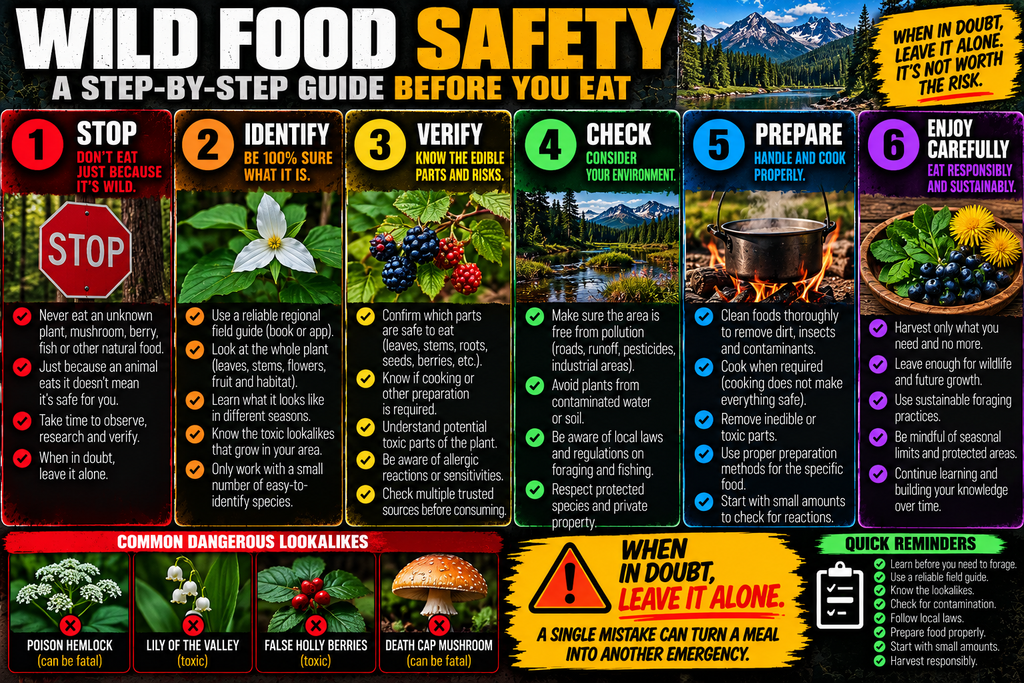
Before eating or collecting wild food:
- Identify the species positively
- Know dangerous lookalikes
- Confirm which part is edible
- Know whether cooking is required
- Consider contamination
- Check local harvesting regulations
- Evaluate the energy required to obtain it
- Avoid unknown mushrooms
- Treat wild game and aquatic foods as raw food
- Cook animal foods appropriately
- Protect your drinking-water source
- Store food safely around wildlife
- Take only what you need
- Don’t wander away from a good rescue location just to search for food
Free Printable: Wilderness Food & Foraging Safety Checklist
Want a quick reference you can take with you? Download our Wilderness Food & Foraging Safety Checklist for a printable summary of food priorities, plant and mushroom safety, fishing, crayfish, primitive trapping, food handling and preparedness.
Final Thoughts
Foraging, fishing, trapping and hunting are legitimate outdoor skills with histories stretching back far beyond modern survival culture.
They’re worth learning.
But learning them should make you more realistic about wilderness survival, not less.
Catching a fish takes more than owning a hook. Building a primitive trap doesn’t guarantee an animal will walk into it. Recognizing an edible plant requires more than matching it to a photograph. And attempting to identify an unfamiliar mushroom because you’re hungry can turn a difficult situation into a medical emergency.
Practice primitive food-gathering skills because they increase your knowledge and connection to the environment.
Carry dependable food because emergencies rarely happen under ideal conditions.
The best wilderness survival strategy combines knowledge, preparation and good judgment rather than depending on luck.