
Affiliate Disclosure: This post contains affiliate links. If you purchase through these links, Survival Place Blog may earn a commission at no additional cost to you. As an Amazon Associate I earn from qualifying purchases.
Clean drinking water is easy to take for granted until something changes. A boil-water advisory, aging plumbing, private-well problem, severe storm, or extended power outage can quickly make water quality a much bigger concern.
But choosing among the many water filter systems available can be confusing. Pitcher filters, activated carbon, reverse osmosis, ultraviolet treatment, gravity filters, under-sink units, and whole-house systems all work differently. More importantly, no single filter should be assumed to remove every possible contaminant.
The right system depends on your water source, what you need to remove, how much water you use, and whether you’re preparing for everyday use, emergencies, or both.
This guide will help you sort through those choices and build a practical approach to safer drinking water at home.
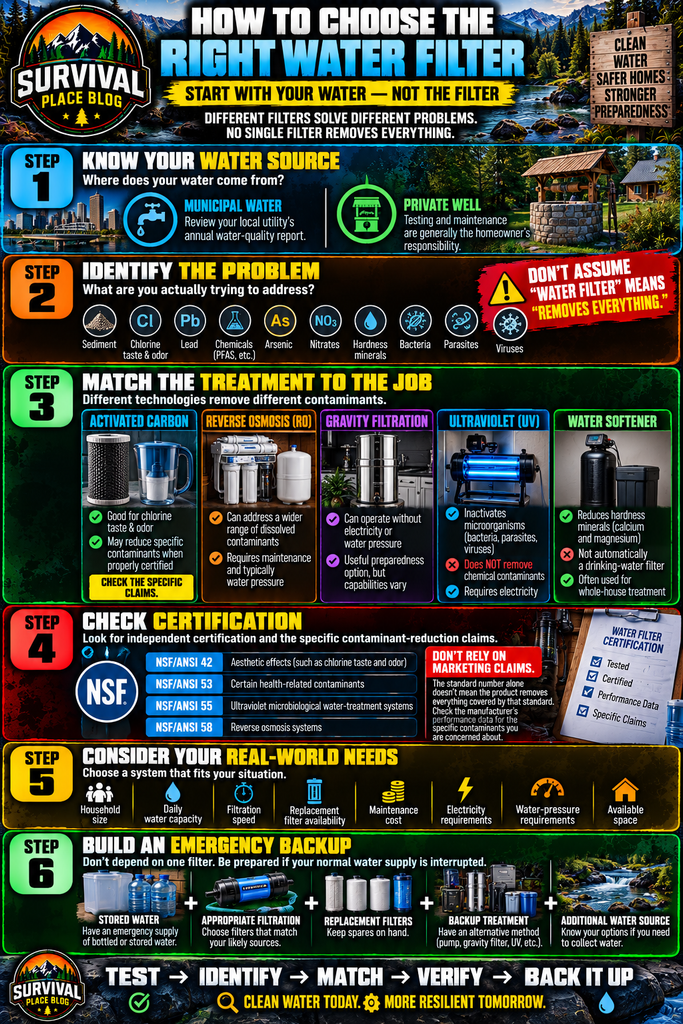
Start With Your Water, Not the Filter
One of the biggest mistakes people make is shopping for a water filter before determining what they actually need it to do.
Water that looks, smells, and tastes perfectly normal can still contain contaminants. At the same time, unpleasant taste or odor does not automatically mean water is unsafe.
Start by identifying your water source.
If your home receives municipal water, review your local water utility’s annual water-quality report. These reports can help identify substances detected in the public water supply.
Private-well owners have a different responsibility because the homeowner generally needs to arrange appropriate testing and maintenance.
Testing becomes especially important if there has been flooding, a change in the water’s appearance, taste or odor, nearby construction, known groundwater contamination, or other reason to question the water supply.
The goal isn’t to buy the filter with the longest list of features. It’s to identify the problem first and choose treatment designed for that problem.
Understand What You’re Trying to Remove
Different water problems require different solutions.
Possible concerns include:
- Sediment
- Chlorine taste and odor
- Lead
- Certain pesticides or organic chemicals
- Some PFAS
- Arsenic
- Nitrates
- Hard-water minerals
- Bacteria
- Parasites
- Viruses
That doesn’t mean all of these are present in your water.
It means you shouldn’t assume a product labeled “water filter” addresses all of them.
This distinction is particularly important when comparing inexpensive pitcher or refrigerator filters with more comprehensive treatment systems.
Learn What Water-Filter Certifications Actually Mean
Certification is one of the most useful tools consumers have when comparing water-treatment products.
Instead of relying solely on statements such as “advanced filtration” or “removes contaminants,” look for independent certification and the specific contaminant-reduction claims associated with that certification.
Several NSF/ANSI standards commonly appear on residential water-treatment products.
NSF/ANSI 42 generally addresses aesthetic effects such as chlorine taste and odor.
NSF/ANSI 53 covers certain contaminants that can have health effects. The specific reduction claim still matters.
NSF/ANSI 55 applies to ultraviolet microbiological water-treatment systems.
NSF/ANSI 58 applies to reverse-osmosis systems.
The number by itself doesn’t mean a filter removes everything covered somewhere within that standard. Check the manufacturer’s performance data and certification for the particular contaminant you’re concerned about.
That small step can prevent a very expensive purchasing mistake.
Activated Carbon Filters
Activated carbon is one of the most common technologies used in household water filters.
You’ll find it in many:
- Water-filter pitchers
- Refrigerator filters
- Faucet-mounted filters
- Countertop systems
- Under-sink systems
- Multi-stage filtration systems
Activated carbon can be useful for reducing chlorine and improving taste and odor. Certain certified carbon filters can also reduce specific contaminants.
But “activated carbon” alone doesn’t tell you exactly what a particular filter removes.
Two carbon filters can have very different capabilities.
Check the certification and performance data rather than assuming every carbon filter provides the same protection.
Reverse-Osmosis Water Filter Systems
Reverse osmosis, commonly called RO, forces water through a semipermeable membrane.
Residential RO systems are commonly installed under the kitchen sink and may combine several treatment stages, such as sediment filtration, activated carbon and the RO membrane itself.
Depending on the system and its certification, reverse osmosis can reduce a broad range of contaminants.
That can include certain:
- Metals
- Dissolved salts
- Minerals
- Microorganisms
- Chemical contaminants
RO systems also have disadvantages.
They typically cost more than simple carbon filtration, require replacement filters and membranes, need adequate water pressure, and produce a reject-water stream during operation.
For households with a specific water-quality problem that RO is certified to address, however, the technology can be extremely useful.
Gravity Water Filters
Gravity-fed filtration has an important advantage for preparedness: it doesn’t necessarily depend on household water pressure or electricity to move water through the system.
Water is placed in an upper chamber or reservoir and moves through the filtration elements into a clean-water chamber below.
That simplicity makes gravity systems useful for everyday drinking water as well as some emergency situations.
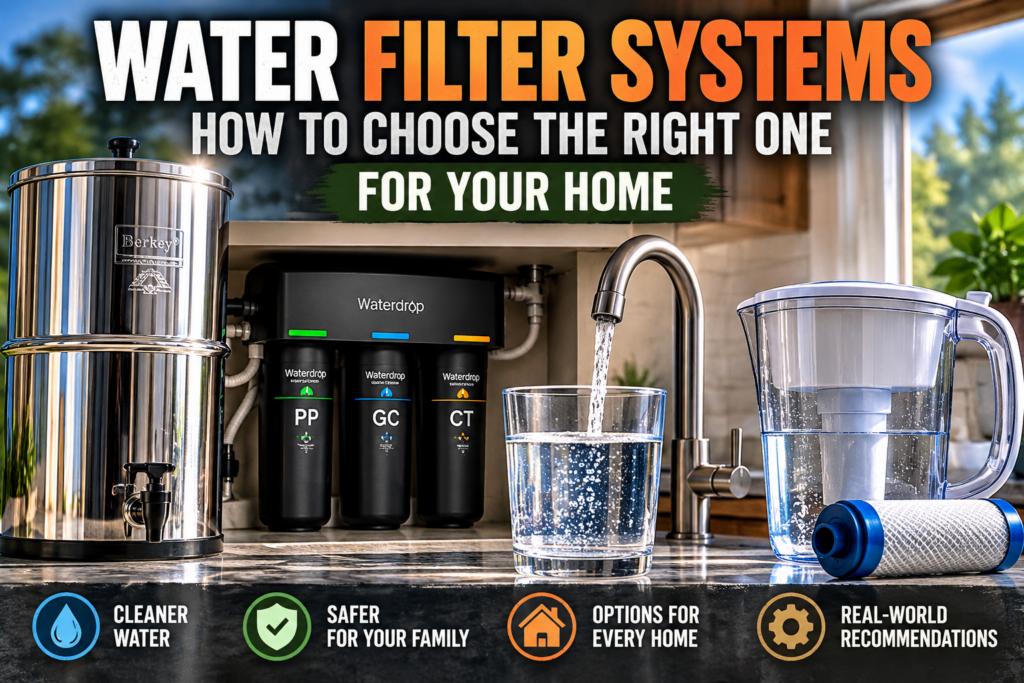
I’ve used a Berkey gravity system for years, and that experience is one reason I appreciate the basic gravity-fed concept. But regardless of brand, I would still choose a current system based on verified contaminant-reduction claims, replacement-filter availability and the specific water being treated.
For emergency preparedness, gravity filtration can provide another option when normal household systems aren’t operating as expected.
But gravity-fed does not automatically mean that a system removes every microorganism or chemical contaminant. As with any filtration method, check the specific product’s capabilities.
Ultraviolet Water Treatment
Ultraviolet systems approach the problem differently.
Instead of primarily trapping contaminants in filter media, UV treatment uses ultraviolet light to inactivate microorganisms.
UV can be useful when microbiological contamination is a concern, particularly in certain private-well applications.
However, UV does not remove chemical contaminants from water.
It also works best when the water is sufficiently clear for the UV light to reach microorganisms effectively. For that reason, UV systems are often paired with prefiltration.
They also require electricity.
That last point matters for preparedness. A UV system may perform well during normal conditions but become unavailable during an extended outage unless backup power is available.
Whole-House vs. Point-of-Use Filtration
Another important decision is where you need treated water.
Point-of-Use Systems
Point-of-use filtration treats water at a specific location.
Examples include:
- Pitcher filters
- Faucet-mounted filters
- Refrigerator filters
- Countertop filters
- Under-sink systems
These make sense when your primary concern is water used for drinking and cooking.
What I Use: I’ve also had good results with a Waterdrop under-sink filtration system that I installed at home. I like the convenience of having filtered water available directly at the kitchen sink without taking up counter space.
Whole-House Systems
Whole-house systems, sometimes called point-of-entry systems, treat water as it enters the home.
That means treatment can affect water going to multiple fixtures rather than only the kitchen faucet.
Whole-house treatment may make sense when the problem affects water throughout the home.
But bigger isn’t automatically better.
Removing certain disinfectants from all incoming water, for example, can change conditions within household plumbing. The treatment system should match the actual water-quality issue rather than simply treating everything possible.
What About PFAS?
PFAS have become an increasingly important drinking-water concern in some communities.
Certain activated-carbon, ion-exchange and reverse-osmosis technologies may reduce particular PFAS compounds, but this is another area where vague marketing claims aren’t enough.
Look for current third-party certification specifically addressing PFAS reduction and check exactly what the product has been tested to reduce.
If PFAS are a concern in your area, first determine whether your public water system has testing information available or whether testing your private water source is appropriate.
Then choose treatment based on those results.
A Water Softener Is Not the Same as a Water Filter
Water softeners are frequently confused with drinking-water filtration systems.
A traditional water softener primarily addresses hardness, especially calcium and magnesium that can cause scale buildup.
That’s useful for protecting plumbing fixtures and appliances and improving the way soap performs.
But a softener should not automatically be treated as a substitute for drinking-water filtration or microbiological treatment.
If your home has both hardness problems and drinking-water concerns, you may need different treatment technologies working together.
Don’t Forget Filter Capacity
A filter can only help if it produces enough water for the people relying on it.
Think about your normal drinking and cooking needs, but also consider emergency conditions.
A small pitcher might be perfectly adequate for one person under normal circumstances. It can become frustrating if several people are trying to obtain drinking water from it during an emergency.
Gravity systems and larger-capacity units can offer more convenient production, but they also take up more space.
Before purchasing, consider:
- Number of people in the household
- Daily drinking-water needs
- Cooking needs
- Filtration speed
- Storage capacity
- Replacement-filter capacity
- Available counter or cabinet space
Capacity matters just as much as filtration performance.
Filter Replacement Is Part of the System
Every replaceable filter eventually reaches the end of its useful service life.
Ignoring replacement schedules can reduce performance and potentially create sanitation problems.
Before purchasing any system, find out:
- How frequently filters typically need replacement
- What replacement filters cost
- Whether replacements are widely available
- How they should be stored
- Whether multiple filter stages have different schedules
- How you’ll know when replacement is necessary
Then consider keeping at least one appropriate replacement filter available.
During a regional emergency, replacement cartridges may be harder to find at exactly the time demand increases.
Don’t Depend on Filtration Alone for Emergency Water
A home filtration system and an emergency water supply solve different problems.
If municipal water service stops completely, the best filter in the world can’t produce water from an empty faucet.
That’s why household preparedness should begin with stored water, with filtration and treatment providing additional layers of protection.
Stored water can cover the immediate period after an emergency while you determine whether the normal water supply remains available and safe.
A more resilient household water plan combines:
Stored water + appropriate filtration + backup treatment methods + the ability to collect additional water if necessary
That is much stronger than relying on one device.
Build Redundancy Into Your Water Plan
Preparedness is rarely about finding one perfect piece of equipment.
Water is no different.
For example, a household might have:
- Stored drinking water
- Everyday kitchen filtration
- Gravity filtration
- Replacement filter elements
- A method for boiling water
- Water-treatment tablets
- Portable filtration for evacuation
You don’t necessarily need every option.
The point is to avoid having your entire water plan depend on one faucet, one filter cartridge or one source of electricity.
A backup method that costs relatively little and takes up almost no storage space can provide useful redundancy if your primary system becomes unavailable.
Home Filtration and Wilderness Filtration Are Different Jobs
This distinction deserves special attention.
A household filter designed primarily to improve municipal tap-water taste isn’t necessarily appropriate for untreated wilderness water.
Likewise, a compact backpacking filter designed for streams isn’t necessarily the best everyday household treatment system.
The potential hazards are different.
When treating untreated surface water outdoors, microorganisms become a major concern, and the appropriate combination of filtration and disinfection depends on the source and situation.
Treat the two situations separately and choose equipment accordingly.
Water Filters During a Boil-Water Advisory
A common preparedness mistake is assuming that having a household filter means boil-water instructions no longer apply.
That may not be true.
Many common household filters are designed primarily for taste, odor or particular chemical contaminants and are not designed to reliably remove all disease-causing microorganisms.
During an official boil-water advisory, follow the instructions issued by the local water authority or public-health agency.
Don’t substitute the presence of a filter for official treatment instructions unless the equipment and guidance specifically support doing so.
Think About Power Outages
Some water-treatment systems work perfectly well without electricity.
Others do not.
A simple pitcher or gravity system may continue operating during an outage, while UV treatment requires electricity and some household water systems may stop functioning if pumps lose power.
Your home’s actual water availability can also depend on where you live.
Homes supplied directly by municipal pressure may behave differently during an outage than properties relying on electric well pumps.
If your primary filtration method depends on electricity, consider what you’ll use if power is unavailable for several days.
Private Wells Need Special Planning
Private wells require a different approach than municipal water.
Well owners should understand their local testing recommendations, potential contamination risks and how their pumping equipment operates.
If your well pump depends on grid electricity, a power outage can become a water emergency even when the groundwater itself remains perfectly usable.
Flooding can create another problem by potentially introducing contaminants into a well.
For preparedness purposes, private-well households should consider both water quality and water access.
Those are separate vulnerabilities.
Don’t Forget Water Storage Containers
Filtration solves only part of the problem.
Once you’ve produced clean water, you need an appropriate way to store or transport it.
Dedicated water containers are much easier to manage than trying to improvise after an emergency begins.
For larger emergency reserves, multiple manageable containers can also provide redundancy. If one container leaks or becomes contaminated, you haven’t lost your entire supply.
For temporary emergency storage when advance warning is available, a bathtub water-storage bladder can dramatically expand household capacity.
That can be particularly useful before hurricanes, major storms or other events where you may have enough warning to fill additional containers before utility service is disrupted.
Seven Questions to Ask Before Buying a Water Filter
Before spending money on any filtration system, work through these questions.
1. What is actually in my water?
Use your utility’s water-quality information or appropriate testing rather than guessing.
2. What specifically do I want to reduce?
Taste and odor? Lead? Particular chemicals? Microorganisms? Hardness?
Different problems require different treatment.
3. Is the system independently certified for that reduction?
Look beyond broad marketing language.
4. How much treated water do I need?
A filter that works for one person may be inconvenient for a large household.
5. What does maintenance cost?
Calculate replacement cartridges, membranes, UV lamps and other consumables.
6. Does it require electricity or water pressure?
Know how the system behaves during an outage.
7. What is my backup if the system fails?
Stored water and a secondary treatment method can prevent one equipment failure from becoming an emergency.
Common Water-Filter Buying Mistakes
Water filtration doesn’t have to be complicated, but a few mistakes are worth avoiding.
Buying based only on taste
Better-tasting water isn’t necessarily safer water.
Assuming expensive means comprehensive
Price doesn’t tell you which contaminants a system has been certified to reduce.
Ignoring replacement-filter costs
A reasonably priced system can become expensive if proprietary cartridges need frequent replacement.
Buying more treatment than you need
If your water already meets your needs, an elaborate system may provide little practical benefit.
Assuming one filter removes everything
Different technologies target different contaminants.
Ignoring emergency conditions
A system that depends completely on electricity or household water pressure needs a backup plan.
Forgetting stored water
Filtration cannot replace water that isn’t available.
Where Water Filtration Fits Into Emergency Preparedness
Water filtration is most useful when it’s part of a broader preparedness plan.
Start with the basics:
- Store an emergency supply of drinking water
- Know where your normal water comes from
- Understand the most relevant water-quality concerns
- Choose filtration appropriate to those concerns
- Keep replacement filters available
- Maintain a backup treatment method
- Know how you’ll obtain additional water if normal service stops
Water is one of the foundational preparedness priorities because almost every emergency becomes harder when safe drinking water is limited.
The objective isn’t to build an elaborate water-treatment laboratory in your house.
It’s to have enough layers that one problem doesn’t eliminate your access to safe drinking water.
A Practical Home Water Setup
For many households, a sensible preparedness setup can remain relatively simple.
Keep an emergency supply of stored water. Use an appropriate household filtration system if your water quality or personal preferences justify it. Keep replacement filters on hand. Add a backup treatment method that doesn’t depend on your primary equipment.
Then make sure everyone in the household understands what each system can—and cannot—do.
You can expand from there as your preparedness plan develops.
Final Thoughts
Choosing among today’s many water filter systems becomes much easier once you stop looking for the “best” filter and start asking what job the filter needs to perform.
Identify your water source. Learn what’s actually in the water. Decide which contaminants you need to address. Look for appropriate independent certification. Consider capacity, maintenance and replacement costs. Then think about how the system will function when normal utilities aren’t available.
For everyday life, that can mean better-tasting water and treatment targeted to a known concern.
For emergency preparedness, it means something more important: redundancy.
Stored water, suitable filtration, replacement supplies and backup treatment methods give you options when conditions change.
And when it comes to something as essential as drinking water, having options is exactly where you want to be.