Affiliate Disclosure: This post contains affiliate links. If you purchase through these links, Survival Place Blog may earn a commission at no additional cost to you. As an Amazon Associate I earn from qualifying purchases.
Prepping doesn’t have to mean building a bunker, filling every room with supplies, or preparing for the end of civilization.
At its most useful, preparedness is much simpler:
What does your household need to keep functioning when normal systems temporarily stop working?
A winter storm knocks out electricity.
An earthquake damages roads and utilities.
A wildfire forces an evacuation.
A water-main break interrupts safe drinking water.
A cyberattack disrupts payment systems or communications.
A vehicle problem strands you away from home.
A family member experiences a medical emergency.
Different emergencies create different problems, but good preparedness tends to come back to the same basic needs.
That’s where the five pillars of prepping become useful.
They provide a framework for building preparedness without trying to predict every disaster that might happen.
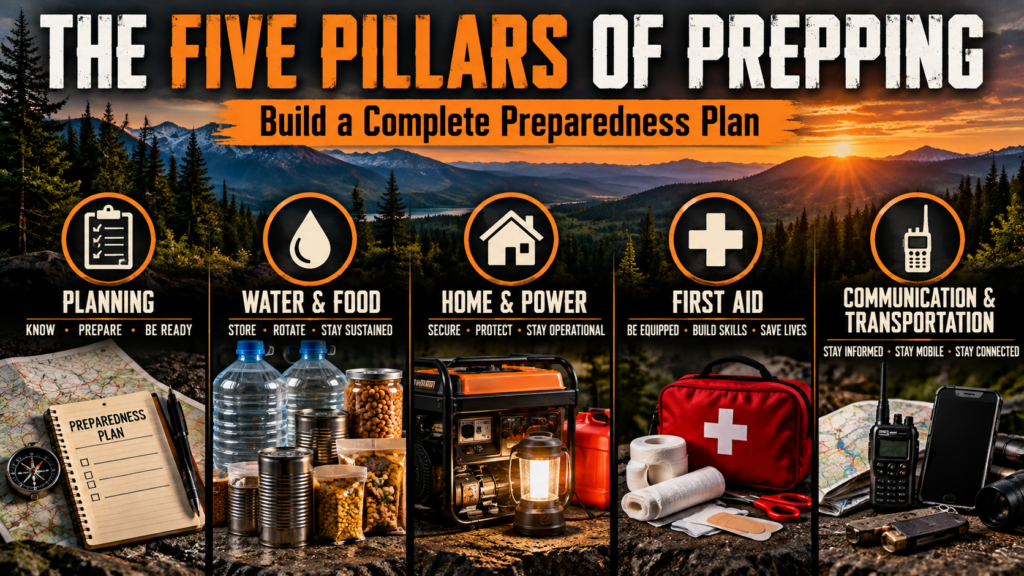
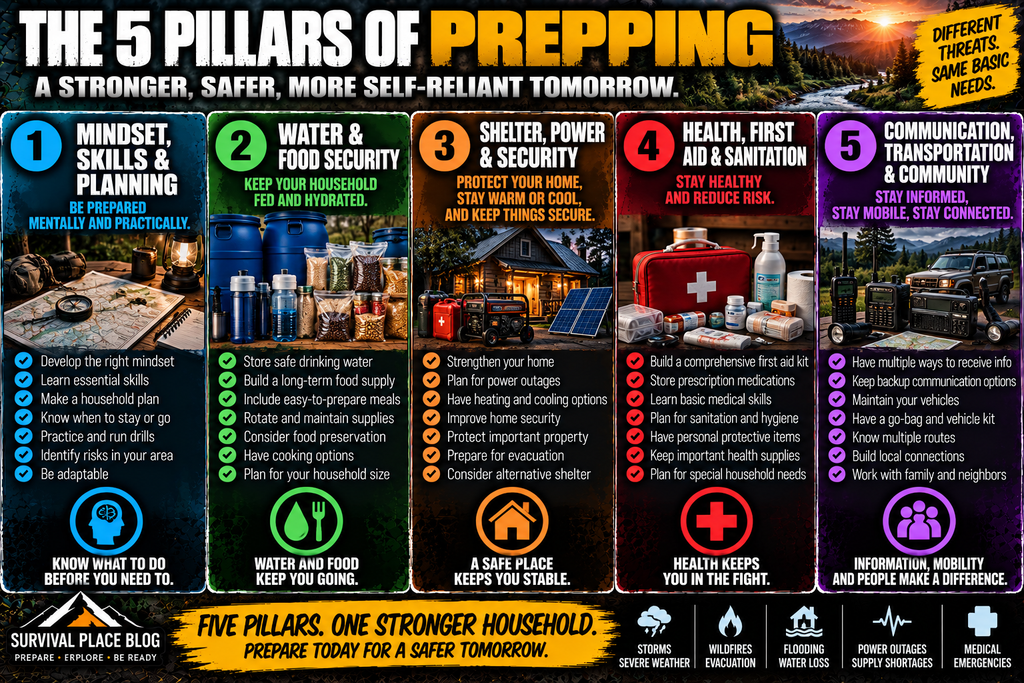
The five pillars are:
- Mindset, Skills & Planning
- Water & Food Security
- Shelter, Power & Security
- Health, First Aid & Sanitation
- Communication, Transportation & Community
You don’t need to complete all five at once.
In fact, you probably shouldn’t.
Build one layer.
Test it.
Fix the weaknesses.
Then add another.
That’s how a pile of emergency supplies becomes an actual preparedness system.
Want to build beyond the basics? See our 90-Day Emergency Preparedness Checklist for a practical plan to expand your household supplies for longer disruptions.
Why the Five Pillars of Prepping Work
Preparedness can become overwhelming because almost everything seems important.
Water.
Food.
Generators.
Medical supplies.
Radios.
Tools.
Fuel.
Bug-out bags.
Vehicle kits.
Home security.
Gardening.
Emergency cash.
You could spend thousands of dollars and still wonder whether you’re prepared.
The five-pillar approach solves a different problem.
Instead of asking:
“What else should I buy?”
ask:
“Which essential function am I trying to protect?”
A $500 piece of gear that doesn’t solve an important problem may be less useful than a $20 item that fills a critical gap.
The framework also exposes weak spots.
A household with six months of food but almost no stored water has a serious imbalance.
Someone with expensive survival equipment but no evacuation plan has another.
A family with a generator but no safe way to operate it during an outage hasn’t finished that part of the plan.
Preparedness works best as a system of overlapping layers.
Start With the Emergencies Most Likely to Affect You
You don’t need to prepare equally for every possible disaster.
Start with your actual circumstances.
Consider:
- Severe storms
- Extended power outages
- Earthquakes
- Wildfires
- Flooding
- Extreme heat
- Extreme cold
- Water interruptions
- Transportation disruptions
- Supply shortages
- Financial emergencies
- Medical emergencies
- Evacuation orders
Where you live matters.
So does your household.
An apartment renter has different constraints than someone on rural acreage.
A household with infants has different requirements than two healthy adults.
Someone dependent on refrigerated medication has different backup-power priorities than someone who isn’t.
Preparedness should reflect your risks, your people, your location, and your resources.
FEMA recommends starting with the risks where you live, then building an emergency plan around your household’s specific needs. Ready.gov provides resources to help families create and practice an emergency plan.
Pillar 1: Mindset, Skills & Planning
Gear is useful.
Knowing what to do with it is better.
The first pillar of prepping is the ability to assess a problem, make decisions, and adapt when the original plan stops working.
That doesn’t require becoming a survival expert.
It requires developing useful knowledge before you’re under pressure.
Make Decisions Before the Emergency
Some decisions are much easier when the lights are on and nobody is panicking.
For example:
When would we evacuate?
Where would we go?
Who picks up the children?
What happens if family members can’t reach one another?
Where do we meet?
Who checks on an older relative?
What if our normal route home is blocked?
What if cell service isn’t working?
A simple plan created beforehand reduces the number of decisions you’ll have to make while stressed.
Shelter in Place or Evacuate?
One of the most important preparedness decisions is whether to stay or leave.
For many emergencies, your home is your best shelter.
It contains your supplies, clothing, tools, food, water, medications, and familiar surroundings.
But there are emergencies where staying can become dangerous.
Examples may include:
- Wildfire evacuation orders
- Flooding
- Structural damage
- Gas leaks
- Hazardous-material incidents
- Certain severe weather threats
- Other instructions from emergency officials
There isn’t one rule that works for every emergency.
Your plan should support both options.
Prepare your home so you can remain there when appropriate.
Prepare an evacuation system so you can leave when necessary.
Build a Household Emergency Plan
At minimum, everyone in the household should understand:
- Primary meeting location
- Backup meeting location
- Emergency contacts
- Evacuation routes
- Who is responsible for children
- Who is responsible for pets
- Where emergency supplies are stored
- Where important documents are kept
- How utilities can be shut off if appropriate
- Which situations would cause the household to evacuate
Keep the plan simple enough that people can actually remember it.
A twenty-page emergency binder nobody has read isn’t necessarily better than one page everyone understands.
Skills Beat Unfamiliar Equipment
Emergency gear is most useful when you’ve already used it.
Don’t wait for a blackout to learn how your emergency radio works.
Don’t wait until evacuation day to discover your backpack doesn’t fit.
Don’t wait until the water stops running to read the instructions on your filter.
Don’t wait for a winter storm to find out your tire chains don’t fit.
Periodically practice with the equipment you depend on.
That can include:
- Water filters
- Camp stoves
- Emergency radios
- Fire extinguishers
- First-aid supplies
- Backup lighting
- Power stations
- Generators
- Vehicle emergency equipment
A little familiarity dramatically reduces confusion later.
Practice Small Emergencies
You don’t need elaborate survival exercises.
Try turning off unnecessary electricity for an evening.
Cook a meal without using your normal kitchen appliances.
Find your flashlights in the dark.
Have everyone identify the household meeting location.
Pack the vehicle as though you had to evacuate.
Walk through how you’d shut off utilities if authorities instructed you to do so.
Try living from your emergency pantry for a weekend.
Small exercises reveal problems cheaply.
Preparedness Is Also Financial
One emergency people routinely underestimate is loss of income.
A job loss, major repair, medical bill, or unexpected travel expense can disrupt a household without any natural disaster occurring.
Emergency savings, appropriate insurance, important account information, and copies of essential documents belong in a serious preparedness plan.
Cash can also be useful during temporary power or communications failures when electronic payment systems aren’t available.
You don’t need a pile of cash hidden around the house.
But having a reasonable amount in smaller denominations can provide another option.
Don’t Let Fear Drive the Plan
Preparedness information can become addictive.
There’s always another disaster scenario.
Another piece of equipment.
Another reason to worry.
Useful preparedness should generally make you less anxious, because you’ve identified realistic problems and done something about them.
If preparing for emergencies makes you feel like catastrophe is constantly around the corner, reconsider the balance.
The objective is resilience.
Not fear.
Pillar 2: Water & Food Security
If you’re starting preparedness from zero, water deserves immediate attention.
Most households depend completely on systems they don’t control.
Turn on the faucet and water appears.
Open the refrigerator and food is cold.
Visit a grocery store and shelves are stocked.
Emergencies can interrupt any of those systems.
Emergency Water Comes First
A water outage can happen for many reasons:
- Broken water mains
- Contamination
- Power failures
- Earthquakes
- Flooding
- Treatment-plant problems
- Severe weather
The simplest starting point is storing water before you need it.
FEMA and Ready.gov commonly use at least one gallon of water per person per day for several days as a basic emergency-planning benchmark, with additional water potentially needed for children, nursing mothers, illness, pets, hot climates, or other circumstances.
That’s a starting point.
Not necessarily the finish line.
For a deeper look at calculating your household’s needs, choosing containers, rotating stored water, and building a larger reserve, see our complete Home Water Storage System guide.
Stored Water, Treatment and Filtration Are Different Layers
These concepts are sometimes treated as interchangeable.
They aren’t.
Stored water is immediately available.
Filtration can remove certain contaminants depending on the filter.
Disinfection or treatment may address microorganisms depending on the method.
A strong household plan can include more than one layer.
For example:
- Stored potable water
- A way to collect additional water
- A reliable filtration/treatment method
- A backup treatment method
Never assume that any portable filter makes every water source safe.
Different technologies address different contaminants.
Know what your equipment is designed to do.
One compact option I personally keep on hand is the Sawyer MINI Water Filtration System. I own Sawyer MINI filters and like them because they’re small, lightweight, and easy to include in an emergency kit or go-bag.
Don’t Forget Water for Pets and Sanitation
Drinking isn’t the only use for water.
You may also need it for:
- Food preparation
- Basic hygiene
- Cleaning
- Pets
- Certain medical needs
- Limited sanitation
This is one reason a household’s real water requirement can exceed the simplest emergency recommendation.
Build a Practical Emergency Pantry
Emergency food doesn’t have to be expensive freeze-dried survival food.
Start with foods your household already eats.
Useful emergency foods often share a few characteristics:
- Long shelf life
- Minimal preparation
- Familiar to the household
- Reasonable nutrition
- Easy storage
- Ingredients that can be rotated into normal meals
Examples include:
- Canned meats
- Canned beans
- Canned vegetables
- Canned fruit
- Peanut or other nut butters
- Oats
- Rice
- Pasta
- Shelf-stable milk
- Crackers
- Dried fruit
- Nuts
- Soups
- Ready-to-eat meals
Remember to account for dietary restrictions, allergies, infants, older adults, and medical requirements.
Build the Pantry in Stages
Trying to buy three months of food at once can be expensive and wasteful.
Build gradually.
Stage 1 — Three Days
Enough food and water to handle a short interruption.
Stage 2 — One Week
A useful buffer for storms and short-term disruptions.
Stage 3 — Two Weeks
More flexibility during extended outages or supply interruptions.
Stage 4 — One Month
A deeper household pantry.
Stage 5 — Longer-Term Resilience
Additional food, preservation skills, gardening, and renewable or replenishable resources.
The exact target is up to you.
The important part is progressing from where you are.
Rotate What You Store
A preparedness pantry shouldn’t become a museum of expired food.
Use a simple rule:
Store what you eat. Eat what you store.
Put newer items behind older ones.
Periodically check expiration or best-quality dates.
Replace damaged containers.
Watch for pests and moisture.
Rotation keeps preparedness affordable because the food remains part of normal household consumption.
Plan for Cooking Without Grid Power
A pantry isn’t very useful if everything requires equipment you can’t operate.
Think through how you’ll prepare food during an outage.
Depending on your home and circumstances, that might include:
- Foods requiring no cooking
- Outdoor grills
- Camp stoves used in appropriate outdoor locations
- Other manufacturer-approved emergency cooking equipment
Never use charcoal grills or equipment that produces dangerous combustion gases indoors.
Carbon monoxide is invisible and can be deadly.
Long-Term Food Resilience
Once your basic pantry is established, skills can extend it.
Gardening is one option.
Food preservation is another.
Learning to dehydrate, freeze, can, or otherwise preserve foods appropriately can reduce waste and build pantry depth.
The objective isn’t necessarily to become completely self-sufficient.
Even producing or preserving part of what your household consumes adds another layer.
Dehydrating is one of the most practical ways to preserve fruits, vegetables, herbs, and other foods while reducing the amount of storage space they require. Our Dehydrate Food for Long-Term Storage guide covers preparation, safe drying, conditioning, packaging, and storage.
You also don’t need acres of land to grow useful food. Our Suburban Survival Garden guide explains how to use raised beds, containers, patios, and limited yard space to gradually add home-grown food to your preparedness plan.
Pillar 3: Shelter, Power & Security
In many emergencies, your home becomes the center of your preparedness system.
That’s an advantage.
Your home already contains resources that would be difficult to carry:
- Clothing
- Bedding
- Food
- Water
- Tools
- Medications
- Hygiene supplies
- Cooking equipment
- Documents
- Communication equipment
The goal is to keep the home functional for as long as it’s safe to remain there.
Start With the Building
Basic home maintenance is preparedness.
Look for vulnerabilities before severe weather exposes them.
Consider:
- Roof condition
- Gutters and drainage
- Trees and branches near the home
- Door and window condition
- Exterior lighting
- Smoke alarms
- Carbon monoxide alarms
- Fire extinguishers
- Utility shutoffs
- Basement or crawl-space water problems
A small repair made now can prevent a larger emergency later.
Prepare for Power Failure
Electricity supports more of modern life than many people realize.
A long outage can affect:
- Lighting
- Heating
- Cooling
- Refrigeration
- Cooking
- Internet
- Phones
- Medical equipment
- Well pumps
- Security systems
- Garage doors
- Fuel stations
- Electronic payments
Start with the functions you actually need.
Lighting and phone charging are inexpensive places to begin.
Then determine whether your household needs more substantial backup power.
A longer blackout creates problems in stages as batteries drain, refrigeration warms, communications become harder, and normal services begin to disappear. Our Extended Power Outage guide walks through what can happen during the first 48 hours and how to prepare for it.
Build Lighting Redundancy
Don’t depend on one flashlight.
A practical setup might include:
- Headlamps
- Handheld flashlights
- Rechargeable lanterns
- Spare batteries
- Rechargeable battery packs
Headlamps are particularly useful because they leave both hands free.
A simple option for an emergency kit is the Energizer Universal LED Headlamp 2-Pack. Keeping more than one headlamp available also gives you a backup or lets two people work hands-free at the same time.
Backup Power Should Match the Problem
Not every household needs the same backup-power system.
A power bank may be enough for keeping phones charged.
A portable power station may support phones, lights, laptops, small electronics, or certain medical devices depending on capacity.
A generator can support larger loads but introduces fuel, noise, maintenance, electrical, and carbon-monoxide considerations.
Before buying backup power, identify:
What absolutely needs electricity?
How many watts does it require?
How long does it need to run?
How will I safely recharge or refuel the system?
Buy the solution after answering those questions.
Heat and Cold Can Become Emergencies
Loss of heating during severe winter weather can become dangerous.
So can loss of air conditioning during extreme heat.
Have a plan for both.
That might include:
- Appropriate clothing and bedding
- Safe backup heating strategies
- One-room conservation strategies
- Battery-powered fans
- Backup power
- Identifying warming or cooling centers
- Relocating temporarily
Never improvise indoor heating using equipment that isn’t designed for indoor use.
Cold weather can turn a routine power outage into a much more serious problem. Our Fall and Winter Storm Preparedness guide covers home heating, power outages, heavy snow, ice, high winds, and the steps you can take before severe weather arrives.
Home Security During Disruptions
Most outages don’t turn neighborhoods into chaos.
There’s no reason to assume they will.
But darkness, disabled alarms, disrupted communications, or evacuation can change normal security conditions.
Start with ordinary measures:
- Working locks
- Reinforced entry points where appropriate
- Exterior lighting
- Closed garage doors
- Secured windows
- Knowing your neighbors
- Keeping valuables out of sight
Good everyday home security is also good emergency security.
For a deeper look at protecting your home when normal lighting, alarms, communications, and neighborhood routines are disrupted, see our Home Security During a Power Outage guide.
Fire Safety Matters More During Emergencies
Outages can increase the use of:
- Candles
- Generators
- Portable heaters
- Extension cords
- Alternative cooking equipment
That can increase fire and carbon-monoxide risks.
Keep working smoke and CO alarms.
Keep appropriate fire extinguishers accessible.
Use equipment according to manufacturer instructions.
Don’t overload electrical equipment.
And don’t turn a manageable power outage into a house fire by improvising.
Your Backup Shelter May Be Somewhere Else
Sometimes the safest preparedness decision is leaving.
Identify alternatives before you need them.
That could mean:
- Family
- Friends
- Hotel
- Community shelter
- Warming/cooling center
- Evacuation center
Know what you’d take and how you’d get there.
If you need to leave quickly, having essential supplies already packed can save valuable time. Our 72-Hour Go-Bag Checklist covers the practical water, food, clothing, first aid, documents, tools, and other essentials to have ready for an evacuation.
Pillar 4: Health, First Aid & Sanitation
Health is one of the easiest preparedness categories to underestimate.
A minor medical problem during normal life may be easy to solve.
During an extended emergency, access to pharmacies, clinics, transportation, clean water, or normal sanitation may be limited.
Start With First Aid
Every household should have basic first-aid supplies appropriate to its needs.
A basic kit might include:
- Adhesive bandages
- Sterile gauze
- Medical tape
- Antiseptic supplies
- Disposable gloves
- Tweezers
- Thermometer
- Appropriate OTC medications
- Any household-specific supplies
But equipment isn’t enough.
Training matters.
A first-aid or CPR course can provide practical experience that a checklist cannot.
The American Red Cross offers first aid and CPR training options for people who want hands-on instruction and practical emergency skills.
Prescription Medications Require Planning
If someone in your household depends on prescription medication, include that in your emergency planning.
Don’t wait until a storm arrives to discover you’re nearly out.
When appropriate, discuss emergency supply options with your physician, pharmacist, or insurer.
Also consider:
- Medication lists
- Dosage information
- Prescriber information
- Pharmacy contact information
- Refrigeration requirements
- Backup power for necessary medical equipment
Never stockpile or use prescription medications outside appropriate medical guidance.
Consider Household-Specific Medical Needs
Generic emergency kits can miss the things your household actually requires.
Think about:
- Glasses
- Contact-lens supplies
- Hearing-aid batteries
- Mobility equipment
- Diabetes supplies
- Allergies
- Infant supplies
- Menstrual products
- Dental needs
- Refrigerated medications
- CPAP or other powered equipment
Preparedness becomes much more useful when it reflects real people rather than a generic checklist.
Hygiene Prevents Secondary Problems
An emergency doesn’t suspend the need for sanitation.
In some situations, hygiene becomes more important.
Keep supplies for:
- Hand washing
- Soap
- Toilet paper
- Feminine hygiene
- Diapers if needed
- Trash bags
- Cleaning
- Dental care
- Basic bathing
- Household disinfection
Hand sanitizer can be useful when appropriate, but it doesn’t replace every function of soap and water.
Plan for Toilets Without Running Water
People often prepare food and forget about toilets.
A water or sewer interruption can create sanitation problems quickly.
Your plan will depend on the type of disruption and local guidance, but it’s worth keeping:
- Heavy-duty trash bags
- Disposable gloves
- Toilet paper
- Disinfecting supplies
- An appropriate emergency toilet solution if needed
Human waste needs to be managed carefully.
Follow local public-health guidance during sewer or water emergencies.
Mental Health Matters Too
Emergencies can be stressful.
Sleep may be disrupted.
Children may be frightened.
Information can be confusing.
Normal routines disappear.
Simple things can help:
- Maintain routines where possible
- Limit constant exposure to alarming news
- Give children age-appropriate information
- Eat and hydrate regularly
- Rest when you can
- Divide responsibilities
- Stay connected with other people
Preparedness isn’t just keeping the body alive.
It’s maintaining enough stability to make good decisions.
Pillar 5: Communication, Transportation & Community
This is where modern preparedness plans often have a major blind spot.
You can have supplies at home and still find yourself:
- At work
- On the highway
- Traveling
- Picking up children
- Across town
- Without cell service
A household emergency plan needs to function when everyone isn’t standing in the same room.
Have More Than One Way to Receive Information
During severe weather or other emergencies, information helps you make decisions.
Possible sources include:
- Wireless emergency alerts
- Local emergency-management notifications
- NOAA Weather Radio
- Local radio
- Official government websites
- Trusted news organizations
Don’t rely exclusively on social media.
Rumors travel quickly during emergencies.
When decisions involve evacuation, severe weather, road closures, or public safety, prioritize official sources.
An Emergency Radio Still Has a Role
Phones are excellent communication tools.
But batteries die.
Cell towers can become overloaded.
Internet service can fail.
A battery-powered or hand-crank emergency radio gives you another way to receive information.
One emergency radio worth considering is the Midland ER310 Emergency Crank Weather Radio. It provides AM/FM and NOAA weather radio reception, multiple power options, and can serve as a backup USB charging source for small devices.
Create a Family Communication Plan
Everyone should know:
- Who to contact
- Where to meet
- What to do if calls don’t connect
- Who the out-of-area contact is
- Where important numbers are stored
Text messages may sometimes get through when voice calls are difficult, although no communication method is guaranteed during an emergency.
Write important numbers down.
A phone with a dead battery shouldn’t erase your entire contact list.
Transportation Is Preparedness
Your vehicle may be how you:
- Get home
- Evacuate
- Reach medical care
- Pick up family
- Transport supplies
- Reach a shelter
Keep it reasonably maintained.
That includes:
- Tires
- Battery
- Fluids
- Brakes
- Wipers
- Lights
Try not to routinely drive on an almost-empty fuel tank or nearly depleted EV battery.
During widespread emergencies, refueling or charging may become more difficult.
Emergencies don’t always happen while you’re safely at home. Our Commuter Emergency Plan explains how to prepare for road closures, earthquakes, storms, outages, alternate routes, and situations where you may have to find another way home.
Cold weather adds another layer of risk to vehicle emergencies. Our Winter Vehicle Preparedness guide covers tires, batteries, emergency gear, snow and ice, traction equipment, and what to do if you become stranded in cold weather.
Keep Basic Emergency Supplies in the Vehicle
What belongs in the vehicle depends on climate and travel patterns.
Possible items include:
- Water
- Shelf-stable snacks
- Flashlight or headlamp
- Phone charging cable
- Power bank
- First-aid kit
- Warm clothing
- Blanket
- Work gloves
- Basic tools
- Reflective warning equipment
- Seasonal traction equipment where appropriate
Avoid turning the vehicle into an uncontrolled storage locker.
Heat and cold can damage certain supplies.
Inspect the kit periodically.
Know More Than One Route
Navigation apps are excellent.
But emergencies can close roads quickly.
Know alternate ways between:
- Home and work
- Home and school
- Home and major evacuation routes
- Home and relatives
- Home and medical care
Paper maps can provide a useful backup when devices or networks aren’t available.
Community Is a Force Multiplier
The stereotypical survivalist does everything alone.
Real emergencies often demonstrate the opposite.
Neighbors may have:
- Medical training
- Tools
- Chainsaws
- Generators
- Vehicles
- Local knowledge
- Communication equipment
- Construction skills
- Mechanical skills
You may have something they need too.
You don’t need to create a formal survival group.
Simply knowing the people around you can make a significant difference.
Know Who May Need Extra Help
Think about people nearby who may have difficulty during an emergency.
That might include:
- Older adults
- People with disabilities
- Someone living alone
- Families with infants
- People dependent on medical equipment
Helping others shouldn’t require putting yourself in danger.
But a simple check-in can sometimes solve a problem before it becomes an emergency.
How the Five Pillars Work Together
The real power of the five pillars of prepping appears when you stop treating them as separate categories.
Imagine a three-day winter power outage.
Pillar 1 — Mindset, Skills & Planning
You know what systems are affected and have already decided what would cause you to leave.
Pillar 2 — Water & Food
You have drinking water and food that doesn’t depend entirely on grid-powered cooking.
Pillar 3 — Shelter, Power & Security
You have lighting, backup power, warm clothing, working CO alarms, and a plan for maintaining a safe temperature.
Pillar 4 — Health & Sanitation
Medications, first aid, hygiene, and sanitation are covered.
Pillar 5 — Communication & Transportation
You can receive weather information, contact family, and have a vehicle prepared if relocation becomes necessary.
No single piece of gear solved the emergency.
The system did.
Where Should a Beginner Start?
If you’re completely new to preparedness, don’t start with expensive equipment.
Start here.
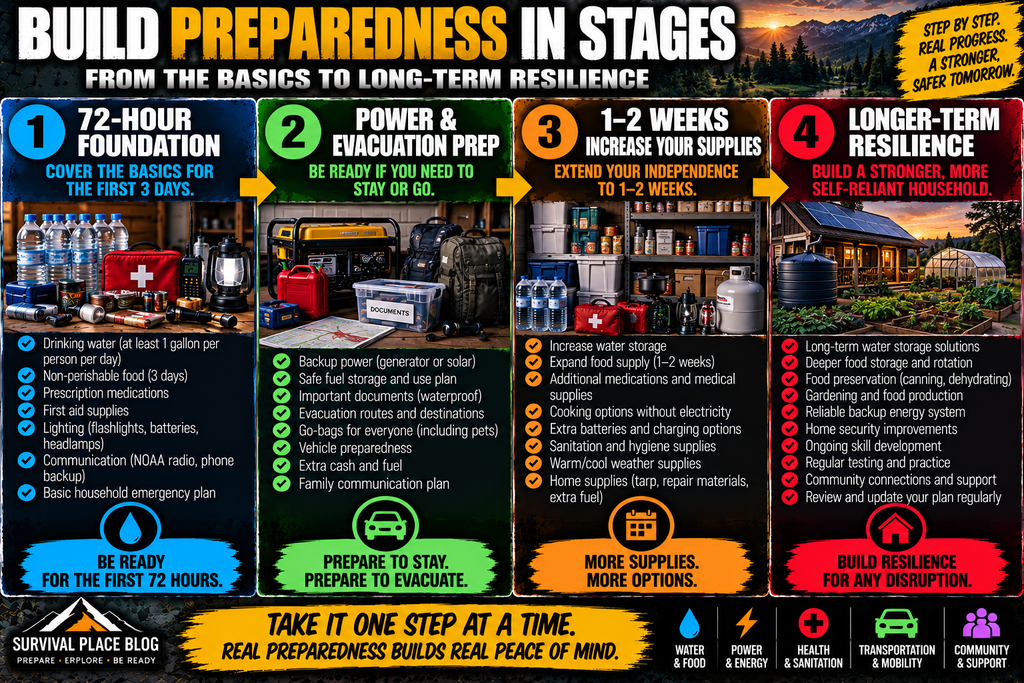
Step 1 — Build a 72-Hour Foundation
Cover the basics for approximately three days:
- Water
- Food
- Medications
- Lighting
- Communication
- First aid
- Hygiene
- Basic emergency plan
Step 2 — Prepare for a Power Outage
Make sure you can function for at least a short period without electricity.
Step 3 — Build Your Evacuation Capability
Have essential documents, supplies, transportation planning, and a go-bag.
Step 4 — Expand to One or Two Weeks
Increase water, food, household supplies, medications where appropriate, and backup-power capability.
Step 5 — Build Longer-Term Resilience
Once the basics are covered, consider:
- Larger water storage
- Deeper pantry
- Food preservation
- Gardening
- Backup energy
- Advanced first aid
- Communication skills
- Household security improvements
- Longer-duration planning
If evacuation is part of your preparedness plan, our Ultimate Bug Out Bag Guide takes a deeper look at building a practical 72-hour evacuation bag around water, food, shelter, first aid, communication, navigation, clothing, and essential gear.
What Should You Buy First?
This is where people often spend money backward.
They buy interesting equipment before solving boring problems.
Before buying another survival gadget, ask:
Do I have enough emergency water?
Can I feed my household without going shopping?
Do I have necessary medications and first-aid supplies?
Can I see in the dark?
Can I charge a phone?
Can I receive emergency information?
Can I keep warm or cool enough?
Can I leave quickly if necessary?
Does my vehicle work reliably?
If the answer to one of those is no, that’s probably a better place to spend money.
Gear Should Solve a Defined Problem
This principle can save you a lot of money:
Don’t buy emergency equipment until you can explain exactly what problem it’s supposed to solve.
A generator isn’t automatically useful because it’s expensive.
A $25 headlamp may solve a more immediate problem.
A huge survival knife doesn’t solve a water shortage.
A year’s worth of freeze-dried food doesn’t help much if you haven’t planned how to store enough water.
Build capabilities.
Not collections.
Common Prepping Mistakes
Even experienced people can create weak preparedness plans.
Buying Gear Instead of Building Skills
Equipment feels productive because you can see it.
Skills require practice.
You need both.
Ignoring Water
Food gets more attention because it’s interesting.
Water is often the more immediate household problem.
Storing Food Nobody Eats
If your emergency pantry is full of food your family dislikes, rotation becomes difficult and waste increases.
Depending on One Solution
One flashlight.
One water filter.
One phone.
One evacuation route.
One way to cook.
Critical functions deserve redundancy.
Forgetting Maintenance
Batteries discharge.
Fuel ages.
Food expires.
Medications change.
Children grow.
Vehicles need maintenance.
Preparedness isn’t a one-time project.
Preparing for Dramatic Disasters but Not Ordinary Emergencies
You may never experience a massive national catastrophe.
You may absolutely experience:
- Power outages
- Storms
- Job loss
- Vehicle breakdowns
- Water interruptions
- Medical emergencies
- Evacuations
Prepare for ordinary disruptions first.
Much of that preparation also helps with larger emergencies.
Ignoring the People in the Plan
A preparedness system has to work for everyone who depends on it.
Consider:
- Children
- Older adults
- Disabilities
- Pets
- Medical conditions
- Dietary restrictions
- Anxiety and stress
- Physical limitations
The best plan isn’t the one with the most equipment.
It’s the one your household can actually use.
The Five-Pillar Preparedness Audit
Use this quick audit to identify your weakest area.
Pillar 1 — Mindset, Skills & Planning
Can everyone explain the emergency plan?
Do we know when we would evacuate?
Do we know where we would go?
Have we practiced with our equipment?
Pillar 2 — Water & Food
How many days of drinking water do we actually have?
How many days of food?
Can we prepare some of it without electricity?
Do we have a backup water-treatment method?
Pillar 3 — Shelter, Power & Security
Can we safely stay home during a multi-day outage?
Do we have lighting?
Do we have working smoke and CO alarms?
Can we maintain safe temperatures?
Are doors and windows secure?
Pillar 4 — Health, First Aid & Sanitation
Is our first-aid kit current?
Do we have necessary medications?
Can we maintain basic hygiene?
What would we do if toilets stopped working?
Does anyone depend on powered medical equipment?
Pillar 5 — Communication, Transportation & Community
Can we receive emergency information without internet access?
Does everyone know who to contact?
Is the vehicle maintained?
Do we know alternate routes?
Do we know which neighbors we could help—or call for help?
Whichever pillar has the weakest answers is where you start next.
Want to see where your preparedness plan is strongest—and where it still has gaps? Download the free Five Pillars Preparedness Audit and work through each category at your own pace.
A Practical 30-Day Prepping Plan
If the entire subject still feels overwhelming, spread it across one month.
Week 1 — Plan
Create household contacts.
Choose meeting locations.
Identify evacuation routes.
List household-specific medical needs.
Week 2 — Water & Food
Build or expand stored water.
Add several days of shelf-stable food.
Check your water filter or treatment supplies.
Week 3 — Home & Health
Check smoke and CO alarms.
Check first aid.
Check flashlights.
Review medications.
Add hygiene and sanitation supplies.
Week 4 — Communication & Transportation
Check the vehicle.
Test the emergency radio.
Check phone backup power.
Review family communication plans.
Pack or inspect your go-bag.
At the end of thirty days, you’ll have accomplished more than someone who spent the month researching expensive survival equipment and bought nothing useful.
Preparedness Is Built Over Time
You don’t become “prepared” on a particular day.
Your circumstances change.
People move.
Children grow.
Vehicles change.
Medications change.
Equipment wears out.
New risks emerge.
The goal isn’t to reach some imaginary finish line.
The goal is to become more resilient than you were yesterday.
Review your supplies periodically.
Practice skills.
Replace what expires.
Adjust the plan.
Learn from real emergencies.
And don’t be afraid to simplify.
A system you understand and maintain is better than an elaborate system you’ve forgotten how to use.
Final Thoughts: Build the Five Pillars, Not a Pile of Gear
The five pillars of prepping give you a way to organize preparedness around what actually matters.
Mindset, Skills & Planning help you make better decisions.
Water & Food Security keep essential resources available.
Shelter, Power & Security help maintain a safe place to live.
Health, First Aid & Sanitation protect the people inside the plan.
Communication, Transportation & Community keep you connected and mobile when normal systems are disrupted.
You don’t need a bunker.
You don’t need unlimited money.
And you don’t need to prepare for every disaster imaginable.
Start with the emergencies most likely to affect your household.
Fix the biggest weakness.
Then move to the next one.
That’s the difference between collecting survival gear and building actual preparedness.
Prepare the system. Practice the plan. Build resilience one layer at a time.