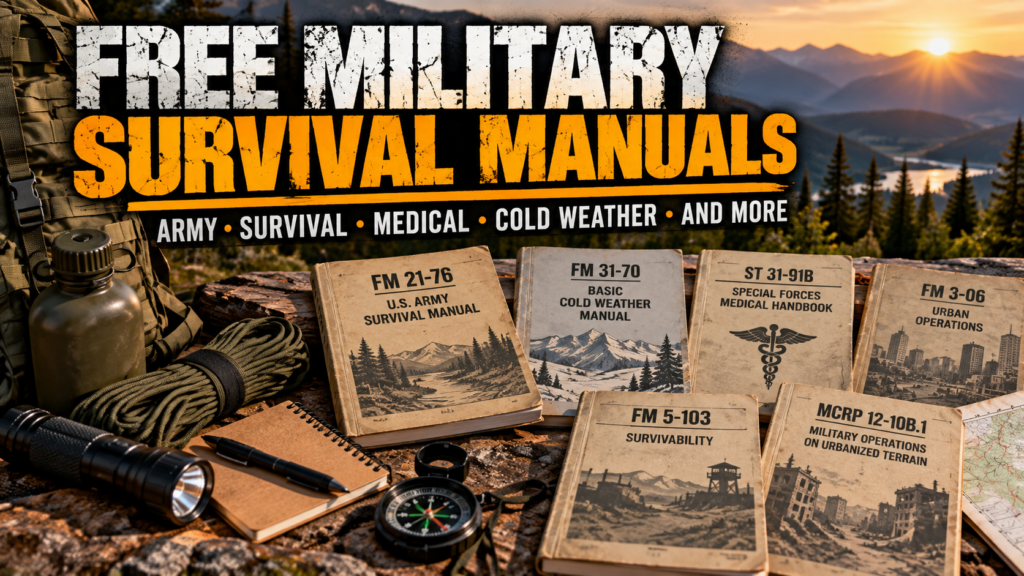
Military survival manuals contain an enormous amount of practical information covering wilderness survival, navigation, shelter, water, cold-weather operations, medical care, communication, and emergency planning.
Survival Place Blog has collected several military survival manuals and reference guides that you can download as free PDFs. Some are comprehensive survival manuals, while others focus on specialized subjects such as cold weather, medical care, urban environments, and military communication.
You don’t need to be in the military to learn from them. Outdoor enthusiasts, hikers, campers, preparedness-minded households, and anyone interested in traditional survival skills can use these manuals as reference material.
However, many military field manuals were written for specific military purposes and some are older publications. Medical recommendations, equipment, terminology, procedures, and operational doctrine may have changed since publication. Use these manuals as educational and historical resources rather than substitutes for current medical advice, local emergency guidance, or modern safety standards.
Free Military Survival Manuals
All of the manuals below can be downloaded directly as PDFs.
Save the ones that interest you to your computer, tablet, or phone so you’ll have access to them even when an internet connection isn’t available.
Communication Reference
NATO Phonetic Alphabet
The NATO phonetic alphabet provides standardized words for communicating individual letters clearly.
Instead of simply saying a letter such as B or D—which can be easily misunderstood over a poor radio or telephone connection—you use standardized words such as Bravo or Delta.
Learning the phonetic alphabet can be useful for:
- Radio communication
- Emergency communication
- Relaying names and locations
- Communicating serial numbers
- Clarifying letters over weak connections
This is a small reference worth saving or printing.
General Survival
FM 21-76 — U.S. Army Survival Manual
One of the most comprehensive manuals in this collection, FM 21-76 covers a broad range of traditional survival subjects.
Topics include survival planning, shelter, water procurement, fire, food, navigation, signaling, dangerous plants and animals, and survival in different environments.
For someone building a digital survival library, this is a logical place to start.
FM 21-76 US ARMY SURVIVAL MANUAL
FM 21-76-1 — Survival, Evasion and Recovery
This guide provides a more condensed survival reference intended to put important information into a format that can be consulted quickly.
It covers essential concepts related to survival, evasion, navigation, signaling, water, food, shelter, medical considerations, and recovery.
It can serve as a companion reference to the larger survival manual.
FM 21-76-1 SURVIVAL, EVASION AND RECOVERY
Cold-Weather Survival
FM 31-70 — Basic Cold Weather Manual
Cold environments create survival problems that don’t exist in warmer conditions.
This manual focuses on operating and surviving in severe cold, including clothing, shelter, movement, equipment, health considerations, and other challenges associated with winter environments.
Even though it was developed for military use, portions of the material can be useful background reading for people interested in winter survival and cold-weather preparedness.
FM 31-70 BASIC COLD WEATHER MANUAL
For practical civilian preparation for freezing temperatures, snow, ice, and winter travel, see our guide, Winter Vehicle Preparedness: How to Prepare Your Car for Cold Weather.
FM 3-06 — Urban Operations
FM 3-06 examines U.S. Army operations in urban environments.
It discusses the characteristics and challenges of cities and other developed areas, including terrain, infrastructure, populations, planning considerations, and military operations.
For civilian readers, this manual is best viewed as military doctrine and reference material rather than a guide to everyday emergency preparedness.
FM 5-103 — Survivability
FM 5-103 focuses on military survivability and protective positions.
Its subject matter includes the preparation and use of fighting and protective positions for personnel, vehicles, weapons, and equipment.
Because this material was written for military operations, much of it won’t apply directly to normal household preparedness. However, readers interested in military fieldcraft, protective construction, and historical field manuals may find it useful.
Medical Reference
ST 31-91B — Special Forces Medical Handbook
This is a much more specialized resource than a typical household first-aid guide.
The handbook was developed as a reference for Special Forces medical personnel and covers a wide variety of diseases, injuries, medical conditions, treatments, and health problems that personnel could encounter in different parts of the world.
Because medical standards and recommended treatments change, older military medical manuals should not be treated as substitutes for current professional medical guidance.
For preparedness purposes, its value is primarily as a historical and educational medical reference.
ST 31-91B SPECIAL FORCES MEDICAL HANDBOOK
MCRP 12-10B.1 — Military Operations on Urbanized Terrain
This U.S. Marine Corps publication addresses military operations in urbanized terrain.
It covers the organization, planning, and conduct of military operations in built-up areas and is primarily intended as military instructional material.
Like FM 3-06, this should be treated as military reference material rather than a civilian emergency-response manual.
MCRB 12-10B.1 MILITARY OPERATIONS ON URBANIZED TERRAIN
Build an Offline Survival Library
Downloading these manuals is useful, but don’t assume you’ll always be able to reach Survival Place Blog—or any other website—during an emergency.
Consider keeping important preparedness information in more than one place.
For example:
- Computer
- Phone
- Tablet
- USB drive
- External storage device
- Printed binder
Prioritize the information you would actually need if electricity, cellular networks, or internet service were unavailable.
For a practical starting point for building the supplies your household may need during an emergency, see our guide, Start Here: Your 72-Hour Preparedness Plan.
A small collection of carefully chosen offline resources is more useful than hundreds of files you have never opened.
Start With the Survival Manual You Will Actually Read
You don’t need to study every military field manual ever published.
If you’re primarily interested in general survival, start with FM 21-76. If cold weather is a major concern, add FM 31-70. If you’re interested in emergency communications, keep the NATO Phonetic Alphabet available as a quick reference.
Then actually read them.
Download the manuals that match your interests, save copies offline, and use them alongside current preparedness information and modern safety guidance.
Survival knowledge becomes much more valuable when you’ve learned it before you need it.