Affiliate Disclosure: This post contains affiliate links. If you purchase through these links, Survival Place Blog may earn a commission at no additional cost to you. As an Amazon Associate I earn from qualifying purchases.
Getting lost in the woods can happen faster than most people expect.
You step off the trail to look at something. A familiar landmark disappears behind the trees. Fog rolls in. Snow covers the trail. You follow what looks like the right path only to realize twenty minutes later that nothing looks familiar.
The natural reaction is to keep moving and try to fix the mistake.
That can be exactly what makes the situation worse.
Every unnecessary mile can take you farther from your last known location, burn energy, increase your risk of injury and make the search area larger for rescuers.
If you become lost in the woods, your first objective isn’t to prove your wilderness survival skills.
Your objective is to stay alive, avoid making the situation worse and make yourself as easy as possible for rescuers to find.
Being prepared before an emergency gives you more options when things go wrong. For a broader foundation, see our guide, Wilderness Navigation: How to Navigate Without GPS.
Your Rescue Starts Before You Leave
One of the best things you can do if you ever become lost happens before you even enter the woods.
Tell someone where you’re going.
A basic trip plan should include:
- Where you’re going
- Your planned trail or route
- Where you parked
- Your expected return time
- Who is traveling with you
- Any planned alternate route
- When someone should become concerned if you haven’t returned
Don’t simply tell someone you’re “going hiking.”
The more specific the information, the more useful it can become if a search has to be started.
If you’re traveling into a remote area, consider leaving identifying information about your vehicle and trailhead as well.
The National Park Service recommends leaving a trip plan with a trusted contact who isn’t going with you, including where you’re going and when you expect to return.
Technology can add another layer. Depending on where you’re traveling, a satellite communicator or personal locator beacon can provide emergency communication where normal cellular service doesn’t exist.
But no electronic device replaces good planning.
Batteries die. Devices break. Signals can be obstructed.
Your first rescue tool is making sure someone knows where you were supposed to be.
Lost in the Woods? Start With STOP
Once you suspect you’re lost, resist the urge to immediately start walking faster.
Use the simple STOP approach:
Stop
Stop moving.
Continuing in an uncertain direction can turn a small navigation mistake into a much larger problem.
Think
Ask yourself:
When did I last know exactly where I was?
What trail, road, stream, ridge or landmark did I recently pass?
How much daylight remains?
Is anyone expecting me?
Do I have cell service?
Is anyone injured?
What is the weather doing?
Observe
Look carefully at your surroundings.
Check your map, compass, GPS or phone if you have them.
Look for trail markers, signs, footprints, roads, structures, power lines or other recognizable features—but don’t immediately chase after something simply because you think it looks familiar.
Plan
Only after assessing the situation should you decide what to do next.
Sometimes moving makes sense.
Often, staying where you are is the safer decision.
For additional guidance, the National Park Service Outdoor Emergency Plan explains what to do if you become lost or injured and how to improve your chances of being found.
Should You Stay Put or Try to Move?
This may be the most important decision you make.
If someone knows your route and expected return time, rescuers may begin with your planned route and last known location.
Continuing to wander can move you outside that search area.
Staying put generally deserves serious consideration when:
- Someone knows where you planned to be
- You aren’t confident of your location
- Darkness is approaching
- Weather is deteriorating
- You are injured
- Terrain is difficult or dangerous
- You have shelter, water or useful resources nearby
- You don’t have a reliable navigation method
There are situations where moving may be appropriate.
You may know with reasonable certainty that a trail, road, occupied building or other safe destination is nearby. Your current location may also expose you to an immediate hazard such as wildfire, flooding, falling rocks, dangerous weather or another threat.
The key distinction is simple:
Move because you have a reason and a plan—not because you’re frightened and feel like you need to be doing something.
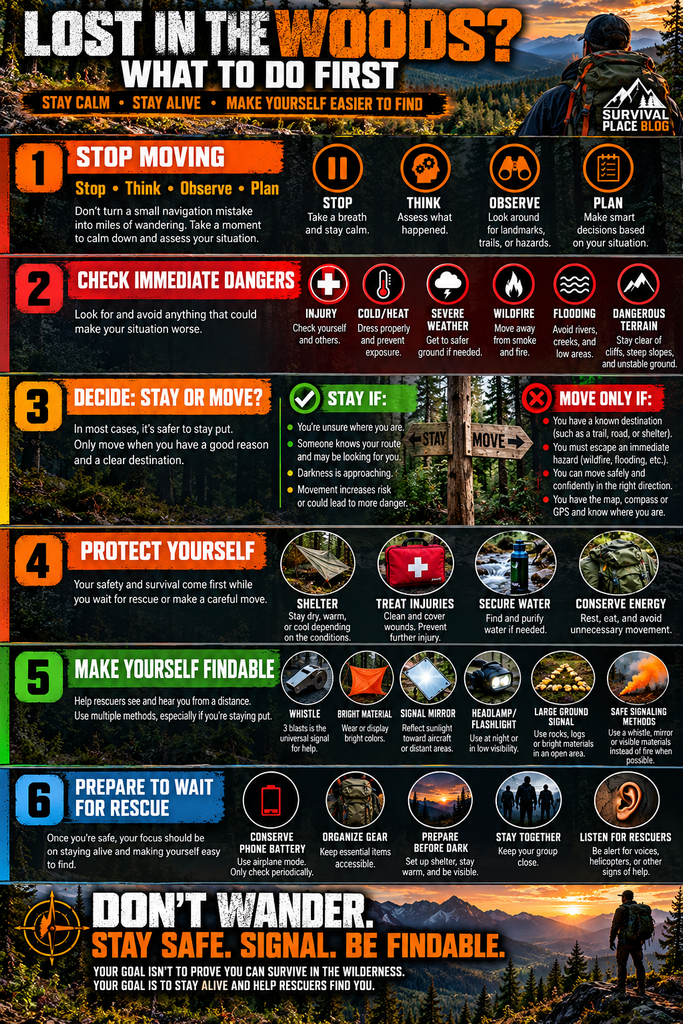
Deal With Immediate Threats First
Survival priorities change with conditions.
There isn’t one universal checklist that applies perfectly to every lost-person situation.
A serious injury may become your first priority.
In freezing weather, preventing hypothermia may matter more than finding water.
During extreme heat, shade and hydration may become urgent.
During a thunderstorm, moving away from exposed terrain may be more important than staying exactly where you realized you were lost.
Before worrying about food or building elaborate survival equipment, deal with whatever can hurt you right now.
Ask:
Am I injured?
Am I dangerously cold or overheated?
Am I exposed to severe weather?
Am I in a flood zone, avalanche area, wildfire path or other immediate hazard?
Solve the most dangerous problem first.
Find or Build Shelter
Exposure can become dangerous long before hunger does.
Your shelter doesn’t need to look like something from a survival television show.
It needs to help protect you from:
- Wind
- Rain
- Snow
- Cold ground
- Excessive sun
- Falling temperatures
Start with what you already have.
A rain jacket, poncho, emergency blanket, tarp or extra clothing may provide more immediate protection than spending hours constructing a primitive shelter.
A compact emergency blanket can provide another lightweight layer of protection from wind, rain and heat loss. The Primacare HB-10 Emergency Mylar Thermal Blankets are easy to keep in a daypack or basic wilderness emergency kit.
If natural shelter is necessary, choose the location carefully.
Avoid setting up:
- In dry streambeds or washes
- Directly beneath dead branches
- At the bottom of terrain prone to flooding
- On exposed ridgelines during storms
- Beneath unstable rocks
- In areas showing obvious animal activity
Insulation underneath you can be just as important as protection overhead because the ground can pull heat from your body.
Use your available equipment and surrounding materials carefully to create separation from cold or wet ground.
And don’t exhaust yourself constructing something elaborate when a simpler shelter will do the job.
For a closer look at choosing a safe location and creating protection from the elements, see our guide, Emergency Outdoor Shelter: How to Choose, Build, and Survive the Night.
Conserve energy whenever possible.
Stay Warm Without Creating Another Emergency
Fire can be extremely useful in a wilderness emergency.
It can provide warmth, help dry wet clothing, boil water under appropriate circumstances, improve morale and potentially help rescuers locate you.
But fire is not automatically the right choice.
In dry forests or during periods of extreme wildfire danger, an uncontrolled fire can turn one emergency into a much larger one.
Before building a fire, consider:
- Current fire restrictions
- Wind
- Surrounding vegetation
- Availability of a safe location
- Whether you actually need the fire
- Whether you can completely control and extinguish it
Before starting any fire, check local restrictions and conditions. The National Park Service campfire safety guidance also emphasizes keeping fires attended and completely extinguishing them before leaving
If you do safely build a fire, keep it manageable.
If you want to learn these skills before you actually need them, see our guide, Wilderness Fire Starting: Methods, Tinder and Fire Safety.
Gather fuel before you need it, maintain control of the fire and never allow it to spread into surrounding vegetation.
Your emergency does not eliminate wildfire risk.
Water Becomes a Priority
Water will generally become a serious survival concern before food.
If you carried water with you, rationing doesn’t mean refusing to drink while becoming increasingly dehydrated. Use what you have intelligently while evaluating how you might obtain additional safe water.
Possible natural sources can include:
- Streams
- Springs
- Lakes
- Collected rainwater
- Snow under appropriate conditions
But clear water is not automatically safe water.
Natural water can contain microorganisms capable of causing illness, and becoming sick while already lost can make the situation considerably worse.
Whenever possible, use an appropriate combination of filtration, purification or disinfection for the source and conditions you’re dealing with.
For a more detailed look at locating and treating water outdoors, see our guide, Wilderness Water: How to Find, Filter and Purify Water Safely.
A compact wilderness water filter or purification method can be one of the most useful pieces of equipment in a hiking kit.
One compact option for a hiking or emergency kit is the Sawyer MINI Water Filtration System, which is small enough to carry in a daypack without taking up much space.
Don’t take unnecessary risks reaching water.
A stream at the bottom of a steep ravine isn’t helpful if reaching it causes a serious fall.
And don’t wander miles away from a good rescue location simply because you hear running water.
Food Is Usually Not Your First Problem
One of the biggest misconceptions about becoming lost is that you immediately need to find food.
Usually, you don’t.
For a relatively short survival situation, shelter, temperature regulation, water, injury prevention, signaling and rescue are typically much more important.
Searching for food can consume energy and lead you farther away from the location where rescuers are looking.
It can also introduce new risks.
Don’t eat wild plants or mushrooms unless you can identify them confidently and know they are safe.
Fishing, trapping or gathering wild food may have a place in a genuinely prolonged survival situation, but these activities shouldn’t distract from your primary objective.
If you want to build those skills before an emergency, read our guide, Foraging for Survival: Finding Food Safely in the Wilderness, which takes a closer look at finding food in a wilderness survival situation.
Getting rescued is a better food strategy than spending your first day wandering around looking for dinner.
Make Yourself Easy to Find
Once your immediate survival needs are under control, think like a search-and-rescue team.
Your job is to make yourself noticeable.
In a huge forest, a person can be surprisingly difficult to see—even from relatively close range.
Use contrast.
Bright clothing, an emergency blanket, brightly colored gear or other material that looks unnatural against the landscape can attract attention.
If you’re staying in one location, make that location obvious.
An open area that can safely be seen from above may offer signaling advantages over dense tree cover, provided moving to it doesn’t expose you to additional danger.
You want rescuers to notice something that clearly doesn’t belong there.
How to Signal Search and Rescue
Carry more than one signaling method whenever possible.
Whistle
A whistle is inexpensive, lightweight and can carry farther than your voice.
It also requires far less energy than repeatedly shouting.
A lightweight emergency survival whistle is worth keeping attached to your pack where you can reach it quickly without digging through your gear.
Use repeated whistle blasts when you believe rescuers may be nearby, then stop and listen.
Signal Mirror
A proper signal mirror can reflect sunlight over considerable distances under suitable conditions.
It weighs very little and doesn’t require batteries.
Flashlight or Headlamp
At night, a flashlight or headlamp becomes both a survival tool and a signaling device.
Repeated flashes may attract attention from rescuers.
A reliable headlamp also keeps both hands free after dark while providing another way to signal rescuers. The Energizer Universal LED Headlamp is a practical addition to a hiking or wilderness emergency kit.
Bright Ground Signals
If you have access to an open area, create a large, obvious signal using materials that contrast with the surroundings.
The signal needs to be large enough to be noticed from a distance or aircraft.
Fire and Smoke
Fire may provide a visible signal, but only use it when conditions allow you to do so safely and legally.
Do not start an uncontrolled smoky fire in dry vegetation simply because you want to attract attention.
Sound and Movement
If you hear aircraft, voices, vehicles or rescuers nearby, make yourself noticeable.
Whistle.
Wave brightly colored material.
Flash a light.
Use a mirror.
Call out.
Then listen for instructions.
Using Your Phone When You’re Lost
A smartphone can be extremely valuable even when normal cellular service is weak or unavailable.
If you have service, contact emergency services and provide as much useful information as possible.
Depending on your device, location and available services, emergency communication features may also be available outside traditional cellular coverage.
Once you’ve communicated your situation, conserve battery power.
Consider:
- Reducing screen brightness
- Closing unnecessary apps
- Using low-power mode
- Keeping the phone protected from extreme cold
- Limiting unnecessary photos and video
- Avoiding entertainment use
- Using an external battery bank if available
Keeping a backup charging source in your pack can extend your ability to communicate, navigate and call for help. A Portable Power Bank can provide emergency phone charging when you’re away from normal power sources.
Don’t continuously wander around trying to find another bar of cellular service unless moving is otherwise justified.
Your phone is a tool.
Don’t let the search for a signal turn into another reason to become more lost.
Navigation: When Moving Is Actually the Right Decision
If you’re truly lost, improvising navigation from vague natural clues can be dangerous.
The idea that you can simply follow the sun, moss, stars or a stream back to civilization sounds reassuring, but real terrain isn’t that simple.
A compass is useful only when you know how to use it and have enough information to choose the correct direction.
A map becomes far more useful when you can identify your approximate location.
The National Park Service recommends carrying appropriate navigation tools, including a map and compass, and knowing how to use them before heading into the wilderness.
If you know you are very close to a trail you just left and can confidently retrace your steps, doing so may make sense.
If you have no idea where you are, randomly choosing a direction may not.
Navigation should reduce uncertainty—not create more of it.
If You Must Move
If circumstances make movement necessary, become more deliberate than you would during a normal hike.
Before leaving your location:
- Decide where you’re trying to go
- Determine why you believe it’s safer
- Check your map and compass
- Consider remaining daylight
- Evaluate terrain and weather
- Leave an obvious indication of your direction if practical
Don’t rush.
A sprained ankle, broken leg or serious fall can transform a manageable situation into a medical emergency.
Be particularly cautious around:
- Cliffs
- River crossings
- Loose rock
- Snowfields
- Steep slopes
- Dense brush
- Fallen timber
- Wet rocks and logs
If you’re uncertain whether a shortcut is safe, don’t take it.
First Aid and Injury Management
Small injuries can become bigger problems when you’re far from help.
Clean and protect cuts when possible.
Address bleeding promptly.
Support injured joints or limbs.
Treat developing hot spots on your feet before they become serious blisters.
Watch yourself and others for signs of heat illness, dehydration or hypothermia.
For a more detailed look at treating injuries and medical problems away from immediate help, see our guide, Wilderness First Aid: Essential Skills for Outdoor Emergencies.
A compact first-aid kit belongs in even a basic hiking setup.
Carrying basic medical supplies gives you more options when an injury happens far from help. The EVERLIT 250-Piece Survival First Aid Kit combines first-aid supplies with additional emergency gear for outdoor and preparedness use.
But equipment is only part of the solution.
Basic first-aid training can be more valuable than carrying supplies you don’t know how to use.
Nightfall: What Changes After Dark
Darkness changes the risk equation.
Terrain becomes harder to evaluate.
Trail markers become more difficult to see.
Navigation errors become easier.
Falls become more likely.
Unless staying where you are creates a greater danger, nightfall is usually a strong reason to stop unnecessary movement and establish a safe location.
Prepare before you’re completely out of daylight.
Organize your gear.
Improve your shelter.
Put on insulating clothing before you become seriously cold.
Locate your flashlight or headlamp.
Make signaling equipment accessible.
If you’re with other people, keep the group together.
Night can make the situation feel much worse psychologically.
But darkness doesn’t mean you’ve failed.
Sometimes the smartest survival decision is simply to make it safely to morning.
Mental Survival: Avoid Panic and Bad Decisions
Fear is normal when you’re lost.
The danger comes when fear begins making decisions for you.
Panic encourages people to:
- Move too quickly
- Ignore injuries
- Take dangerous shortcuts
- Abandon useful equipment
- Waste phone battery
- Wander without direction
- Make unnecessary survival decisions
Give yourself manageable tasks.
Assess your location.
Treat injuries.
Improve shelter.
Inventory water.
Prepare signaling equipment.
Check the weather.
Organize your gear.
Then reassess.
A simple routine creates structure and gives you something productive to focus on.
You don’t need to solve the entire situation at once.
Solve the next important problem.
If You’re Lost With Children or Other People
Groups create both advantages and additional responsibilities.
Stay together unless there is an immediate, compelling reason to separate.
Don’t send one person wandering off alone to “look around.”
Inventory everyone’s:
- Water
- Clothing
- Food
- Medications
- Navigation equipment
- Communication devices
- Physical condition
Children may become frightened, cold or dehydrated faster than adults realize.
Keep them close, give them simple tasks when appropriate and explain what’s happening without creating unnecessary fear.
If one person has to make decisions for the group, keep those decisions deliberate and conservative.
A lost group becoming several lost individuals makes rescue harder.
What to Carry Before Going Into the Woods
You don’t need a fifty-pound survival pack for an afternoon hike.
But heading into the woods with nothing except a phone creates unnecessary vulnerability.
A practical basic hiking survival kit might include:
- Water
- Appropriate water-treatment method
- Extra food
- Weather-appropriate clothing
- Rain protection
- Map
- Compass
- Flashlight or headlamp
- Spare batteries or charging capability
- First-aid kit
- Whistle
- Signal mirror
- Fire-starting equipment where appropriate
- Emergency shelter
- Knife or multi-tool
- Necessary medications
- Sun protection
- Navigation/communication device appropriate to the trip
For a broader look at the equipment worth carrying outdoors, see our Essential Camping Checklist for additional gear and preparedness ideas.
The exact kit should change with the environment.
A summer day hike near town requires different preparation than a winter trip into remote mountain country.
Don’t simply carry survival equipment.
Learn how to use it before you need it.
After You’re Found
Seeing rescuers doesn’t always mean the emergency is immediately over.
Follow their instructions.
Don’t suddenly begin moving toward an aircraft, vehicle or rescue team unless directed.
If you’re injured, tell rescuers.
Let them know about:
- Medical conditions
- Medications
- Injuries
- Dehydration
- Possible hypothermia or heat illness
- Anyone else who may still be missing
If you activated an emergency beacon or sent an SOS, follow the appropriate instructions for your device and rescuers.
Once you’re safe, notify anyone who may still believe you’re missing.
That can prevent unnecessary searching and keep rescue resources available for others.
Respect the Land During a Survival Situation
An actual survival emergency may force decisions you wouldn’t normally make during recreational travel.
But don’t cause unnecessary damage simply because you’re lost.
Use existing clearings when practical.
Avoid damaging live vegetation unless necessary.
Pack out what you reasonably can.
Respect wildlife.
Avoid unnecessary disturbance to cultural or historic sites.
And if you encounter private property while genuinely trying to reach safety, focus on getting help rather than wandering through property unnecessarily.
Survival may require flexibility.
It doesn’t require abandoning common sense.
The Most Important Rule: Help Rescuers Find You
Survival skills matter.
Shelter matters.
Water matters.
Navigation matters.
First aid matters.
But if you’re lost and people are searching for you, one of the most valuable things you can do is make their job easier rather than harder.
That means having someone know your trip plan before you leave.
It means stopping before a navigation mistake becomes miles of wandering.
It means staying put when staying put makes sense.
It means conserving energy and battery power.
It means making yourself visible and audible.
And it means avoiding unnecessary risks while waiting for help.
The wilderness doesn’t care whether you’re an experienced hiker or someone taking a short afternoon walk.
Small mistakes can become serious problems.
Preparation gives you more options when they do.
Keep the most important survival and rescue steps with you before you head into the wilderness. Our free Lost in the Woods: Survival & Rescue Checklist provides a quick-reference guide for what to do when you realize you’re lost, including when to stay put or move, immediate survival priorities, water, signaling, phone battery conservation, preparing for nightfall, and essential gear to carry. Download a copy, print it, and keep it with your hiking or emergency gear.
Final Thoughts
If you become lost in the woods, don’t immediately turn the situation into a test of primitive survival.
Stop. Think. Observe. Plan.
Deal with immediate threats. Protect yourself from exposure. Secure safe water when necessary. Treat injuries. Signal for help. Conserve your resources. Move only when you have a good reason to move.
Most importantly, make yourself easier to rescue.
Before your next trip, tell someone exactly where you’re going and when you expect to return. Carry basic emergency equipment. Learn how to navigate. Practice first aid. Understand the environment you’re entering.
Because when something goes wrong miles from the trailhead, the goal isn’t to become a wilderness survival legend.
The goal is to come home.