Affiliate Disclosure: This post contains affiliate links. If you purchase through these links, Survival Place Blog may earn a commission at no additional cost to you. As an Amazon Associate I earn from qualifying purchases.
Backcountry skiing offers something resorts can’t: untouched snow, remote terrain and the freedom to explore mountains far beyond marked runs and lift lines.
That freedom also removes many of the protections resort skiers take for granted.
There may be no ski patrol nearby, no marked boundary showing the safest route home, no warming lodge and no quick response when something goes wrong. Weather can deteriorate rapidly, daylight disappears early during winter, and a navigation mistake can place you in dangerous terrain.
Getting lost backcountry skiing is especially serious because becoming disoriented may happen alongside cold exposure, exhaustion, injury or avalanche danger.
If you realize you’re lost or stranded, your objective changes immediately.
The ski trip is over. Your priorities are staying alive, avoiding additional hazards and helping rescuers find you.
Before You Go: Your Rescue Plan Starts at Home
Backcountry survival begins before you put on your skis.
Someone who isn’t traveling with you should know where you’re going, your intended route, where you parked, who you’re traveling with and when you expect to return.
Don’t simply tell someone you’re “going skiing in the mountains.”
Give them enough information that authorities would have a realistic starting point if you don’t return.
A useful trip plan can include:
- Trailhead or access point
- Intended route
- Destination or turnaround point
- Vehicle description and license plate
- Names of everyone in the group
- Equipment carried
- Expected return time
- Emergency contact information
Make sure your contact understands when to take action if you haven’t returned.
Before heading into the backcountry, leave detailed information with someone you trust. The National Park Service recommends creating a Trip Plan and leaving it with a trusted contact who can alert authorities if you don’t return as expected.
Check Weather and Avalanche Conditions Before Leaving
Mountain conditions can change dramatically during a backcountry trip.
Before leaving, check the current weather forecast and expected conditions for the area you’ll actually be traveling through—not simply the nearest town.
Pay attention to:
- Snowfall
- Wind
- Temperature
- Visibility
- Incoming storms
- Rapid warming
- Freezing rain
- Wind chill
Winter weather isn’t the only forecast that matters.
If your route enters avalanche terrain, check the current avalanche forecast for that region before leaving and understand what the danger rating means.
Conditions can change during the day, so continue observing weather, snow and terrain rather than treating the morning forecast as a guarantee.
Mountain weather can deteriorate rapidly during winter travel. Before leaving, check the latest forecasts, watches and warnings from the National Weather Service, and continue monitoring conditions when possible.
Before entering avalanche terrain, check the current regional forecast. Avalanche.org provides access to avalanche forecasts across the United States, including information about avalanche danger, current problems, snowpack conditions and travel considerations.
Backcountry Skiing Requires More Than Skiing Ability
Being an excellent skier doesn’t automatically make someone prepared for backcountry travel.
Resort skiing and backcountry skiing are very different environments.
Backcountry travelers need skills beyond downhill technique, including:
- Navigation
- Avalanche awareness
- Route planning
- Weather assessment
- Emergency communication
- Wilderness first aid
- Cold-weather survival
- Companion rescue
Anyone traveling in avalanche terrain should understand the equipment and training appropriate to that environment before heading out.
The middle of an emergency is not the time to learn how your safety equipment works.
Lost Backcountry Skiing? STOP Before You Make It Worse
The moment you seriously question your location, stop.
Don’t continue downhill because it seems easier.
Don’t follow another set of tracks simply because they’re there.
Don’t assume the drainage below you leads somewhere safe.
Use the STOP method:
Stop. Stop unnecessary travel.
Think. When were you last certain of your location?
Observe. Check terrain, weather, daylight, your group, your physical condition and your equipment.
Plan. Decide what to do based on reliable information rather than hope.
A few minutes spent thinking clearly can prevent a small navigation mistake from becoming a much larger emergency.
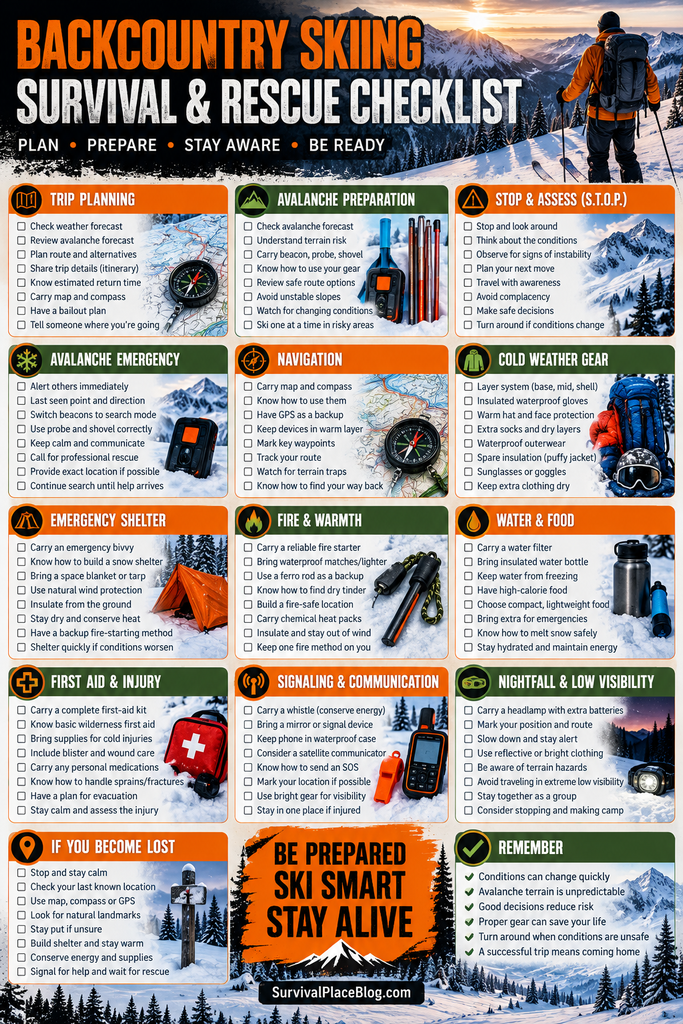
Backcountry skiing emergencies can combine navigation problems, avalanche hazards, cold exposure and rapidly changing weather. Use this checklist to prepare before leaving and remember the priorities if you become lost or stranded.Determine Your Last Known Location
Think backward.
Where were you when you last knew exactly where you were?
Possibilities might include:
- Trail junction
- Ridge
- Saddle
- Creek crossing
- Hut
- Road
- GPS waypoint
- Recognizable terrain feature
- Known point along your planned route
Check your map, compass, GPS or offline navigation application if available.
Then determine whether you can confidently and safely retrace your route.
Being able to point generally toward your vehicle isn’t enough.
Winter terrain can make a seemingly short route extremely difficult or dangerous.
Knowing how to navigate without depending entirely on electronics can become critical when batteries die, equipment fails or winter conditions make familiar terrain difficult to recognize. For practical navigation techniques, see our guide, Wilderness Navigation: How to Navigate Without GPS.
Stay Put or Attempt Self-Rescue?
There is no universal answer.
If you’re close to a known route and can confidently and safely retrace your path, self-rescue may be reasonable.
Staying put may be safer when:
- You don’t know your location
- You don’t know which direction to travel
- Someone has your trip plan
- Searchers are likely to be looking for you
- Darkness is approaching
- Visibility is deteriorating
- Someone is injured
- Your group is exhausted
- Weather is worsening
- Moving would require entering questionable terrain
Movement may be necessary if your current location exposes you to an immediate hazard.
The important distinction is that movement should have a specific safety reason or known destination.
Wandering is not self-rescue.
Deciding whether to stay put or attempt self-rescue is one of the most important decisions in any wilderness emergency. For a deeper look at making that decision and improving your chances of being found, see our guide, Lost in the Woods? How to Survive and Get Rescued.
Avalanche Terrain Changes the Decision
This is where becoming lost while backcountry skiing differs dramatically from becoming lost during many other outdoor activities.
The shortest route out may not be the safest route.
If you’re disoriented in or near avalanche terrain, don’t blindly descend because downhill travel seems likely to lead toward civilization.
Terrain below you may include:
- Avalanche paths
- Terrain traps
- Gullies
- Cliffs
- Creek beds
- Deep snow
- Dense timber
- Dangerous stream crossings
A navigation decision that would be reasonable during summer may be dangerous under winter snow conditions.
If you don’t understand the avalanche terrain around you, don’t compound a navigation problem by making an uninformed descent.
Terrain can dramatically affect avalanche consequences. The National Avalanche Center emphasizes recognizing avalanche terrain and terrain traps as part of making safer backcountry travel decisions.
If an Avalanche Emergency Occurs
A lost-person situation and an avalanche emergency require different immediate responses.
If someone in your group is caught or buried, companion rescue becomes urgent.
Backcountry travelers entering avalanche terrain should already understand how to use appropriate rescue equipment and should have practiced with it before the trip.
Common avalanche rescue equipment includes:
- Avalanche transceiver
- Probe
- Shovel
Equipment alone isn’t enough.
Knowing how to use it quickly under stress matters.
If you’re unfamiliar with avalanche rescue procedures, formal avalanche education and hands-on practice should happen before entering avalanche terrain.
Anyone traveling in avalanche terrain should understand companion rescue before an emergency occurs. Avalanche.org emphasizes carrying essential avalanche rescue equipment—including a transceiver, probe and shovel—and knowing how to use it.
Cold Exposure Can Become the Bigger Emergency
Once you’re lost, cold can become more dangerous than navigation.
Backcountry skiers frequently generate significant heat while climbing. Clothing that becomes damp with sweat can rapidly cool once you stop moving.
Wind and falling temperatures can make the situation worse.
Watch for signs of hypothermia such as:
- Persistent shivering
- Loss of coordination
- Confusion
- Slurred speech
- Unusual fatigue
- Difficulty performing simple tasks
Take action early.
Don’t wait until someone is severely cold before deciding that shelter and insulation matter.
Add dry insulation when available, protect yourself from wind and precipitation, and reduce unnecessary heat loss.
If you’re forced to spend an unexpected night in winter conditions, knowing how to safely establish a fire can provide warmth, light and an additional signaling option. For practical techniques, see our guide, Wilderness Fire Starting: Methods, Tinder and Fire Safety.
Shelter Before Darkness
If there’s a realistic chance you’ll spend the night outside, begin preparing while you still have daylight and usable energy.
Don’t wait until you’re exhausted and shivering.
Choose your shelter location carefully.
Avoid areas exposed to obvious hazards such as:
- Avalanche runout zones
- Steep loaded slopes
- Cornices
- Dead or unstable trees
- Creek channels
- Terrain traps
- Areas where drifting snow may create additional problems
Your first option should generally be whatever emergency shelter you’re already carrying.
A bivvy, tarp or other compact emergency shelter can reduce the time and energy needed to establish protection.
If an unexpected night outdoors becomes likely, establishing protection from wind, snow and cold should become an early priority. For more detailed shelter strategies, see our guide, Emergency Outdoor Shelter: How to Choose, Build, and Survive the Night.
Carrying a compact emergency shelter can save valuable time and energy if you’re stranded overnight. The S.O.L. Survive Outdoors Longer 90% Emergency Bivvy with Survival Whistle & Tinder Cord provides a lightweight emergency shelter option that can stay in your backcountry pack until needed.
Snow Shelters Require Judgment
Snow can provide insulation, but constructing a snow shelter isn’t as simple as digging a hole and climbing inside.
Location, snow stability, ventilation, moisture and the physical effort required to build the shelter all matter.
Avoid digging into questionable slopes or terrain where avalanche exposure exists.
If you construct any enclosed snow shelter, ventilation is essential.
The objective isn’t to build an impressive wilderness shelter.
It’s to reduce exposure while conserving enough energy to survive the night.
Stay Dry and Manage Your Body Temperature
One of the easiest ways to become dangerously cold is to continue working so hard that you soak your clothing with sweat.
Adjust layers before overheating.
When you stop moving, add insulation before you become chilled.
Protect yourself from:
- Wind
- Wet snow
- Rain
- Ground contact
- Damp clothing
If you have dry clothing, preserve it carefully.
Your insulation system is one of your most important survival resources.
Fire May Help—But Don’t Depend on It
A fire can provide warmth, morale and potentially another visual signal.
But winter conditions can make starting and maintaining one difficult.
Snow-covered or wet fuel, wind and limited dry tinder can consume considerable time and energy.
If you carry reliable fire-starting equipment and conditions allow safe use, a controlled fire may be useful.
But don’t make fire your only cold-weather survival plan.
Shelter, insulation and staying dry remain critical.
Reliable fire-starting equipment can be valuable if an unexpected backcountry emergency leaves you exposed to freezing temperatures. The 4″ Survival Ferro Rod Drilled Flint Fire Starter and Striker Kit provides a compact backup ignition method that can stay in your pack until needed.
Water Still Matters in Winter
Being surrounded by snow doesn’t mean you’re protected from dehydration.
Cold air, heavy exertion and altitude can contribute to fluid loss, while cold temperatures may reduce your desire to drink.
If you need snow for water, melting it is preferable to consuming large quantities of snow directly because your body must expend energy warming it.
Start with some liquid water in the container when possible before adding snow gradually.
If you’re collecting water from a natural source, remember that clear mountain water isn’t automatically safe.
Even in winter, knowing how to obtain and safely treat backcountry water can become important during an extended emergency. For more detailed guidance, see our guide, Wilderness Water: How to Find, Filter and Purify Water Safely.
Carrying a compact water filter gives you another option if your emergency lasts longer than expected and you need to use a natural water source. The Sawyer MINI Water Filtration System is small enough to keep in a backcountry pack without taking up much space.
Food Supports Energy, But Don’t Waste Energy Finding It
Food can become more important during a cold-weather emergency because your body is working to maintain temperature.
That doesn’t mean you should start searching the mountains for food.
Eat the emergency food you’re carrying.
High-energy foods that require little or no preparation are particularly useful in a winter survival kit.
Your calories are there for the emergency.
This is the time to use them.
Make Yourself Easier to Find
Staying alive is only half of the objective.
You also want rescuers to locate you.
Useful signaling equipment may include:
- Whistle
- Headlamp
- Bright clothing
- Signal mirror
- Emergency strobe
- Reflective material
- Satellite communication device
If you’re remaining in one location, make that location visually distinctive when you can do so safely.
Bright equipment placed against snow can be highly visible.
A whistle allows you to signal repeatedly without exhausting your voice.
At night, a headlamp or flashlight can become an important signaling tool as well as a source of illumination.
A whistle can be especially useful when visibility is poor because it allows you to signal repeatedly without exhausting your voice. The LuxoGear Emergency Whistles with Lanyard, Plastic 2 Pack are compact enough to keep attached to a pack or other easily accessible gear.
Your Phone Can Still Be Valuable
A phone can remain useful even when cellular coverage is poor.
If you have service, contact emergency services and provide as much useful information as possible, including your location, injuries, group size and immediate hazards.
If service is unavailable, conserve battery.
Consider:
- Lowering screen brightness
- Closing unnecessary apps
- Limiting nonessential use
- Protecting the phone from extreme cold
- Keeping the device close enough to your body to reduce battery loss from cold
- Using offline maps if already downloaded
- Carrying backup power
Some modern devices also provide satellite-based emergency communication.
If yours does, learn how it works before entering the backcountry.
Cold temperatures and extended emergencies can drain phone batteries when you need them most. Carrying a Portable Power Bank provides an additional charging option for your phone and other compatible emergency electronics.
GPS Is Helpful—But Carry Navigation Skills Too
GPS devices and mapping applications are extremely useful in winter backcountry travel.
They are not infallible.
Electronics can fail because of:
- Dead batteries
- Extreme cold
- Water or snow
- Physical damage
- User error
Carry navigation tools appropriate for your trip and know how to use them.
A map and compass don’t help much if they’re buried in your pack and you’ve never practiced with them.
Snow and moisture can damage the very navigation and communication tools you’re depending on. A Waterproof Pouch Dry Bags Document Map Holder for Water Sport 3PACK can help protect a phone, paper map, identification and other important items inside your backcountry pack.
If You Must Move, Move With a Destination
One of the most dangerous pieces of generic lost-person advice is:
“Just go downhill.”
That isn’t a safe universal strategy in mountainous winter terrain.
Descending can take you into avalanche paths, cliffs, deep drainages, creek channels or terrain you cannot safely climb back out of.
If you decide to move:
- Establish your best-known position.
- Identify a specific destination.
- Evaluate the terrain between you and that destination.
- Consider avalanche exposure.
- Check remaining daylight.
- Consider the group’s physical condition.
- Maintain awareness of changing weather.
If your confidence in the route begins dropping, stop and reassess.
Don’t turn one uncertain decision into several miles of additional uncertainty.
Injury Changes Everything
A leg, knee or ankle injury that might be manageable near a road can become extremely serious deep in winter backcountry terrain.
Control serious bleeding first.
Protect injuries from further damage and consider how the injury changes your ability to travel, build shelter and maintain body temperature.
A person who cannot move normally may become cold much faster.
Every backcountry group benefits from having someone trained in wilderness first aid.
Injuries become much more serious when cold, snow and distance from professional help are added to the situation. For practical guidance on handling medical emergencies in remote environments, see our guide, Wilderness First Aid: Essential Skills for Outdoor Emergencies.
Carrying first-aid supplies gives you more options when an injury occurs far from immediate help. The EVERLIT 250-Piece Survival First Aid Kit combines first-aid supplies with additional emergency gear that can be useful for vehicle-based or backcountry preparedness.
Darkness Changes the Risk
Winter daylight disappears quickly.
Continuing to travel simply because you believe the trailhead “can’t be much farther” can lead to falls, navigation errors and dangerous terrain choices.
If you’re uncertain of your route and darkness is approaching, stopping early may give you time to:
- Choose a safer location
- Establish shelter
- Add insulation
- Melt snow or secure water
- Organize equipment
- Treat injuries
- Prepare signaling devices
- Establish communication
A headlamp should be considered basic backcountry equipment even when you fully expect to return during daylight.
A dependable headlamp can become essential when an unexpected delay keeps you in the backcountry after sunset. The Energizer Universal LED Headlamp provides hands-free light for navigation, shelter setup, first aid and emergency signaling.
Don’t Separate the Group Without a Good Reason
A difficult situation can become much worse when a group splits up.
Unless circumstances require otherwise, keep the group together.
Before any backcountry trip, establish what everyone should do if separation occurs.
Know:
- Meeting locations
- Communication procedures
- Turnaround times
- Emergency plans
If someone becomes missing, avoid creating additional lost people by sending uncoordinated searchers in multiple directions.
What Backcountry Skiers Should Carry
Equipment needs vary depending on route, terrain, weather, avalanche exposure and remoteness, but an emergency kit may include:
- Map and compass
- GPS or navigation device
- Phone
- Backup power
- Satellite communication device when appropriate
- Headlamp and spare batteries
- Whistle
- Emergency bivvy or shelter
- Extra insulation
- Waterproof/windproof outer layer
- Gloves and spare hand protection
- First-aid supplies
- Fire-starting equipment
- Water
- Method for melting snow
- Emergency food
- Repair supplies
- Knife or multi-tool
When traveling in avalanche terrain, appropriate avalanche rescue equipment and the knowledge to use it are a separate essential consideration.
Don’t judge emergency equipment only by whether you expect to need it.
Ask yourself:
Could I safely survive an unexpected night with what I’m carrying?
A preassembled survival kit can provide a useful foundation for emergency gear, although it should always be supplemented with equipment specific to winter backcountry travel. The RIKOJUXI 262-Piece Survival Kit with First Aid Kit Pouch and Crossbody Bag combines first-aid supplies and survival tools in a portable kit that can be adapted to your needs.
If Someone in Your Group Is Overdue
If a backcountry skier doesn’t return as planned, the trip plan becomes extremely important.
Useful information for authorities may include:
- Intended route
- Trailhead
- Vehicle
- Group size
- Clothing
- Equipment
- Medical conditions
- Phone number
- GPS information
- Satellite-device information
- Planned turnaround time
- Last known location
Contact the appropriate emergency authorities when circumstances warrant it.
Don’t launch an uncoordinated search that places additional people in dangerous terrain.
Weather and avalanche conditions that endangered the missing person can also endanger would-be rescuers.
After Rescue
Once you’re found, follow rescuers’ instructions.
Cold exposure, dehydration, exhaustion, frostbite and injuries may require medical evaluation even if you initially feel capable of walking out.
Afterward, examine what happened.
Was navigation neglected?
Did the group miss its turnaround time?
Did weather deteriorate faster than expected?
Was avalanche terrain misunderstood?
Did electronics fail?
Was essential emergency equipment missing?
Did everyone understand the emergency plan?
A close call should become a lesson rather than simply a story.
Lost Backcountry Skiing: Remember the Priorities
If you’re lost backcountry skiing, don’t allow pride or impatience to push you into an even more dangerous situation.
Remember:
STOP.
Determine your last known location.
Assess avalanche and terrain hazards.
Address injuries and cold exposure.
Decide whether staying or moving is actually safer.
Prepare for darkness early.
Establish shelter.
Maintain hydration and energy.
Make yourself visible.
Signal for rescue.
Conserve communication devices.
And don’t descend blindly simply because downhill feels like the obvious way out.
The mountains don’t become safer because you want to get home quickly.
Sometimes the safest survival decision is to stop moving, protect yourself from the environment and give rescuers the best possible chance of finding you.
The ski trip is over. Stay warm. Stay out of dangerous terrain. Stay findable. Get home.
Heading into the backcountry this winter? Download our free Backcountry Skiing Survival & Rescue Checklist, print a copy, and use it when preparing your pack and emergency gear before your next trip.