Affiliate Disclosure: This post contains affiliate links. If you purchase through these links, Survival Place Blog may earn a commission at no additional cost to you. As an Amazon Associate I earn from qualifying purchases.
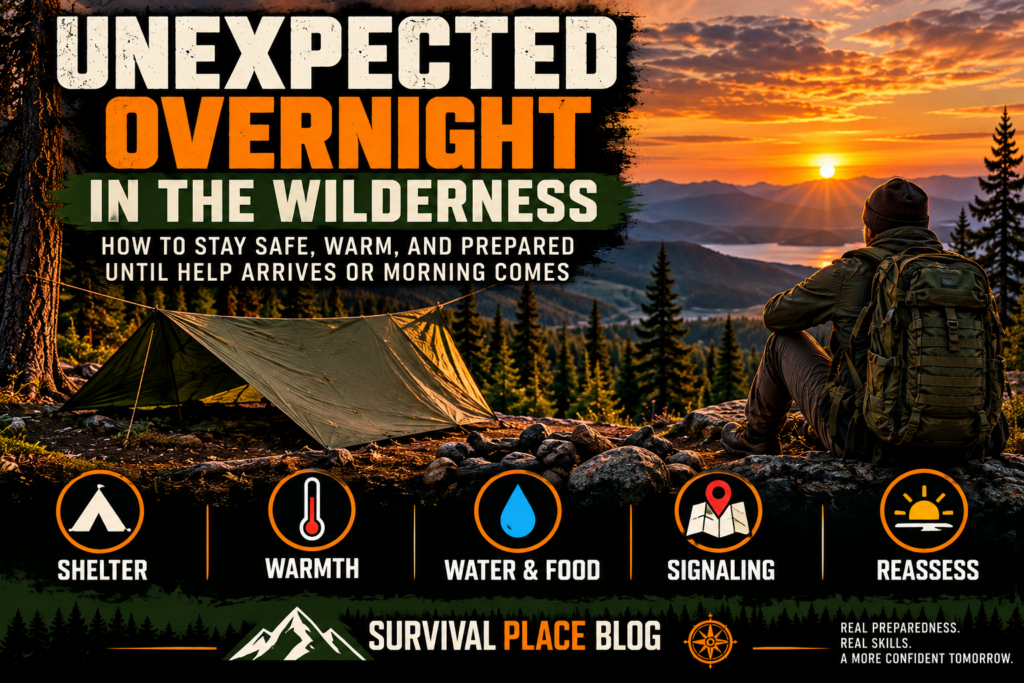
An ordinary day outdoors can become an unexpected overnight survival situation faster than most people realize.
A hiker spends extra time exploring a trail. A hunter follows animal sign farther into the woods than planned. Someone stops to enjoy a viewpoint, underestimates the return distance, and suddenly notices the sun dropping behind the mountains.
The trailhead may be only a few miles away, but fading daylight, unfamiliar terrain, exhaustion, or changing weather can make those miles far more dangerous than expected.
Being stranded overnight in the wilderness does not automatically mean you are lost, injured, or facing a life-threatening emergency. But it does mean your original plan has changed, and the decisions you make next matter.
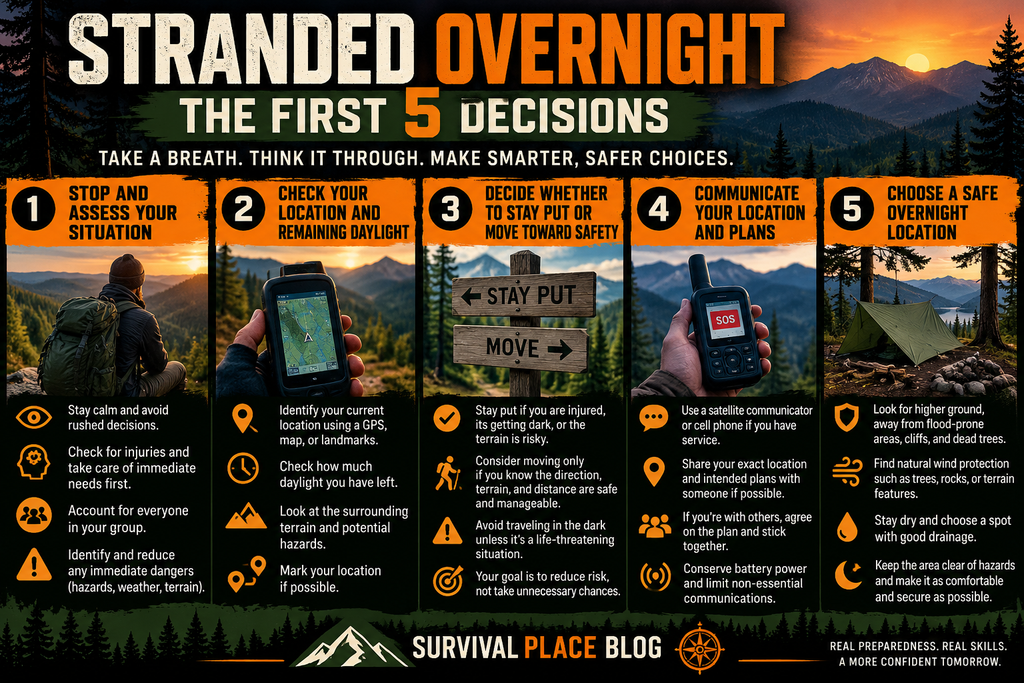
Should you keep walking? Stop and establish a temporary shelter? Contact someone? Move to a safer location? Wait until morning?
There is no universal answer.
This guide explains how to evaluate those decisions, manage available equipment, protect yourself from exposure, and prepare for a safe return or rescue.
The goal is not to turn every unexpected overnight into an elaborate survival exercise. It is to help you avoid making a manageable situation worse.
1. Why Unexpected Overnights Happen
Most people who become stranded overnight did not intend to spend the night outdoors.
The situation often begins with a series of small decisions rather than one dramatic mistake.
Common causes include:
- Underestimating the distance back to the trailhead.
- Spending longer than expected hunting, fishing, photographing, or exploring.
- Taking an unfamiliar trail or missing a junction.
- Slower travel caused by difficult terrain.
- Fatigue, dehydration, or a minor injury.
- Sudden weather changes.
- Equipment failure.
- Losing access to a planned route.
- Overestimating the amount of daylight remaining.
A person may know exactly where they are and still be unable to return safely before dark.
This distinction is important.
Being stranded is not always the same as being lost.
If you know your location, understand your route, and have appropriate equipment, an unplanned overnight may be manageable.
If you are disoriented, injured, exposed to severe weather, or unable to contact anyone, the situation may require emergency assistance.
The first step is recognizing which circumstances you are actually facing.
2. Losing Track of Time or Underestimating the Return Distance
Time can disappear quickly during outdoor activities.
A hunter may spend hours watching a clearing. A hiker may stop repeatedly for photographs. Someone fishing along a remote stream may continue farther upstream without realizing how much distance they have covered.
The outward trip can also feel easier than the return.
Descending a trail, crossing difficult terrain, or navigating around obstacles may take longer than expected.
The Return Trip Is Not Always Equal
Before assuming you have enough time to get back, consider:
- Actual distance remaining.
- Elevation gain and loss.
- Trail conditions.
- Fatigue and physical limitations.
- Weather changes.
- Navigation uncertainty.
- Available daylight.
- Whether you must cross difficult terrain.
Do not estimate your return time solely by remembering how long the outward journey took.
Recognize the Warning Signs
You may be approaching an unsafe return when:
- The sun is nearing the horizon.
- Familiar landmarks become harder to identify.
- You are moving slower than planned.
- You are uncertain about the next trail junction.
- Your headlamp is missing or has limited battery life.
- The route contains steep, rocky, or exposed sections.
- Weather is deteriorating.
These are signals to reassess, not reasons to hurry.
3. Recognize When Continuing Is No Longer Safe
One of the most important wilderness survival decisions is knowing when to stop traveling.
Continuing toward the trailhead may seem like the obvious choice. After all, home is somewhere ahead.
But determination cannot eliminate darkness, difficult terrain, or navigation uncertainty.
When Continuing May Be Reasonable
Continuing toward safety may be appropriate when:
- You know your exact location.
- The route is familiar and clearly identifiable.
- You have a reliable light source.
- Weather and terrain remain manageable.
- You are physically capable of completing the return.
- You have enough battery power and navigation information.
- Continuing does not create unreasonable risk.
A short walk along a well-maintained, familiar trail is very different from crossing steep, unfamiliar terrain in darkness.
When Stopping May Be Safer
Consider stopping when:
- You are uncertain about your location.
- The route becomes difficult to follow.
- You face dangerous terrain or crossings.
- You lack reliable lighting.
- Fatigue is affecting judgment.
- A companion is injured or becoming ill.
- Weather conditions make travel unsafe.
Do not turn an unexpected overnight into a serious injury by rushing through unfamiliar terrain after dark.
If someone in your group is already injured and cannot safely continue, read our guide, Injured on a Wilderness Trail: What to Do When You Can’t Walk Out. It explains how to assess immediate hazards, avoid worsening an injury, request assistance, and protect the injured person while waiting for rescue.
However, remaining in place is not always the correct decision either.
Immediate hazards may require movement to a safer location.
The objective is to choose the option with the lowest reasonable risk.
4. Stop, Assess Your Location, and Evaluate Daylight
Once you realize you may not make it home as planned, stop long enough to assess the situation.
Avoid walking aimlessly while trying to decide what to do.
Determine Your Location
Use available resources:
- A map and compass.
- A GPS receiver.
- Offline maps on your phone.
- Known trail junctions.
- Terrain features.
- Signs or trail markers.
- Previously recorded coordinates.
If your position is uncertain, do not invent a location based on guesswork.
For a more detailed explanation of finding your position and navigating without electronic assistance, see our guide, Wilderness Navigation: How to Navigate Without GPS.
Evaluate Remaining Daylight
Check the actual local sunset time if available.
Remember that valleys, dense forests, and steep mountains may become difficult to navigate before the official sunset.
Do not assume you have another hour of usable light simply because the sky still appears bright.
Check Your Resources
Take inventory of:
- Clothing and rain protection.
- Shelter equipment.
- Water and food.
- Navigation tools.
- Communication devices.
- Headlamps and batteries.
- First-aid supplies.
- Fire-starting equipment.
- Signaling devices.
This inventory helps determine whether you should remain nearby, relocate a short distance, or request assistance.
5. Emergency Communication and Location Sharing
If you expect to be delayed, communicate before your situation becomes more difficult.
When cellular service is available, contact the person who knows your trip plan.
Explain:
- Where you are.
- Whether you are safe or injured.
- Why you are delayed.
- Whether you intend to remain in place.
- When you expect to communicate again.
If you cannot return safely, are lost without a safe plan, face serious exposure risk, or require rescue, contact emergency services.
In the United States, call 911 for an emergency.
Share Useful Location Information
Provide GPS coordinates when possible, along with the trail name, recreation area, nearby landmarks, and any other information rescuers request.
Coordinates are most useful when communicated accurately and in the correct format.
When Cellular Service Is Unavailable
Some phones support emergency satellite messaging in certain regions and conditions. Learn how your device works before relying on that feature.
A registered personal locator beacon is another emergency communication option.
The Ocean Signal rescueME PLB1 Personal Locator Beacon can transmit an emergency distress alert through a compatible satellite rescue system when activated appropriately.
A PLB is intended for genuine emergencies. It is not a routine two-way messaging device, and registration and operating instructions matter.
If you have successfully contacted rescuers, follow their guidance about remaining in place, signaling, and any necessary movement.
6. Decide Whether to Stay Put or Move Toward Safety
The decision to remain in place or continue traveling depends on the circumstances.
Neither choice is automatically correct.
Reasons to Remain Nearby
Remaining in a known, reasonably safe location may be preferable when:
- Your location has been shared with rescuers.
- The route ahead is uncertain.
- Darkness makes navigation hazardous.
- You are exhausted or injured.
- The terrain is dangerous.
- You have sufficient protection to wait.
Remaining near a known location may also make it easier for rescuers to find you.
Reasons to Relocate
Movement may be necessary when:
- Your current location is exposed to falling rocks.
- Floodwater is rising.
- You are near an unstable slope.
- Wildfire threatens the area.
- A safer nearby location is accessible.
- Emergency responders direct you to move.
If you must relocate, move deliberately and avoid creating new hazards.
When possible, communicate your new position.
If You Are Actually Lost
Do not keep walking simply because you believe you should be making progress.
Stop, assess your position, and use reliable navigation information.
Our guide, Lost in the Woods? How to Survive and Get Rescued, explores lost-person decision-making and rescue preparation in greater detail.
7. Select a Safe Overnight Location
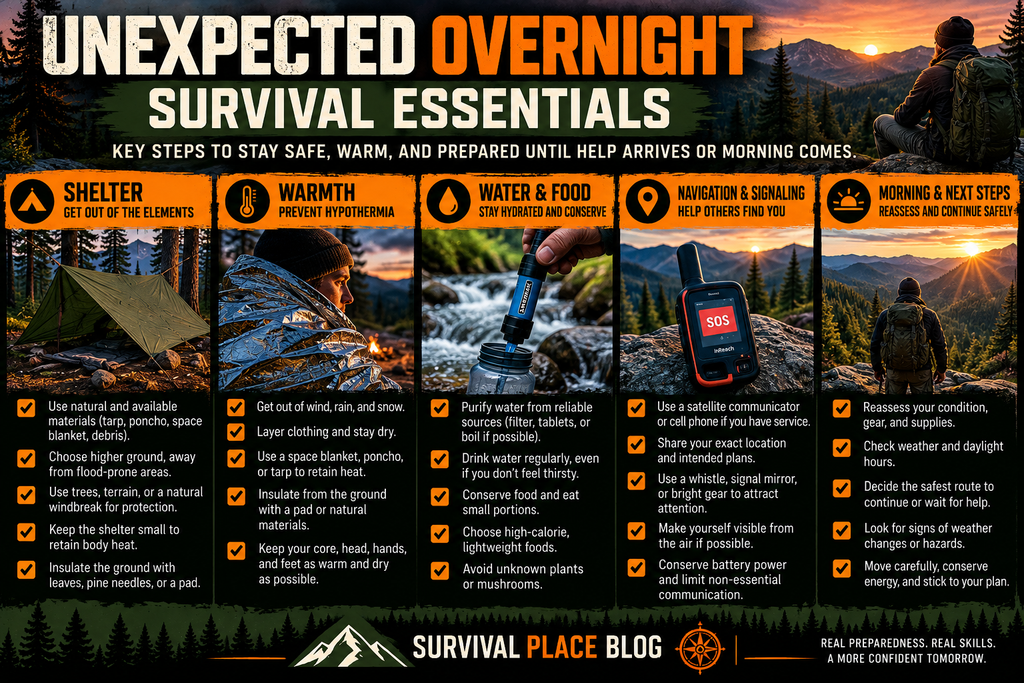
If spending the night outdoors becomes the safest practical option, choose your location carefully.
A suitable overnight location should reduce exposure without introducing additional danger.
Look for
- Relatively level, stable ground.
- Protection from prevailing wind where possible.
- Adequate drainage.
- Distance from unstable slopes.
- A location away from hazardous water crossings.
- Enough space to use available shelter equipment.
- Reasonable visibility for rescue, when appropriate.
Avoid
- Dry streambeds or flood-prone channels.
- Unstable cliffs and rockfall areas.
- Dead trees, hanging branches, or damaged timber.
- Exposed ridgelines during thunderstorms.
- Shorelines vulnerable to rising water.
- Areas with obvious wildlife or terrain hazards.
Before settling in for the night, look for signs of recent wildlife activity and avoid camping near animal carcasses or other obvious attractants. Store food and scented items according to local wildlife guidance. For a more detailed explanation of cougar and bear behavior, encounter prevention, and species-specific safety responses, read our guide, Dangerous Wildlife Encounters: How to Survive Cougars, Bears, and Other Threats.
Lightning Requires Special Attention
A tent, tarp, or emergency bivy is not lightning-safe shelter.
The National Weather Service explains that no outdoor location is safe during a thunderstorm. A substantial enclosed building or hard-topped vehicle offers the appropriate protection when accessible.
If no such shelter is reachable, use official outdoor lightning risk-reduction guidance while recognizing that risk remains.
Do not assume a rocky overhang, isolated tree, or improvised shelter provides lightning protection.
8. Create Emergency Shelter and Ground Insulation
Once you have selected a suitable location, focus on protection rather than building an elaborate shelter.
An unexpected overnight is not the time to begin a complicated construction project unless the circumstances genuinely require it.
Use What You Already Carry
Possible shelter options include:
- A lightweight tent.
- A tarp.
- An emergency bivy.
- A suitable rain shelter.
- An emergency blanket used as supplemental protection.
The S.O.L. Survive Outdoors Longer Emergency Bivvy is a compact option intended to provide emergency protection against heat loss and some wind and precipitation.
Another shelter option is the FREE SOLDIER Waterproof Camping Tarp Shelter. This lightweight, packable tarp can provide overhead protection from rain and wind when properly secured. It offers a more versatile shelter setup than an emergency bivy, although it requires suitable anchor points, a reliable setup, and additional insulation for cold conditions.
Its usefulness depends on the conditions, the user’s clothing and insulation, and proper use.
Ground Insulation Matters
Lying directly on cold or wet ground can increase heat loss.
Use an appropriate sleeping pad or available dry insulating material when it can be used safely and without unnecessary environmental damage.
Keep the Setup Simple
Prioritize:
- Protection from precipitation.
- Protection from wind.
- Insulation from the ground.
- Dry clothing and equipment.
- Adequate ventilation.
For detailed shelter types, construction methods, and location selection, see Emergency Outdoor Shelter: How to Choose, Build, and Survive the Night.
The purpose here is to get through the night safely, not to build a permanent campsite.
9. Manage Cold, Wind, Rain, and Exposure Hazards
Exposure can become one of the most serious threats during an unplanned overnight.
Cold conditions are especially concerning when clothing is wet, wind is strong, or a person is exhausted.
Protect Against Heat Loss
- Put on dry insulating layers when available.
- Wear a hat and protect exposed skin.
- Use wind and rain protection.
- Insulate yourself from cold ground.
- Avoid unnecessary sweating and exertion.
- Keep sleeping equipment dry.
Watch for Signs of Hypothermia
Warning signs can include:
- Uncontrolled shivering.
- Confusion.
- Poor coordination.
- Slurred speech.
- Unusual drowsiness.
- Declining responsiveness.
Suspected hypothermia requires prompt attention and may require emergency medical assistance.
Move the person to a safer environment when feasible, prevent further heat loss, and follow recognized first-aid guidance. Do not attempt aggressive rewarming methods beyond your training.
For related emergency assessment and care principles, read Wilderness First Aid: Essential Skills for Outdoor Emergencies.
Fire Is Not Always the Answer
A fire may provide warmth in suitable circumstances, but it can also create serious hazards.
Before considering one, evaluate:
- Current fire restrictions.
- Wildfire conditions.
- Available fuel.
- Wind and precipitation.
- Whether you can maintain control.
- Whether starting a fire is actually necessary.
Do not build a fire where it is prohibited or where it could escape.
For detailed fire-starting methods and safety precautions, see Wilderness Fire Starting: Methods, Tinder and Fire Safety.
Shelter, dry insulation, and exposure management should not depend entirely on successfully starting a fire.
10. Conserve Equipment, Batteries, Energy, and Supplies
An unexpected overnight requires careful resource management.
The goal is not to preserve every item at the expense of safety. It is to avoid waste while meeting immediate needs.
Battery Management
Your phone may be your most valuable communication and navigation tool.
- Reduce unnecessary screen use.
- Close nonessential applications.
- Use battery-saving settings when appropriate.
- Keep devices protected from extreme temperatures.
- Maintain enough power for emergency communication.
- Use a backup power source if available.
Do not switch off a device when emergency responders have instructed you to remain reachable.
Lighting
Use a headlamp when you need to move safely, organize equipment, or communicate with others.
A reliable headlamp is more practical than holding a phone flashlight while working with both hands.
The Energizer Universal LED Headlamp is a practical hands-free lighting option for hiking, organizing emergency equipment, and handling unexpected overnight situations. Carrying a dependable headlamp with working batteries can make a significant difference when daylight runs out.
Water
Maintain appropriate hydration.
Do not intentionally dehydrate yourself to conserve water.
If you must collect water, use a suitable treatment method. Clear-looking wilderness water is not necessarily safe to drink.
The Sawyer Mini Water Filter can be a compact component of a wilderness water-treatment kit, provided its limitations and instructions are understood.
Food
For a generally healthy adult, food is usually a lower immediate priority during a single unexpected overnight than shelter, temperature regulation, safe water, and communication.
Eat available food as appropriate, especially if exertion and cold conditions increase energy needs.
Physical Energy
Avoid unnecessary travel, complicated shelter projects, or repeated attempts to find a route in darkness.
Conserving energy supports clearer decision-making and reduces fatigue.
11. Respond When Important Gear Is Missing or Damaged
An unexpected overnight becomes more difficult when essential equipment is unavailable.
However, missing gear does not automatically mean you must continue traveling.
No Headlamp
If darkness makes travel unsafe, consider remaining in a safe location until visibility improves.
Do not attempt difficult navigation by relying solely on moonlight or a nearly depleted phone.
No Shelter
Use available clothing and equipment to reduce wind, rain, and ground exposure.
Seek a safer, naturally protected location when appropriate, but avoid unstable overhangs, flood channels, and other hazards.
No Reliable Navigation
Avoid wandering.
Use known landmarks and any remaining map information, and contact emergency services when necessary.
No Water Filter
Do not assume a stream or lake is safe because the water appears clean.
Use another recognized treatment method if available and appropriate. If you cannot make water safe, weigh the risks of dehydration and contaminated water based on the circumstances, and seek professional rescue guidance when possible.
No Communication Signal
Check whether your device offers emergency satellite capabilities.
If you cannot communicate, make your location easier to identify without exposing yourself to danger.
Missing equipment should change your plan—not push you into an unnecessarily risky improvisation.
12. Signal Safely and Prepare for Rescue
If you have requested rescue or someone is searching for you, visibility and communication become important.
Possible signaling tools include:
- A whistle.
- A headlamp.
- Brightly colored clothing.
- A reflective signaling mirror.
- A brightly colored tarp or shelter.
- An emergency beacon.
A compact signaling whistle, such as the LuxoGear Emergency Whistles with Lanyard, provides a battery-free way to attract attention.
Make Your Location Easier to Identify
Use visible equipment in a reasonably open, safe location when appropriate.
Do not climb dangerous terrain or leave a known location simply to improve visibility.
Follow Rescue Instructions
If you have communicated with rescuers, follow their guidance.
Keep communication equipment accessible and provide updates if conditions or your location change.
Avoid Dangerous Signals
Do not start an uncontrolled fire or create smoke where wildfire danger or fire restrictions make it unsafe.
Do not enter exposed terrain during lightning or other severe weather solely to attract attention.
Your signaling efforts should reduce uncertainty for rescuers, not increase the danger to you.
13. Reassess Conditions at Daylight
Morning provides better visibility, but it does not automatically mean travel is safe.
Before packing up and leaving, reassess the situation.
Check Your Condition
Ask yourself:
- Am I alert and thinking clearly?
- Am I injured?
- Am I unusually weak, cold, or dehydrated?
- Is anyone in my group unable to continue safely?
Reevaluate the Route
Consider:
- Current weather.
- Trail visibility.
- Distance to safety.
- Terrain and water crossings.
- Remaining supplies.
- Available navigation information.
- Whether rescuers are already responding.
If Rescue Has Been Requested
Do not leave your location without coordinating with emergency responders when communication is possible.
An unexpected departure can complicate a search and place rescuers at unnecessary risk.
If You Can Return Safely
If no rescue is underway and you have a reliable route, adequate physical ability, and suitable conditions, a deliberate return may be appropriate.
Tell your trip contact about your plans when possible.
Do not assume that sunrise alone makes yesterday’s hazardous route safe.
14. Prevention: Turnaround Times, Trip Plans, and Essential Supplies
The best unexpected overnight is one that never happens.
Preparation cannot eliminate every problem, but it can reduce the likelihood of becoming stranded and improve your options if plans change.
Establish a Turnaround Time
Before leaving, decide when you must begin returning.
Your turnaround time should account for:
- Total distance.
- Elevation and terrain.
- Your pace.
- Weather.
- Seasonal daylight.
- A reasonable safety margin.
Treat the turnaround time as a decision point, not a suggestion you can repeatedly extend.
Share a Trip Plan
Tell a trusted person:
- Where you are going.
- Your planned route.
- Who is accompanying you.
- Your expected return time.
- When they should seek assistance if you do not check in.
Make sure the contact understands what to do if you are overdue.
Carry Appropriate Essentials
Even for a short day hike, consider carrying:
- Navigation tools and offline maps.
- A headlamp with adequate battery power.
- Extra clothing and rain protection.
- Water and suitable treatment equipment.
- Food.
- First-aid supplies.
- Emergency shelter or bivy.
- A whistle.
- Communication equipment.
- Fire-starting supplies where appropriate and legal.
Equipment should match the terrain, season, weather, remoteness, and your experience.
Real-World Scenario: A Hunter Runs Out of Daylight
A hunter leaves the trailhead early in the morning and hikes into a forested area several miles from the nearest road.
After reaching a promising location, he spends most of the afternoon watching for wildlife.
He believes the return trip will be straightforward.
By the time he begins packing, however, the sun is already low. The route back crosses uneven terrain and several poorly marked junctions.
He initially considers walking quickly to beat the darkness.
Instead, he checks his offline map and estimates the remaining distance.
He realizes that he cannot confidently complete the return before losing visibility.
His headlamp works, but the route includes steep, unfamiliar terrain. Continuing would introduce unnecessary risk.
He contacts his trip partner while cellular service is still available, shares his location, and explains that he may remain overnight.
After evaluating nearby hazards, he selects a stable location away from drainage channels and dead trees.
He uses his emergency bivy, dry clothing, and ground insulation to reduce exposure.
He keeps his phone accessible, organizes his supplies, and avoids unnecessary movement.
At daylight, he checks the weather and route again, confirms his condition, and contacts his trip partner before beginning a careful return.
What Made the Difference?
The hunter did not rely on extraordinary wilderness survival skills.
He recognized that his original plan was no longer realistic.
He stopped before darkness created additional hazards, communicated his location, protected himself from exposure, and reassessed the situation in daylight.
His most important survival tool was good judgment.
Unexpected Overnight Wilderness Checklist
Use this checklist when an outdoor trip may extend beyond the planned return time.
Assess the Situation
- Stop and determine your location.
- Check remaining daylight and weather.
- Assess injuries, fatigue, and immediate hazards.
- Decide whether travel or remaining nearby is safer.
Communicate
- Contact your trip partner or emergency services as appropriate.
- Share accurate coordinates or landmarks.
- Explain your condition and intended actions.
- Follow rescue instructions if assistance is underway.
Prepare for the Night
- Choose a location away from obvious hazards.
- Set up available emergency shelter.
- Insulate yourself from the ground.
- Protect clothing and equipment from moisture.
- Organize water, food, lighting, and communication devices.
Prepare for Morning
- Monitor weather and physical condition.
- Reassess the route in daylight.
- Coordinate with rescuers if applicable.
- Communicate your updated return plan when possible.
An unexpected night in the wilderness can become dangerous when darkness, changing weather, and limited supplies complicate your plans. To help you stay organized and make safer decisions, we’ve created a free Unexpected Overnight Wilderness Safety Checklist. This printable two-page guide walks you through assessing your situation, communicating your location, finding safe shelter, managing exposure, and preparing for daylight or rescue. Download a copy and keep it with your hiking or hunting gear before your next outdoor adventure.
Conclusion: An Unexpected Night Does Not Have to Become a Disaster
Getting stranded overnight in the wilderness can be unsettling, particularly when the situation develops during an otherwise ordinary hike, hunt, or outdoor trip.
The key is recognizing when your original plan is no longer safe.
Instead of rushing toward the trailhead, assess your location, remaining daylight, terrain, weather, and available resources.
Communicate when possible. Choose a safe location. Protect yourself from exposure. Conserve useful equipment and energy. Prepare for rescue if needed.
When daylight returns, reassess before traveling.
Wilderness survival is not always about doing more. Sometimes the most important decision is knowing when to stop, protect yourself, and wait for safer conditions.