
Affiliate Disclosure: This post contains affiliate links. If you purchase through these links, Survival Place Blog may earn a commission at no additional cost to you. As an Amazon Associate I earn from qualifying purchases.
A quiet wilderness trail can change quickly when you realize a large animal is nearby.
You might hear movement in the timber while hunting, discover a bear feeding near your intended campsite, or encounter a cougar while hiking through unfamiliar country.
These situations deserve attention, but the presence of a wild animal does not automatically mean an attack is imminent.
Most wildlife would rather avoid unnecessary conflict with people. The challenge is recognizing when ordinary animal behavior becomes a genuine safety concern and understanding how to respond appropriately.
Dangerous wildlife encounters require different responses depending on the species, its behavior, and the circumstances. What may help during a cougar attack could make a defensive grizzly bear attack worse.
This guide explains how hikers, hunters, and campers can reduce wildlife risks, recognize warning signs, and respond more safely to cougars, black bears, grizzlies, and other potentially dangerous animals.
1. Understanding Wildlife Risks Without Unnecessary Fear
Wildlife is part of the wilderness experience.
Seeing a bear crossing a distant meadow, discovering cougar tracks, or watching elk feed along a hillside does not automatically indicate danger.
Animals have natural territories, feeding areas, travel routes, and defensive instincts.
A bear standing on its hind legs may simply be trying to identify a scent. A cougar moving through the forest may be traveling through its territory. An elk that appears calm can still react aggressively when approached.
Three principles help put wildlife encounters into perspective.
Distance Matters
Wild animals need room to move without feeling trapped or threatened. Approaching wildlife for photographs or a closer look increases the possibility of conflict.
Behavior Matters
An animal’s actions, surroundings, and response to your presence are often more informative than its mere appearance.
Species Matters
Cougars, black bears, grizzlies, moose, and other large animals do not all respond to people in the same way.
Wildlife attacks are uncommon, but serious injuries can occur. The goal is to respect the possibility of danger without treating every animal as an immediate threat.
2. How to Reduce Dangerous Wildlife Encounters
Prevention begins before you reach the trailhead.
Research the wildlife found in your destination, including seasonal activity, recent warnings, and any special restrictions.
Check with park rangers or local wildlife agencies when traveling through unfamiliar habitat.
Practical Wildlife Prevention Habits
- Stay alert to movement, sounds, and changes in your surroundings.
- Travel in groups when practical.
- Avoid surprising wildlife at close range.
- Keep children nearby and pets under control.
- Give animals generous space.
- Never approach or feed wild animals.
- Avoid carcasses and animals with young.
- Follow local food-storage requirements.
- Carry appropriate emergency communication equipment.
- Learn the encounter recommendations for the species in your area.
In bear country, make your presence known when approaching blind corners, thick vegetation, or noisy streams where animals may have difficulty hearing you.
You do not need to shout continuously. The purpose is to reduce surprise encounters, not deliberately disturb wildlife.
For more guidance on choosing campsites and preparing for outdoor trips, see our guide, Camping for Beginners: How to Plan Your First Camping Trip.
3. Wildlife Awareness While Hiking, Hunting, and Camping
Different outdoor activities create different opportunities for wildlife encounters.
While Hiking
Watch the trail ahead and periodically scan the surrounding terrain.
Pay particular attention to dense vegetation, blind turns, animal trails, and places where visibility is limited.
Avoid headphones that prevent you from hearing movement nearby.
While Hunting
Hunters often move quietly through remote terrain and may spend extended periods near wildlife travel routes.
Remain aware of your surroundings, especially when approaching a harvested animal or handling meat.
Large predators may be attracted to carcasses. If you discover that a bear or cougar has claimed an animal, withdraw rather than attempting to approach or recover it.
While Camping
Food odors, unsecured garbage, pet food, and improperly stored cooking equipment can attract wildlife.
Keep a clean campsite and follow the food-storage rules for the area.
Recognizing Signs of Wildlife Activity
Tracks, scat, scratches, disturbed vegetation, and animal remains can indicate wildlife activity.
However, tracks alone do not prove an animal is nearby or behaving aggressively.
Fresh carcasses, repeated close approaches, or an animal persistently following people deserve greater caution.
If you discover evidence of a potentially dangerous situation, avoid investigating it unnecessarily.
4. Recognizing Cougar Activity and Potentially Threatening Behavior
Cougars, also called mountain lions or pumas, inhabit parts of western North America.
They are powerful predators, but attacks on people are rare.
Most cougars avoid direct contact with humans.
Seeing a cougar does not automatically mean you are being hunted.
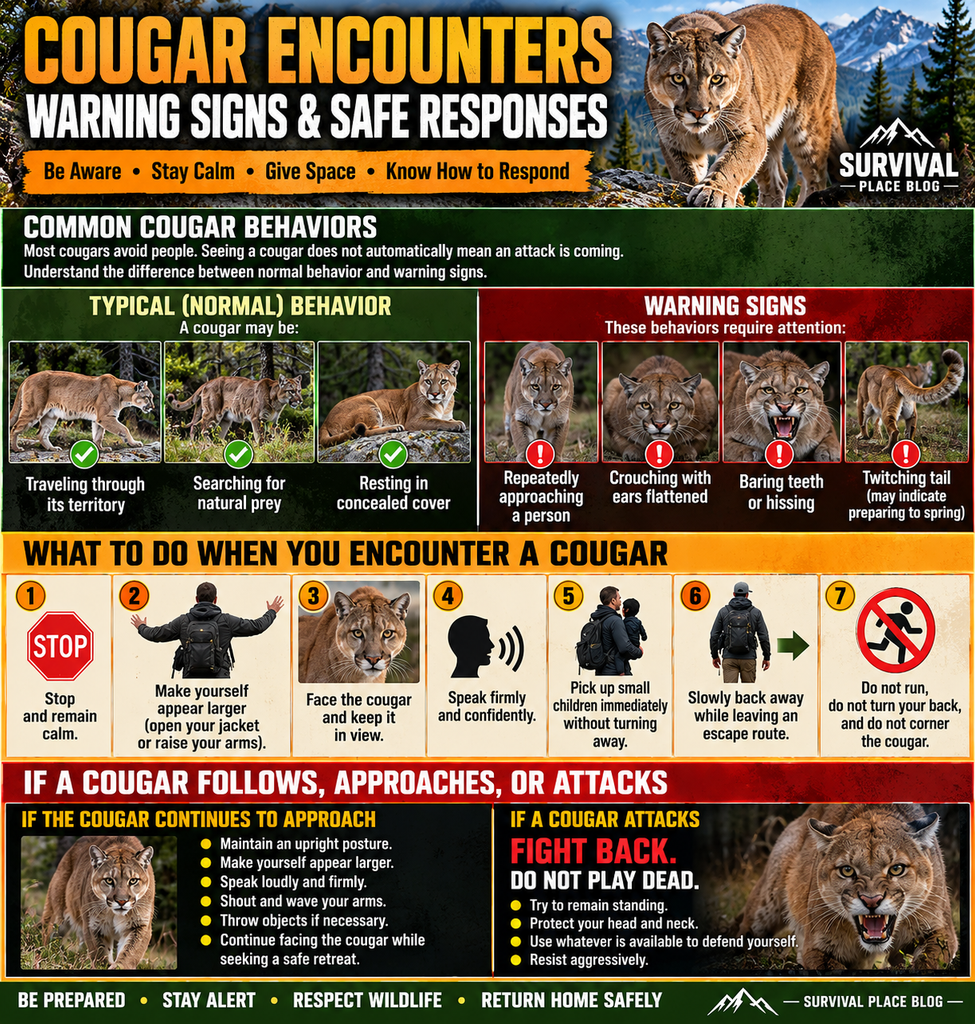
Normal Cougar Activity
A cougar may be:
- Traveling through its territory.
- Searching for natural prey.
- Resting in concealed cover.
- Moving along a wildlife corridor.
- Investigating unfamiliar sounds or movement.
Warning Signs That Require Attention
Potentially threatening behavior can include:
- Repeatedly approaching a person.
- Following someone rather than moving away.
- Crouching with ears flattened.
- Baring teeth or hissing.
- Twitching its tail while displaying other aggressive signals.
- Moving its hind feet as though preparing to spring.
Not every movement has a single explanation. Evaluate the overall situation rather than assuming one behavior proves an attack is coming.
For additional species-specific information, consult the Washington Department of Fish & Wildlife’s cougar safety guidance.
Firsthand Experience: A Cougar in the Timber While Elk Hunting
During an elk hunt, my hunting partner and I found ourselves at the bottom of a partially clear-cut hillside with approximately two feet of snow on the ground.
We decided to work our way uphill along opposite sides of the clearing, each following a separate tree line. We were roughly 300 yards apart, with plans to meet at the top of the hill.
I took the right side, traveling about 20 yards from the timber.
As I worked uphill, I began hearing something moving just inside the trees. At first, I couldn’t tell what it was. But I noticed something unusual.
Every time I stopped walking, the sound stopped.
Every time I started moving again, I could hear what sounded like snow crunching beneath something moving through the timber.
This continued as I climbed the hillside.
I kept moving, watching my flank and paying close attention to the tree line. I couldn’t see anything, but the repeated sounds told me something was moving nearby.
When I finally reached the top of the hill, I found a large stump I could climb onto. From there, I faced the timber, waited, and listened with my rifle ready.
A short time later, my hunting partner approached from behind and startled me. I turned quickly, only to discover it was him.
I explained that something had been following me up the hill.
Naturally, he was skeptical.
We decided to investigate the area where I’d been hearing the movement.
As we approached the tree line, a cougar suddenly jumped away and disappeared down the backside of the ridge.
That confirmed what I’d been hearing throughout the climb: a cougar had been moving through the timber alongside me.
I can’t say with certainty what the cougar intended. It may have been curious, following my movement, or behaving in some other way. But I knew something was there long before I actually saw it.
The lesson I took from that experience is simple: Always pay attention to your surroundings. When you’re hunting in the wilderness, you might not be the only thing out there hunting.
This experience illustrates the value of recognizing unusual patterns in your surroundings. It is not a recommendation to approach a suspected predator or investigate concealed movement. If you suspect a dangerous animal is nearby, prioritize distance, visibility, and a safe route away.
5. What to Do When You Encounter a Cougar
If you unexpectedly encounter a cougar, stop and remain calm.
Do not run. Rapid movement may trigger a chase response.
Recommended Cougar Encounter Response
- Stop and face the cougar.
- Pick up small children immediately without unnecessarily bending or turning away.
- Remain upright and keep the animal in view.
- Make yourself appear larger by opening your jacket or raising your arms.
- Speak firmly and confidently.
- Slowly back away while leaving the animal an escape route.
- Avoid approaching, cornering, or blocking the cougar.
If traveling with companions, stay together rather than scattering.
Never approach a cougar near kittens or a carcass.
The objective is to show that you are not easy prey while giving the animal an opportunity to leave.
6. What to Do if a Cougar Follows, Approaches, or Attacks
A cougar that continues approaching or following you despite your attempts to create distance requires a more assertive response.
If the Cougar Becomes Aggressive
- Maintain an upright posture.
- Make yourself appear larger.
- Speak loudly and firmly.
- Shout and wave your arms if the animal does not retreat.
- Throw available objects toward the animal if necessary to discourage its approach.
- Continue facing the cougar while seeking a safe retreat.
Do not turn your back or run.
If a Cougar Attacks
Fight back. Do not play dead.
Try to remain standing and protect your head and neck.
Use available objects to defend yourself. Wildlife agencies recommend resisting aggressively rather than becoming passive.
If you escape an attack, reach safety and seek emergency medical care.
Animal bites and scratches can cause serious infections and other complications, even when the wounds initially appear minor.
If an injury leaves you or a companion unable to safely walk out of the wilderness, our guide, Injured on a Wilderness Trail: What to Do When You Can’t Walk Out, explains how to assess immediate hazards, request emergency assistance, and protect the injured person while waiting for rescue.
For more information about handling injuries during outdoor emergencies, see our guide, Wilderness First Aid: Essential Skills for Outdoor Emergencies.
7. Understanding Black Bears and Grizzly Bears
Black bears and grizzly bears share some behaviors, but important differences affect how people should respond during an attack.
Correct identification is useful, although the animal’s behavior and circumstances also matter.
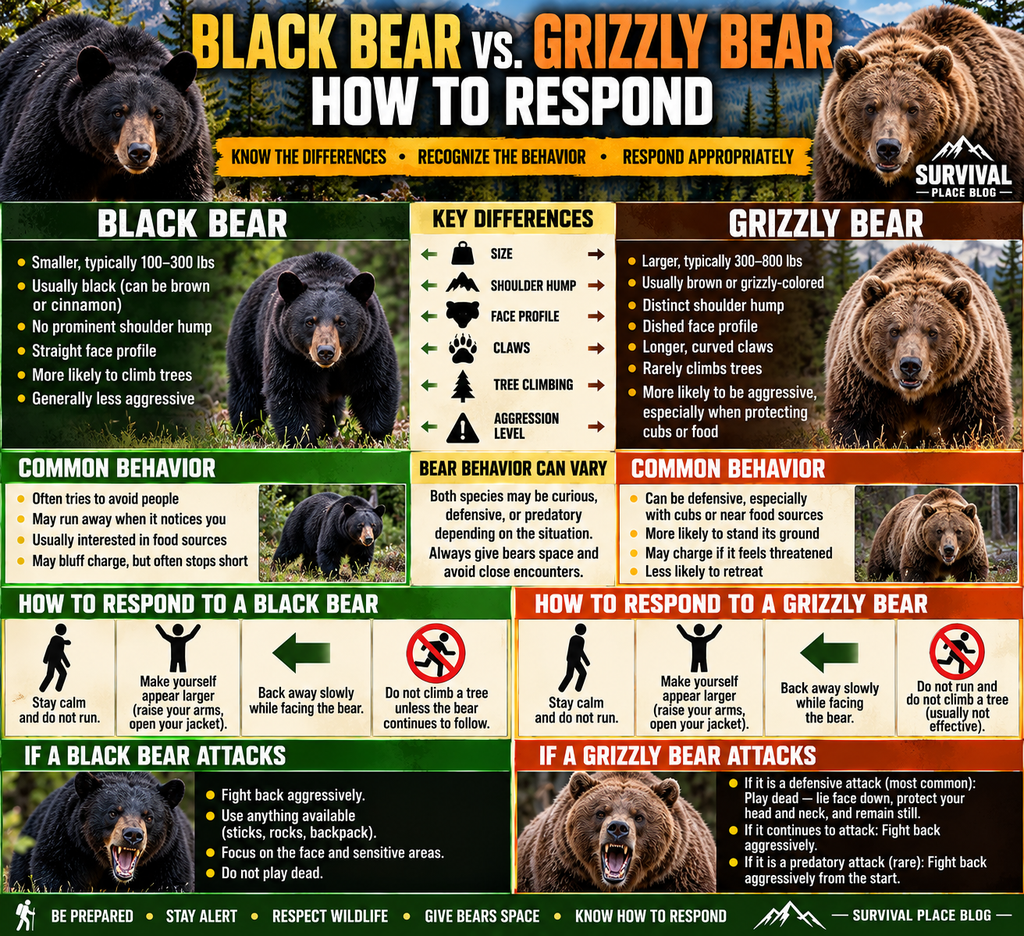
American Black Bears
Black bears inhabit large portions of North America.
Despite their name, they may have black, brown, cinnamon, or other coat colors.
They generally lack the prominent shoulder hump associated with grizzly bears.
Their facial profile is usually straighter, and their ears often appear relatively taller.
Grizzly Bears
Grizzlies are a North American form of brown bear.
They typically have a noticeable shoulder hump, a more dished facial profile, and relatively short, rounded ears.
Their range includes Alaska, western Canada, and portions of the northwestern United States.
Never Identify a Bear by Color Alone
A brown-colored bear is not necessarily a grizzly.
Use multiple physical characteristics and knowledge of the region.
The National Park Service provides additional information about bear behavior and safety.
If you cannot confidently identify a bear, focus on avoiding escalation and creating safe distance rather than making assumptions.
8. Recognizing Defensive Versus Potentially Predatory Bear Behavior
Understanding why a bear is reacting to you can be critical.
Defensive Bear Behavior
A defensive bear may believe it needs to protect itself, its cubs, its food, or its personal space.
This can happen when someone unexpectedly approaches a bear at close range.
Warning behaviors may include:
- Huffing or forceful breathing.
- Jaw popping or teeth clacking.
- Ground slapping.
- Bluff charging.
- Defensive posturing.
A bear standing upright is not necessarily threatening. It may simply be trying to see or smell something more clearly.
Potentially Predatory or Non-Defensive Behavior
A bear that persistently follows, stalks, or approaches a person without an obvious defensive trigger may present a different threat.
Some bears also become conditioned to human food and lose their natural reluctance to approach people.
Curiosity does not automatically mean predatory intent. However, persistent attention and continued close approaches should be treated seriously.
Why This Distinction Matters
A defensive grizzly attack may require playing dead once the bear makes contact.
A black bear attack or predatory attack by either species requires a different response.
Never assume playing dead is appropriate for every bear attack.
The National Park Service explains these distinctions in its guidance on bear attacks.
9. Species-Specific Bear Encounter Responses
When you encounter a bear, remain calm and avoid running.
Speak in a calm voice so the bear can recognize you as a person.
Do not approach the animal or block its escape route.
If it is safe to withdraw, move away slowly while remaining aware of the bear.
Keep your backpack on because it may provide protection.
Encountering a Black Bear
If a black bear notices you, give it space.
Avoid surprising, cornering, or approaching it.
If the bear continues approaching, follow local wildlife-agency recommendations for assertive deterrence.
If a black bear attacks, do not play dead.
Try to escape to a secure location, such as a building or vehicle, if possible.
If escape is not possible, fight back vigorously using available objects.
Encountering a Grizzly Bear
If you surprise a grizzly, avoid sudden or threatening movements.
Speak calmly and back away slowly when safe.
A bear may bluff charge, stopping short or turning away. Do not run from a charging bear.
Have bear spray accessible and be prepared to use it according to your training and the manufacturer’s instructions.
If a defensive grizzly attack makes physical contact:
- Leave your backpack on.
- Lie face down.
- Protect the back of your head and neck with your hands and arms.
- Spread your legs to make it harder for the bear to turn you over.
- Remain still until the bear has left.
Do not immediately get up when the attack stops.
If the attack persists, fight back vigorously.
If Either Bear Species Acts Predatory
If a bear stalks you and attacks, or attacks you inside your tent, do not play dead.
Seek secure shelter if possible.
If attacked, fight back aggressively using whatever is available.
Bear Spray as a Defensive Tool
EPA-registered bear spray is an important defensive option in bear country where permitted.
Carry it somewhere immediately accessible, learn how to deploy it before your trip, and understand its limitations.
Bear spray is not the same as ordinary personal-defense pepper spray.
It is also not a general-purpose repellent to spray on tents, clothing, or equipment.
Before carrying bear spray, check local regulations and review the National Park Service’s bear spray safety recommendations.
10. Food Storage and Avoiding Wildlife Attractions
Improper food storage can turn a campsite into an avoidable wildlife hazard.
Bears and other animals may learn to associate people with accessible food.
That behavior can increase risks for both visitors and wildlife.
Secure Food and Scented Items
Depending on local regulations, appropriate storage methods may include:
- Approved bear-resistant food containers.
- Designated food-storage lockers.
- Approved food-hanging systems where permitted.
- Other methods required by the managing agency.
Store food, garbage, pet food, cooking equipment, and scented items according to local rules.
Never assume an ordinary backpack or a bag hanging from a low tree branch provides adequate protection.
Keep Your Campsite Clean
- Secure food immediately after use.
- Clean cooking equipment.
- Pack out food scraps and garbage.
- Never intentionally feed wildlife.
- Do not store food or scented items in your sleeping shelter.
- Follow local instructions for separating cooking, storage, and sleeping areas.
The National Park Service explains why food storage is essential for protecting both people and bears.
If an unexpected delay forces you to remain outdoors after dark, choosing a safe overnight location and managing your supplies becomes especially important. Our guide, Stranded Overnight in the Wilderness: What to Do When You Can’t Get Home, explains how to make those decisions when your original return plan is no longer safe.
11. Other Dangerous Wildlife Encounters to Understand
Cougars and bears receive considerable attention, but other animals can also cause serious injuries.
The relevant risks depend on where you travel.
Moose
Moose are powerful animals that may charge when threatened, especially cows protecting calves.
Give them substantial space.
If a moose becomes aggressive or charges, retreat to safety. A large tree, vehicle, or other substantial barrier may provide protection.
Unlike cougar and bear encounters, running to escape an aggressive moose can be appropriate.
Elk and Bison
Elk and bison can charge with little warning.
Never approach them for photographs or attempt to walk between adults and their young.
Follow park-specific distance requirements and seasonal advisories.
Venomous Snakes
Watch where you place your hands and feet, especially around rocks, brush, and fallen timber.
Give snakes room to retreat.
If bitten by a potentially venomous snake, seek emergency medical care promptly.
Do not cut the wound, apply a tourniquet, or attempt to suck out venom.
Wolves and Other Predators
Wild wolves generally avoid people, but unusual close approaches deserve attention.
Do not approach or feed predators.
Follow the encounter recommendations of the wildlife agency responsible for the region.
For broader guidance, consult the National Park Service’s wildlife safety information.
12. Protecting Children and Managing Group Encounters
Children may react unpredictably when frightened.
Before entering wildlife habitat, explain that wild animals must never be approached, even when they appear calm.
During a Cougar Encounter
Pick up small children immediately.
Keep everyone together, face the cougar, and avoid running.
During a Bear Encounter
Keep the group together and prevent sudden movements.
Speak calmly and follow species- and situation-specific recommendations.
Avoid screaming or scattering.
During Other Wildlife Encounters
Maintain distance and move toward safety using the appropriate response for that animal.
Keep pets under control and follow leash requirements.
Establish Group Safety Rules
Before your trip, agree to:
- Stay together when wildlife is nearby.
- Keep children within sight.
- Avoid approaching animals.
- Know who carries emergency communication equipment.
- Follow a coordinated plan during an encounter.
A little preparation can reduce confusion when an unexpected situation develops.
13. Reporting Dangerous Wildlife Encounters
Not every distant wildlife sighting is an emergency.
However, dangerous behavior should be reported to the appropriate wildlife authority.
Examples include:
- An animal attacking or injuring someone.
- A cougar repeatedly following or threatening people.
- A bear behaving aggressively near a developed recreation area.
- Wildlife repeatedly approaching people for food.
- An animal creating an immediate public safety threat.
Contact the park ranger, land-management agency, or state wildlife department responsible for the area.
For an immediate threat to life or serious injury in the United States, call 911 when service is available.
Information to Report
- Your location.
- Approximate time of the encounter.
- Species, if known.
- Number of animals.
- Observable behavior.
- Any injuries.
- Direction the animal traveled.
- Whether food, young animals, or a carcass was nearby.
Describe what you witnessed rather than guessing what the animal intended.
If a dangerous encounter leaves you disoriented or unable to return safely, our guide, Lost in the Woods? How to Survive and Get Rescued, explains additional wilderness emergency and rescue considerations.
14. Dangerous Wildlife Encounter Prevention Checklist
Preparation is one of the most effective ways to reduce wildlife risks.
Use this checklist before and during outdoor trips.
Before Your Trip
- Research wildlife species in the area.
- Check current park and wildlife advisories.
- Learn species-specific encounter responses.
- Review food-storage regulations.
- Share your route and expected return time.
- Carry appropriate emergency communication equipment.
- Check whether bear spray is recommended and permitted.
While Hiking, Hunting, or Camping
- Remain aware of your surroundings.
- Avoid surprising wildlife.
- Give animals plenty of space.
- Keep children close and pets controlled.
- Avoid carcasses and animals with young.
- Secure food and scented items.
- Stay together when traveling in a group.
During a Wildlife Encounter
- Identify the animal when possible.
- Observe its behavior without approaching.
- Avoid running from cougars or bears.
- Use species-specific safety guidance.
- Protect children and coordinate with companions.
- Seek emergency assistance when necessary.
After an Encounter
- Move to safety when possible.
- Check for injuries.
- Seek medical care for bites or scratches.
- Report dangerous behavior.
- Record the facts while they are fresh.
For a broader overview of outdoor equipment and preparation, see our Essential Camping Checklist.
Before your next hiking, hunting, or camping trip, download our free Dangerous Wildlife Encounter Safety Checklist. This printable two-page guide covers prevention, cougar encounters, black bear and grizzly bear safety, other wildlife hazards, and what to do after a dangerous encounter. Keep a copy with your outdoor gear for a quick reminder of the precautions and species-specific responses that matter.
Conclusion: Respect Wildlife, Recognize Warning Signs, and Make Safer Decisions
Wildlife is one of the things that makes spending time outdoors rewarding.
Seeing a cougar, bear, moose, or other large animal does not automatically mean you are in danger.
But knowing how to recognize warning signs and respond appropriately can make an important difference when an encounter becomes threatening.
Prevention comes first.
Stay alert, respect wildlife, secure food, and understand which animals inhabit your destination.
If an encounter occurs, consider the species, its behavior, and the surrounding circumstances before responding.
Never assume that the correct response to one animal applies to every other animal.
The goal is not to challenge wildlife or prove your courage. It is to avoid unnecessary conflict, protect yourself and your companions, and return home safely.