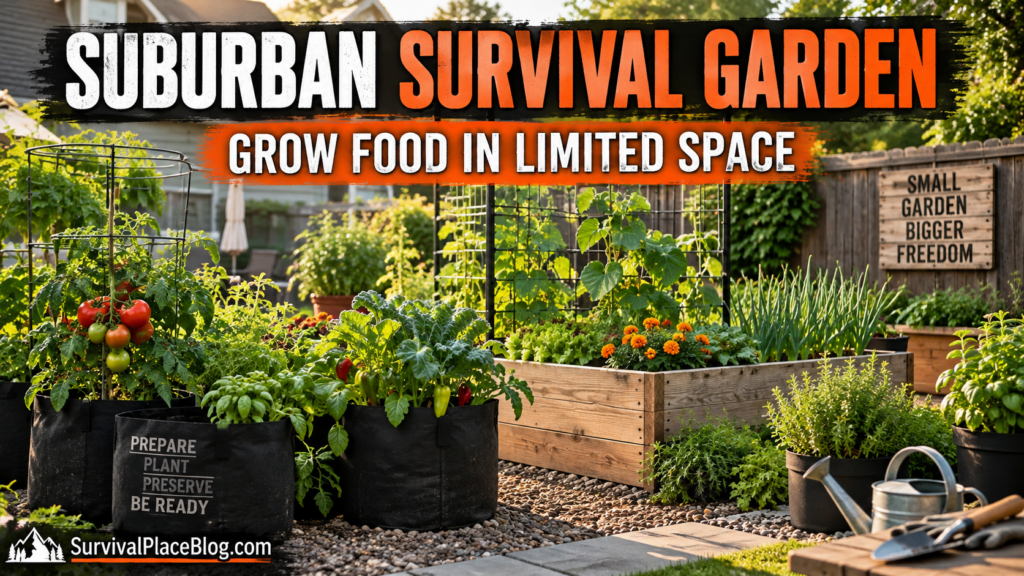
How to turn a backyard, side yard, patio, deck, or small suburban lot into a practical source of fresh food.
Affiliate Disclosure: This post contains affiliate links. If you purchase through these links, Survival Place Blog may earn a commission at no additional cost to you. As an Amazon Associate I earn from qualifying purchases.
A survival garden doesn’t require five acres, a tractor, or a rural homestead.
For many households, it starts with something much smaller:
A backyard.
A few raised beds.
A sunny side yard.
Several containers on a patio.
Maybe even a collection of grow bags on a driveway.
A well-planned suburban survival garden isn’t supposed to replace the grocery store overnight. Its purpose is to increase your household’s food resilience by producing useful crops where you already live.
That distinction matters.
Growing a few tomatoes is gardening.
Learning how to consistently produce vegetables, herbs, storage crops, and preserved food while improving your soil and expanding your growing capacity is preparedness.
You don’t need to grow everything.
You need to learn how to grow something reliably—and then build from there.
What Makes a Survival Garden Different?
A traditional backyard garden might be designed around whatever you enjoy growing.
There’s nothing wrong with that.
A survival-oriented garden asks additional questions:
- How much food does this crop produce?
- How much space does it require?
- How much water does it need?
- How long until harvest?
- Can I grow it more than once per season?
- Can I preserve the harvest?
- Will my family actually eat it?
- Can I save seed or reproduce the crop?
- Does it provide meaningful nutrition or calories?
That doesn’t mean every plant has to be a survival staple.
Fresh lettuce, herbs, tomatoes, and strawberries have value.
But when space is limited, understanding the difference between high-value fresh produce and calorie-producing crops helps you use your garden more effectively.
1. Start With Sunlight, Not Seed Catalogs
Before buying seeds, determine where plants can actually grow.
Most fruiting vegetables perform best with substantial direct sunlight. Tomatoes, peppers, squash, cucumbers, and beans generally need more sun than many leafy greens.
Spend a few days watching your property.
Look at:
- Backyard
- Front yard
- Side yards
- Patio
- Deck
- Driveway edges
- Fence lines
- South-facing walls
- Balcony
- Porch
Don’t assume the traditional garden spot is automatically the best one.
Your driveway may receive excellent sun while the backyard sits under mature trees.
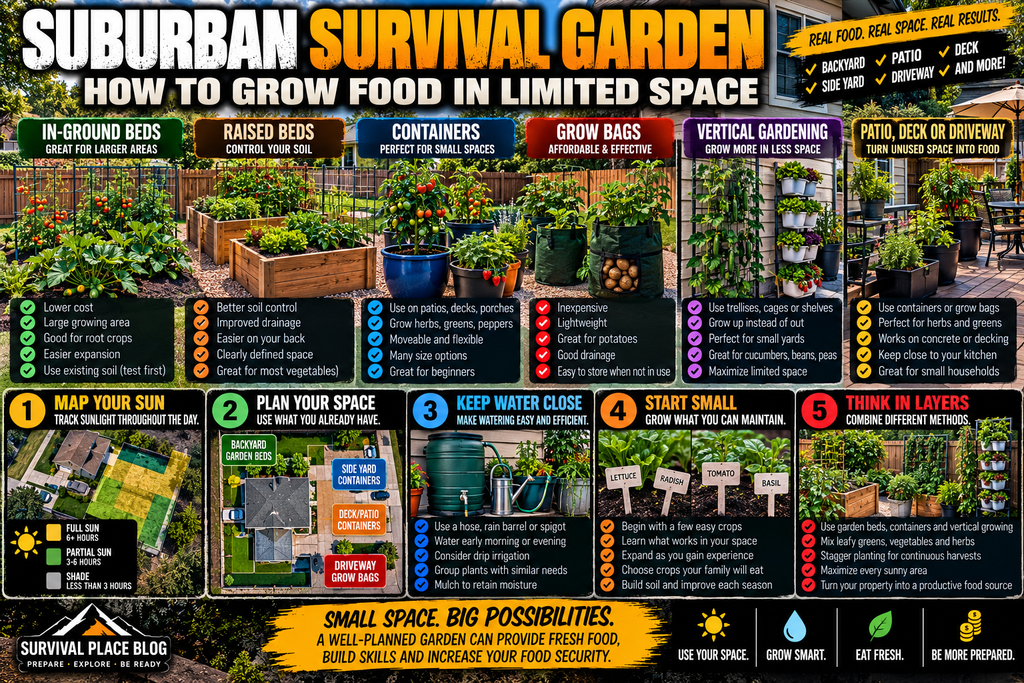
Map Your Sun
Make a simple property sketch.
Mark areas receiving:
- Full sun
- Partial sun
- Heavy shade
Remember that sunlight changes through the season as the sun angle changes and trees leaf out.
This simple exercise can prevent you from putting an expensive raised bed in the wrong place.
2. Decide How Much Space You Can Actually Maintain
It’s easy to build an ambitious garden in April.
Maintaining it in July is another matter.
Start with an area you can realistically:
- Water
- Weed
- Monitor
- Harvest
- Protect from pests
- Improve over time
A small productive garden beats a large neglected one.
If you’re new to gardening, one or two raised beds plus several containers can teach you a tremendous amount without becoming overwhelming.
You can expand after you’ve learned what works.
3. Use Every Type of Growing Space
A suburban survival garden doesn’t have to be one rectangular patch of dirt.
Think in layers.
In-Ground Beds
These can be inexpensive and productive when existing soil is suitable.
Advantages include:
- Less material to purchase
- Larger root zone
- Better moisture buffering than small containers
- Easy expansion
But first understand your soil.
Raised Beds
Raised beds can make gardening easier when:
- Native soil is poor
- Drainage is difficult
- You want better control over growing media
- Bending and kneeling are difficult
- You want clearly defined growing areas
The downside is cost.
A large raised-bed garden requires substantial soil or growing mix, so don’t build more beds than you can afford to fill properly.
Containers
Containers are one of the best options for suburban gardeners.
You can grow food on:
- Patios
- Decks
- Driveways
- Porches
- Balconies
Tomatoes, peppers, herbs, greens, potatoes, strawberries, and many other crops can be grown successfully in appropriately sized containers.
Containers do dry out faster than in-ground beds, so water management becomes more important.
Grow Bags
Fabric grow bags are another flexible option.
They’re relatively easy to move when empty, available in different sizes, and useful for crops such as potatoes, tomatoes, peppers, and other vegetables.
Vertical Space
When ground space is limited, grow upward.
Trellises can support:
- Pole beans
- Peas
- Cucumbers
- Some squash
- Indeterminate tomatoes
Vertical growing can free valuable ground space for other crops while improving access and harvest.
Just be careful about shade.
Place tall trellises where they won’t block sunlight from shorter crops.
4. Test and Improve Your Soil
Good soil is one of the most valuable resources in a food garden.
Instead of randomly adding fertilizers or amendments, learn what you’re working with.
A soil test can provide information about pH and nutrient conditions and help you avoid unnecessary amendments.
Your local Cooperative Extension can be an excellent source for regional soil-testing information, planting recommendations, pest identification, and gardening advice.
Add Organic Matter
Compost can improve many garden soils by supporting soil structure, biological activity, and water management.
Useful sources can include:
- Finished home compost
- Commercial compost
- Well-composted organic material appropriate for vegetable gardens
Avoid assuming that every soil problem requires the same amendment.
For example, trying to “fix” heavy clay by mixing in a little sand can produce disappointing results. Organic matter and appropriate soil-management practices are generally a better starting point.
Consider Contamination
If you’re gardening in an older urban or suburban area, especially near an older structure or questionable fill soil, consider whether testing for contaminants such as lead is appropriate.
When soil quality is uncertain, raised beds or containers filled with clean growing media can provide another option.
5. Choose Crops Based on What You Want the Garden to Do
This is where survival gardening becomes different from simply buying whatever seedlings look good at the garden center.
Think in categories.
Fast Crops
These give you relatively quick harvests and can often be planted repeatedly.
Examples include:
- Radishes
- Lettuce
- Spinach
- Arugula
- Baby greens
They’re excellent for fresh food but generally aren’t major calorie producers.
High-Production Crops
Some plants can produce substantial amounts of food over the season.
Depending on climate and conditions:
- Pole beans
- Bush beans
- Tomatoes
- Cucumbers
- Summer squash
- Kale
- Swiss chard
These can provide repeated harvests from relatively small spaces.
Storage Crops
Storage matters in a preparedness garden.
Consider crops such as:
- Potatoes
- Winter squash
- Onions
- Garlic
- Carrots
- Beets
- Dry beans where climate and space permit
The best choices depend heavily on your growing region and storage conditions.
Herbs
Herbs take relatively little space and can make stored foods far more enjoyable.
Consider:
- Chives
- Parsley
- Thyme
- Oregano
- Sage
- Basil
Some herbs are perennial in suitable climates, providing value year after year.
6. Don’t Confuse Garden Volume With Calories
This is one of the most important realities of a survival garden.
A huge basket of lettuce looks impressive.
But lettuce isn’t a substitute for calorie-dense food.
During a serious long-term disruption, calories matter.
Potatoes, dry beans, winter squash, and other more substantial crops can play a different role than salad greens and herbs.
That doesn’t mean you should stop growing lettuce.
It means your garden should have a purpose.
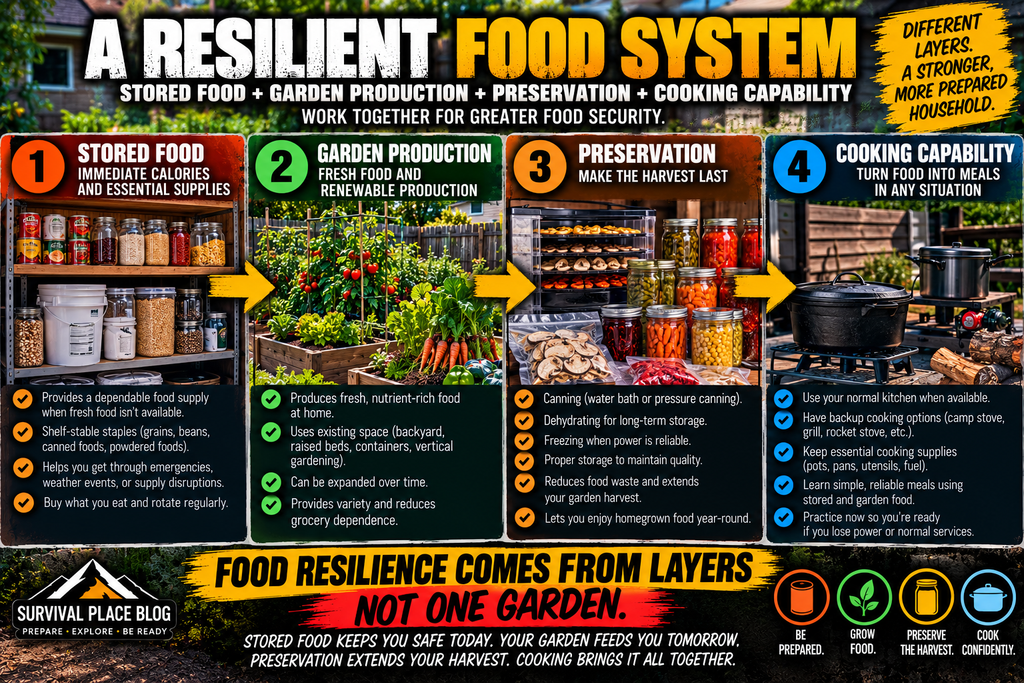
A resilient household food strategy combines:
stored food + garden production + preservation + cooking capability.
The garden is one layer—not the entire plan.
7. Grow What Your Family Actually Eats
A highly productive crop isn’t useful if nobody wants to eat it.
Before dedicating significant space to something, ask:
Do we normally eat this?
If your family eats potatoes every week, potatoes may deserve space.
If nobody likes beets, growing 40 pounds of beets simply because they’re considered a survival crop doesn’t accomplish much.
Use your normal grocery habits as a starting point.
Look at the vegetables, herbs, and produce you already buy.
Then determine which of those you can realistically grow.
8. Seeds or Seedlings?
Both have a place.
Starting With Seedlings
Buying healthy transplants can simplify the first season.
They’re especially useful for crops that require a longer growing season.
You can concentrate on learning:
- Planting
- Watering
- Fertility
- Pest management
- Harvesting
without also learning indoor seed starting immediately.
Starting From Seed
Seeds provide:
- More variety
- Lower cost per plant
- Ability to produce many plants
- Greater control over timing
Some crops are commonly direct-sown because transplanting isn’t necessary or ideal.
Always follow crop-specific planting guidance rather than assuming every vegetable should be started indoors.
9. Know Your Frost Dates and Growing Season
Gardening advice is highly regional.
A planting schedule that works in Georgia may fail in Washington.
Know your approximate:
- Last spring frost
- First fall frost
- Growing-season length
- Summer temperature patterns
- Rainfall pattern
Then choose crops and varieties accordingly.
Your local Extension service is usually far more useful for planting dates than generic national advice.
A gardener in the Pacific Northwest may choose different tomato varieties and planting dates than someone in Texas or Arizona.
Local knowledge beats generic gardening calendars.
10. Plant for Multiple Harvests
One of the easiest ways to increase production from limited space is succession planting.
Instead of planting everything once and leaving empty soil after harvest, plant another crop.
For example:
An early spring crop may finish in time for a warm-season crop.
That crop may later be followed by fall greens.
One small bed can potentially produce food during multiple parts of the growing season.
Stagger Plantings
You can also sow some quick-growing crops at intervals rather than planting the entire packet on one day.
That can prevent the classic gardening problem of having more lettuce or radishes than you can eat at once—and then none later.
11. Use Vertical Growing Strategically
Vertical gardening isn’t merely decorative.
It can substantially increase production from limited ground space.
Instead of letting cucumbers spread across several feet of soil, train suitable varieties onto a trellis.
Pole beans can produce vertically while occupying relatively little ground area.
Indeterminate tomatoes can also be supported upward.
That leaves ground-level space for smaller crops.
But remember:
Vertical structures create shade.
Position them thoughtfully so they don’t turn the rest of the garden into a low-light area.
12. Build a Water Plan Before Summer
Water is one of the biggest vulnerabilities in any food garden.
During mild spring weather, hand watering may seem easy.
Then July arrives.
Containers dry faster.
Temperatures rise.
Rain becomes less reliable in many regions.
Your plants become larger and require more water.
Plan ahead.
Options include:
- Hand watering
- Soaker hoses
- Drip irrigation
- Timers
- Mulch
- Rainwater collection where legal and practical
Water the Soil, Not the Calendar
Avoid rigid rules such as “water every Tuesday and Saturday.”
Plants don’t read schedules.
Water needs vary with:
- Soil
- Temperature
- Rainfall
- Wind
- Plant size
- Crop
- Containers versus ground beds
Check soil moisture and plant condition.
Water deeply enough to reach the active root zone, then adjust frequency to actual conditions.
Mulch Helps
Organic mulch can:
- Reduce evaporation
- Suppress weeds
- Moderate soil temperature
- Reduce soil splash
Suitable materials vary, but shredded leaves, straw, and other appropriate organic mulches can work well.
13. Plan for Water Disruptions Too
A survival garden shouldn’t assume unlimited municipal water.
If water service is disrupted during the hottest week of summer, a garden can deteriorate quickly.
You don’t necessarily need enough stored drinking water to irrigate an entire garden.
But consider:
- Mulching heavily
- Prioritizing high-value plants
- Capturing rainwater where practical and permitted
- Improving soil organic matter
- Using efficient irrigation
- Knowing which crops you would sacrifice first during severe water restrictions
Our Home Water Storage System guide covers emergency household drinking-water storage and treatment. Keep drinking-water needs separate from garden irrigation planning when calculating emergency supplies.
14. Don’t Let Weeds Steal Your Garden
Weeds compete for:
- Water
- Nutrients
- Light
- Space
Small weeds are easier to control than established ones.
Spend a few minutes regularly walking the garden and pulling weeds before they become a major job.
Mulch can dramatically reduce the workload.
The goal isn’t a garden that looks perfect on social media.
It’s keeping resources available for the plants feeding your household.
15. Expect Pests—But Identify Them First
At some point, something will eat your plants.
The mistake is immediately spraying whatever pesticide happens to be available.
First identify the problem.
Look for:
- Aphids
- Slugs
- Caterpillars
- Beetles
- Rodent damage
- Deer or rabbit browsing
- Disease symptoms
Then choose a response appropriate to the actual problem.
Options may include:
- Hand removal
- Water spray
- Barriers
- Row covers
- Netting
- Traps appropriate to the pest
- Crop-specific controls
Integrated Pest Management emphasizes identifying pests, monitoring damage, and choosing appropriate controls instead of automatically reaching for pesticides.
Be Careful With “Natural” Products
Natural doesn’t automatically mean harmless.
Products such as insecticidal soaps, horticultural oils, or other pest controls still need to be used according to their labels and crop-specific directions.
16. Protect Pollinators
Many food crops benefit from pollinators.
You can make the garden more useful to them by providing flowering plants through the season and avoiding unnecessary pesticide use.
Native flowering plants appropriate to your region can be particularly valuable.
You don’t need to turn the entire yard into a pollinator meadow.
Even small flowering areas near the vegetable garden can help.
17. Learn to Preserve What You Grow
A survival garden becomes far more useful when the harvest lasts beyond the day you pick it.
Different crops can be:
- Refrigerated
- Frozen
- Dehydrated
- Canned using tested recipes and safe methods
- Fermented using reliable guidance
- Stored under appropriate conditions
The correct preservation method depends on the food.
Don’t improvise canning procedures.
Food preservation is an area where tested methods matter.
If you’re new to preservation, learning to dehydrate food for long-term storage is one practical way to extend the usefulness of herbs, fruits, vegetables, and other appropriate foods.
18. Build the Garden Around Preservation
Once you’ve gardened for a season or two, start thinking backward.
Instead of:
What should I plant?
Ask:
What do I want in my pantry next winter?
If you regularly use:
- Tomato sauce
- Dried herbs
- Frozen peppers
- Dehydrated vegetables
- Garlic
- Potatoes
- Winter squash
then those foods can influence what you grow.
This creates a much stronger connection between the garden and your household food-storage system.
19. Learn Basic Composting
Composting turns suitable kitchen and yard materials into a useful soil amendment.
Common compost materials include appropriate combinations of:
- Leaves
- Garden residue
- Grass clippings
- Fruit and vegetable scraps
- Coffee grounds
- Other compostable organic material
Avoid adding materials that create pest, odor, disease, or safety problems.
You don’t need an elaborate system.
A simple compost bin or pile can work.
Over time, composting reduces dependence on purchased soil amendments while recycling material already produced at home.
20. Think About Seeds as a Renewable Resource
Seeds are inexpensive compared with many preparedness supplies.
Keep varieties appropriate for your region and growing conditions.
Store seeds according to supplier recommendations in a cool, dry location.
As your gardening skills improve, you may also explore seed saving.
But understand that successful seed saving requires knowing what you’re growing.
Hybrid varieties may not reproduce true to type, and some crops cross-pollinate readily.
Learn the crop before depending on saved seed.
21. Keep a Garden Journal
This sounds unnecessary until you’ve gardened for several seasons and can’t remember what happened.
Write down:
- Planting dates
- Varieties
- Weather
- Frost dates
- Pest problems
- Harvest dates
- Approximate yields
- Crops your family liked
- Crops that failed
- What you preserved
- What you would change
That information becomes your personal growing manual.
After several seasons, your own records may be more useful than generic gardening advice because they’re based on your soil, your yard, your climate, and your household.
22. Don’t Forget the Front Yard
If backyard sunlight is poor, the front yard may offer valuable growing space.
Food-producing landscaping can include:
- Herbs
- Berries
- Attractive greens
- Fruit trees where appropriate
- Edible flowers
- Vegetables integrated into ornamental beds
Check HOA rules, local ordinances, utilities, and property restrictions before making major changes.
A survival garden doesn’t have to look like a farm.
Productive landscapes can still look intentional and attractive.
23. Apartment and Townhome Survival Gardens
No yard?
You can still learn food-production skills.
Depending on available light and property rules, consider:
- Containers
- Grow bags
- Window boxes
- Balcony planters
- Community gardens
- Herbs
- Salad greens
- Compact tomatoes
- Peppers
- Strawberries
You’re unlikely to produce all your household calories on an apartment balcony.
That’s okay.
The skill matters.
Learning how plants grow, how much water they require, how pests behave, and how to harvest food is valuable even at small scale.
24. A Survival Garden Should Complement Stored Food
This is worth repeating.
Don’t rely on a backyard garden as your only long-term food plan.
Gardens can fail.
Possible problems include:
- Heat
- Frost
- Drought
- Excessive rain
- Disease
- Insects
- Wildlife
- Poor germination
- Crop failure
- Personal illness or injury
Your preparedness system should have multiple layers.
Stored shelf-stable food gives you immediate calories.
A garden can provide fresh food and renewable production.
Preservation extends the harvest.
Together, they’re much stronger than any one method by itself.
Our 90 Day Emergency Preparedness Checklist can help you build the larger household system around water, food, power, medical supplies, and other essentials.
25. What Should a Beginner Plant First?
If you’re completely new, don’t start with 30 crops.
Choose perhaps five or six that fit your climate and diet.
A hypothetical beginner garden might include:
One Reliable Producer
Bush beans or another locally dependable crop.
One Fresh-Eating Crop
Tomatoes, if they’re appropriate for your climate and available sun.
One Leafy Green
Lettuce, kale, chard, or another locally suitable green.
One Storage-Oriented Crop
Potatoes, winter squash, onions, or garlic depending on your conditions.
One Herb
Something your household regularly uses.
One Experiment
A crop you’ve never grown before.
This keeps the first season manageable while teaching several different growing skills.
26. A Simple Expansion Plan
Don’t try to build your final garden in Year One.
Year One
Learn:
- Soil
- Sunlight
- Watering
- Five or six crops
- Basic pest control
Year Two
Add:
- More growing space
- Vertical structures
- Succession planting
- Composting
- Food preservation
Year Three
Improve:
- Yield
- Storage crops
- Seed starting
- Season extension
- Water efficiency
- Seed saving where practical
Preparedness grows through experience.
Buying a mountain of gardening equipment in one weekend doesn’t replace three seasons of actually growing food.
27. Your Suburban Survival Garden Starter Checklist
Location
- Map sunlight
- Identify available growing spaces
- Check drainage
- Consider water access
- Check HOA or local restrictions if applicable
Soil
- Evaluate existing soil
- Consider soil testing
- Add appropriate organic matter
- Use clean growing media where soil quality is questionable
- Plan mulch
Crops
- Choose foods your household eats
- Include quick crops
- Include productive crops
- Include at least one storage-oriented crop
- Add useful herbs
- Choose varieties appropriate to your region
Water
- Determine irrigation method
- Mulch beds
- Plan for hot weather
- Consider water disruptions
- Check containers more frequently
Production
- Use vertical space
- Plan succession crops
- Monitor pests
- Keep weeds controlled
- Record planting and harvest dates
Preservation
- Decide what you’ll eat fresh
- Decide what can be frozen
- Identify foods suitable for dehydration
- Use tested procedures for canning
- Plan appropriate storage space
Start Small—But Start Now
The most important survival-gardening skill isn’t knowing every vegetable variety.
It’s experience.
You learn by putting seeds in soil.
You learn by overwatering something.
You learn when insects discover your kale before you do.
You learn which side of the house receives afternoon sun.
You learn which tomato actually performs in your climate.
And eventually you stop relying entirely on gardening instructions because you’ve built knowledge specific to your own property.
That’s when a suburban survival garden becomes something more than a seasonal hobby.
It becomes part of your household preparedness system.
Start with one bed.
Or five containers.
Grow food your family actually eats.
Preserve some of it.
Keep notes.
Then make next year’s garden better than this year’s.
That’s how real food resilience is built.