Practical preparedness for commuters when traffic, bridges, transit, weather, or infrastructure suddenly stop cooperating.
Affiliate Disclosure: This post contains affiliate links. If you purchase through these links, Survival Place Blog may earn a commission at no additional cost to you. As an Amazon Associate I earn from qualifying purchases.
Most commutes are predictable.
You leave work, get on the same highway, cross the same bridge, sit through the same traffic, and eventually pull into your driveway.
Until one day you don’t.
An earthquake closes a bridge. An ice storm turns the freeway into a parking lot. A wildfire blocks your route. Flooding closes a low-lying road. A major power outage knocks out traffic signals. A serious crash shuts down the highway. A public disturbance makes part of downtown temporarily inaccessible.
Suddenly, a routine 45-minute commute becomes a six-hour problem—or you can’t get home at all.
That’s why a commuter emergency plan matters.
You don’t need a vehicle packed like an expedition truck. You need several ways home, enough basic supplies to handle delays, a way to communicate with your family, and the judgment to recognize when trying to get home immediately is more dangerous than waiting.
For anyone who spends a significant amount of time commuting, your vehicle is more than transportation.
During an emergency, it may temporarily become your shelter, charging station, supply cache, and best route home.
Your Realistic Everyday Carry guide covers the essentials you can keep on you every day. This article builds the next layer: what should be in your vehicle and what you should know before your normal commute stops being normal.
Why Commuters Need an Emergency Plan
Preparedness advice often focuses on what you should keep at home.
That’s important—but emergencies don’t wait until you’re standing in your kitchen.
You could be:
- 25 miles from home at work
- Across a river from your family
- Sitting in freeway traffic
- On public transportation
- Picking up children
- Driving through severe weather
- Traveling between cities
- Halfway through your normal commute when conditions change
The farther you routinely travel from home, the more transportation becomes part of your preparedness plan.
For commuters, the key question isn’t only:
“What supplies do I have?”
It’s:
“How do I get home—or somewhere safer—if my normal transportation system fails?”
1. Start With the Three-Route System
Most commuters know one route extremely well.
That’s the problem.
If your normal highway, bridge, tunnel, or arterial closes, thousands of other drivers will immediately search for the same alternate route.
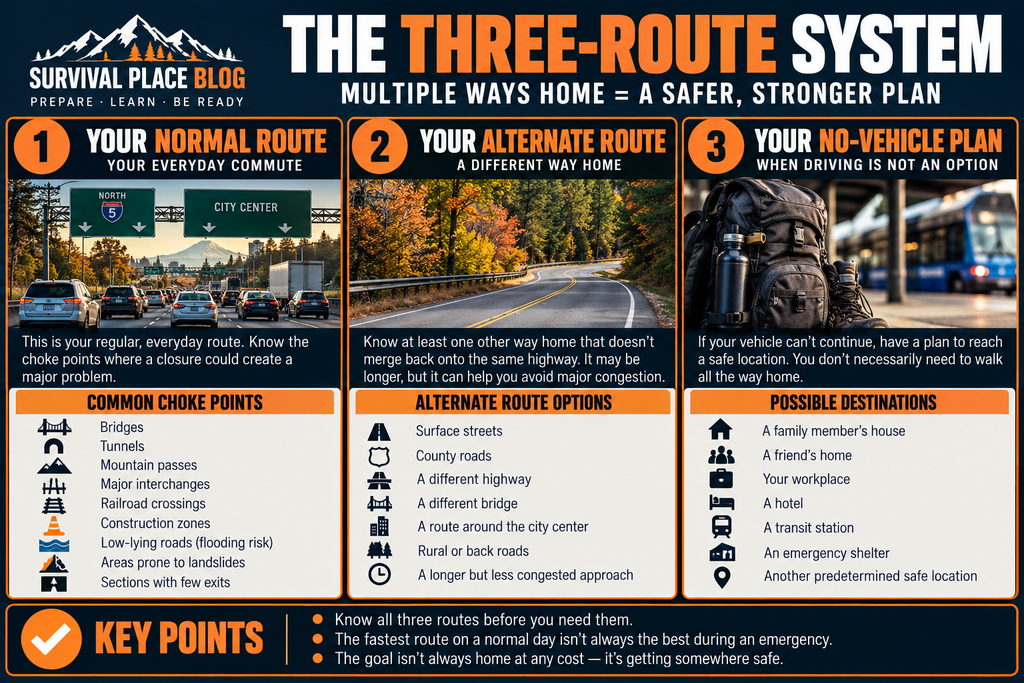
A good commuter emergency plan should include at least three options.
Route 1: Your Normal Route
This is your everyday commute.
Identify the points where one closure could create a major problem:
- Bridges
- Tunnels
- Mountain passes
- Major interchanges
- Railroad crossings
- Construction zones
- Low-lying roads
- Areas vulnerable to landslides or flooding
- Sections with few exits
These are your choke points.
Knowing where they are helps you recognize when to reroute before you’re trapped in traffic.
Route 2: Your Alternate Driving Route
Know another way home that doesn’t simply merge back onto the same highway five miles later.
Your alternate route might involve:
- Surface streets
- County roads
- A different highway
- A different bridge
- A route around the city center
- A longer but less congested approach
The fastest route on a normal day isn’t necessarily the best route during an emergency.
Route 3: Your No-Vehicle Plan
This is the route most people never consider.
What happens if the vehicle can’t continue?
You may have:
- Mechanical failure
- An empty fuel tank
- An impassable road
- A damaged bridge
- Gridlocked traffic
- A mandatory road closure
- A situation where authorities direct people away from an area
You don’t necessarily need to walk all the way home.
Your third plan might involve reaching:
- A family member’s house
- A friend’s home
- Your workplace
- A hotel
- A transit station
- An emergency shelter
- Another predetermined safe location
The objective isn’t always home at any cost.
The objective is getting somewhere safe.
2. Learn Your Commute Without Depending Completely on GPS
Navigation apps are incredibly useful.
Use them.
But don’t make them your only understanding of where you live.
Know the general geography around your commute:
- Which direction is home?
- What rivers separate you from it?
- Which bridges cross those rivers?
- Which highways run north/south and east/west?
- Which neighborhoods or towns are along alternate routes?
- Where are the major hospitals?
- Where could you safely stop?
Download offline maps for areas you travel regularly.
Keeping a paper regional road map in your vehicle adds another inexpensive layer of redundancy.
You don’t need wilderness-navigation skills to drive home.
You simply don’t want your entire route knowledge to disappear with a dead phone.
3. Check Road Conditions Before You Commit to a Route
During a developing emergency, information can save you hours—and keep you away from dangerous conditions.
Before leaving work or entering a major highway, check official transportation information when available.
For commuters in Oregon and Southwest Washington, that means resources such as TripCheck and WSDOT.
TripCheck provides information on Oregon road conditions, incidents, closures, cameras, and travel conditions.
For Washington routes, WSDOT real-time travel information can help you check incidents, restrictions, cameras, travel times, and closures.
Check conditions before joining a traffic backup when possible.
Once you’re surrounded by thousands of stopped vehicles, your options become much smaller.
4. Bridges Deserve Special Attention
For commuters who cross a major river every day, the bridge may be the single most important vulnerability in the entire plan.
If you live on one side and work on the other, ask:
What happens if I can’t cross?
Don’t assume an alternate bridge will automatically solve the problem.
The same earthquake, storm, crash, inspection, or regional emergency may affect multiple crossings simultaneously—or push huge amounts of traffic onto the remaining routes.
Know:
- Your normal crossing
- Alternate crossings
- How far those alternatives really are
- Whether your alternate route depends on another vulnerable bridge
- Where you could safely stay if crossing isn’t possible
For Portland/Vancouver-area commuters, the Columbia River makes this especially important.
Sometimes the smartest plan isn’t driving 50 extra miles looking for another crossing.
It may be waiting safely until authorities determine which routes are usable.
5. Build a Practical Vehicle Emergency Kit
Your vehicle gives you something your pockets don’t:
storage space.
Use it.
A commuter kit doesn’t need to be expensive or tactical-looking. A plain backpack, tote, or small storage container works fine.
Water
Keep drinking water in the vehicle and rotate it periodically.
How much depends on climate, commute length, number of passengers, and available storage.
At minimum, keep enough to handle an unexpectedly long delay.
During hot weather, increase it.
Our Home Water Storage System guide covers larger emergency water planning, treatment, containers, and storage.
Food
Keep simple shelf-stable food that tolerates being stored in a vehicle reasonably well.
Examples include:
- Protein or energy bars
- Nuts
- Crackers
- Shelf-stable snacks
- Dried fruit
Avoid building your vehicle food supply around items that melt easily or deteriorate quickly in temperature extremes.
The purpose isn’t gourmet dining.
It’s enough calories to make an unexpected delay less miserable.
Lighting
Keep at least one reliable flashlight.
A headlamp is especially useful if you need both hands for changing a tire, looking under the hood, walking after dark, or providing first aid.
A reliable headlamp is one of the most useful pieces of vehicle emergency gear because it provides hands-free lighting for repairs, walking, and emergencies after dark.
First Aid
A basic first-aid kit should be easy to reach.
Include supplies appropriate for minor cuts, scrapes, blisters, and other routine injuries.
For a ready-made option, the EVERLIT 250-Piece Survival First Aid Kit combines basic first-aid supplies with several additional emergency items in a portable organized bag. It’s a practical kit to keep in a vehicle.
If you take essential medication, think about how a long delay could affect your normal medication schedule.
Phone Power
A dead phone can take away your navigation, emergency alerts, communication, weather information, and access to transportation updates all at once.
Keep:
- Charging cable
- Vehicle charger
- Portable power bank
A portable power bank gives you another charging option if the vehicle can’t provide power or you need to leave it behind.
Clothing
Your emergency clothing should match your region and season.
Consider:
- Comfortable walking shoes
- Extra socks
- Work gloves
- Warm layer
- Rain shell
- Hat
- Seasonal gloves
If you commute in office shoes, keeping walking shoes in the vehicle can be one of the most practical emergency upgrades you make.
Warmth and Shelter
Depending on climate:
- Emergency blanket
- Compact blanket
- Warm clothing
- Rain protection
- Small tarp or poncho
You aren’t trying to turn the vehicle into a wilderness base camp.
You’re trying to remain reasonably safe and comfortable if you’re delayed for hours.
6. Add Basic Automotive Emergency Equipment
Preparedness doesn’t help much if a routine automotive problem strands you first.
Consider keeping:
- Tire-pressure gauge
- Portable tire inflator
- Proper equipment for changing a tire, if your vehicle has a spare
- Jumper cables or portable jump starter
- Work gloves
- Reflective vest
- Basic tool kit appropriate for your vehicle
- Flashlight or headlamp
- Roadside-assistance information
Know whether your vehicle actually has a spare tire.
Many modern vehicles don’t.
Some have an inflator/sealant kit instead.
Finding that out on the shoulder of a freeway at night is poor timing.
Don’t Carry Automotive Supplies Just Because a List Says To
Your vehicle kit should match what you can actually use.
For example, carrying random spare fluids isn’t particularly useful if you don’t know why the fluid is low, where it goes, or whether adding it is safe.
Likewise, specialized recovery equipment is useful only when you understand its limitations and safe use.
Practical preparedness beats collecting equipment.
7. Keep Enough Fuel to Preserve Your Options
There’s no universal fuel level that guarantees safety.
Vehicle range varies dramatically.
But regularly arriving home with the low-fuel warning illuminated reduces your options during an unexpected disruption.
A practical habit is to avoid routinely letting the tank become nearly empty.
That gives you more flexibility to:
- Reroute
- Wait in traffic
- Drive around a closure
- Reach another safe location
- Get home when nearby stations are unavailable
During severe weather, wildfire conditions, evacuation warnings, or another developing emergency, consider fueling earlier rather than waiting until everyone else has the same idea.
Store Fuel Safely
If you keep emergency fuel at home, use an approved container and follow local fire codes and manufacturer guidance.
Don’t casually store gasoline in your passenger compartment or improvised containers.
8. Prepare for the Emergency Most Likely in Your Region
A commuter kit in Phoenix shouldn’t look identical to one in Portland.
Build around your actual hazards.
Winter Storms and Ice
Consider adding:
- Ice scraper
- Warm gloves
- Warm hat
- Insulated clothing
- Blanket
- Traction equipment appropriate for your vehicle and local requirements
Don’t underestimate how quickly a routine drive can become an overnight delay during severe winter weather.
Wildfire and Smoke
Wildfires can close roads well beyond the immediate fire area.
Smoke can also make conditions unhealthy even when flames aren’t nearby.
Keep evacuation routes flexible and monitor official emergency information.
An N95 respirator may help reduce exposure to wildfire smoke particles when properly fitted and used, although it does not protect against all gases or vapors.
Check official wildfire smoke guidance and local air-quality information when smoke affects your route.
Earthquakes
Earthquakes present a different commuter problem.
Bridges, overpasses, roads, utilities, and public transportation may need inspection before reopening.
After a significant earthquake, don’t assume your normal route is usable simply because your vehicle still runs.
Expect delays.
Listen for official transportation information.
Be prepared to remain where you are temporarily if traveling would put you at greater risk.
Flooding
Never treat floodwater across a roadway as something you can simply “power through.”
Water can hide road damage, carry debris, or be deeper and faster-moving than it appears.
If authorities close a flooded road, turn around and use another route.
9. Know When NOT to Leave Work
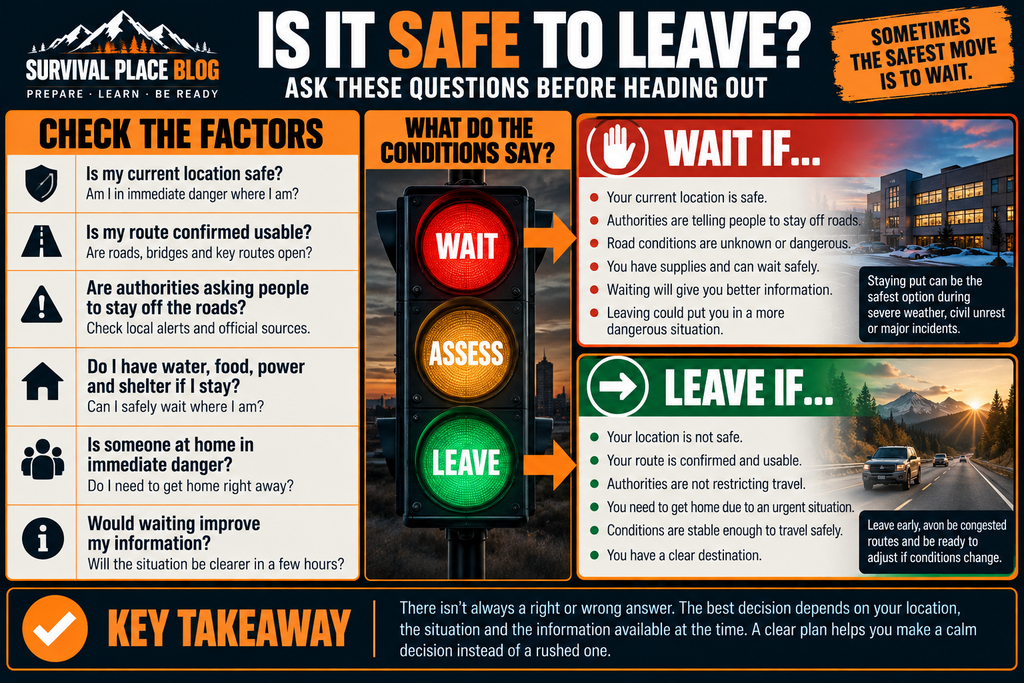
One of the most important commuter preparedness skills is recognizing when not to start driving.
Imagine a major earthquake occurs while you’re at work.
Your first instinct may be:
I need to get home right now.
That’s understandable.
But if bridges are being inspected, traffic signals are out, roads are damaged, and thousands of other people have the same idea, immediately joining traffic may make the situation worse.
Ask:
- Is my current location safe?
- Is the route home confirmed usable?
- Are authorities asking people to stay off roads?
- Do I have water, food, power, and shelter where I am?
- Is someone at home in immediate danger?
- Would waiting an hour or two give me better information?
Getting home is important.
Getting home safely is more important.
10. Have a Walking-Home Plan—but Keep It Realistic
Some preparedness plans casually say:
“If traffic stops, I’ll just walk home.”
Do the math first.
A 25-mile commute could become an all-day walk—or longer—depending on fitness, weather, terrain, injuries, bridge access, and what you’re carrying.
Your walking plan should answer:
- How far is home?
- Is the route actually walkable?
- Are pedestrian bridge crossings available?
- Do I have appropriate shoes?
- What will the weather be?
- Do I have water?
- Is walking safer than remaining where I am?
- Is there a closer safe destination?
A nearby friend, hotel, workplace, family member, or emergency shelter may be far more realistic than trying to walk 20 or 30 miles home at night.
Test Part of Your Plan
You don’t need to walk your entire commute.
But learn the area.
Drive alternate routes occasionally.
Know where sidewalks disappear.
Notice bridges, steep hills, industrial zones, railroad tracks, and areas where pedestrian travel would be difficult.
Maps look different when you’re actually standing there.
11. If You Must Leave the Vehicle
Leaving a vehicle during an emergency should be a decision, not a reflex.
A vehicle provides:
- Shelter
- Visibility
- Storage
- Some protection from weather
- Charging capability
- Transportation if roads reopen
If you’re safely parked and conditions outside are worse, staying with the vehicle may be the better choice.
You might leave if:
- Authorities direct evacuation
- The location becomes dangerous
- Fire or flooding threatens the area
- The vehicle is disabled in an unsafe location
- You have a clearly safer destination you can realistically reach
If you do leave, take only what you reasonably need.
Our 72-Hour Go-Bag Checklist provides a practical framework for a larger emergency kit when you may need to leave your vehicle, workplace, or home for an extended period.
12. Create a Family Communication Plan
Your commute isn’t only about you.
Someone may be waiting at home, school, daycare, or another workplace.
Before an emergency, decide:
- Who contacts whom?
- Who picks up children?
- What happens if one parent can’t cross a bridge?
- Where is the backup meeting location?
- Who is the out-of-area contact?
- What should family members do if calls don’t connect?
- When should everyone stay where they are rather than trying to meet?
Keep important numbers somewhere other than only inside your phone.
A small printed contact card in your wallet or vehicle kit is simple redundancy.
Create a family emergency communication plan before you need it, so everyone understands what to do when normal travel and communication are disrupted.
13. What If Cellular Service Is Overloaded?
A cellular network doesn’t have to completely fail to become difficult to use.
During a major emergency, large numbers of people may try to call simultaneously.
If calls aren’t connecting:
- Try a short text message.
- Keep messages concise.
- Avoid repeatedly draining the battery with unnecessary calls.
- Use official emergency alerts and radio broadcasts when available.
- Follow your predetermined family plan.
A useful message might be:
I’m safe at work. Bridge closed. Staying here for now. I’ll update at 8:00.
That gives your family location, status, plan, and next contact time.
14. Keep an Emergency Radio in the Vehicle
Your smartphone is powerful, but redundancy is useful.
A compact emergency radio can provide another way to receive weather and emergency information when cellular service is unreliable or your phone battery is limited.
An emergency weather radio can provide access to NOAA weather broadcasts and other radio information without depending entirely on your phone.
You don’t necessarily need to carry it in your pocket every day.
The vehicle is an ideal place for this kind of secondary equipment.
15. Road Blockages and Unexpected Human Encounters
Not every road blockage is caused by weather or damaged infrastructure.
You may encounter:
- A collision
- Emergency responders
- A demonstration
- A person experiencing a crisis
- A crowd
- Police activity
- A temporary security perimeter
If the road ahead is blocked, don’t make getting through it your mission.
When practical:
- Keep doors locked.
- Keep windows up if the situation feels unstable.
- Leave room to maneuver when stopped.
- Avoid arguing with people outside the vehicle.
- Don’t exit simply to confront someone blocking the road.
- Back away or turn around when a safe route exists.
- Follow lawful instructions from emergency personnel.
If you’re in immediate danger, contact 911 when you can safely do so.
For more detailed guidance on crowds, demonstrations, road disruptions, chemical irritants, and getting away from unstable situations, see our Civil Unrest Safety guide.
16. Public Transportation Commuters Need a Plan Too
A commuter emergency plan isn’t only for drivers.
If you use buses, light rail, commuter rail, rideshare, or a combination of transportation methods, ask:
- What happens if my normal line stops?
- Where are alternate stations?
- Is another bus route available?
- Could I safely walk part of the trip?
- Who could pick me up?
- Where could I wait safely?
- How would I get home if rideshare services were unavailable?
Keep enough basic supplies with you to tolerate delays.
That doesn’t require carrying a huge backpack.
Water, phone power, essential medication, a small flashlight, weather protection, and appropriate footwear solve many everyday problems.
17. Don’t Advertise Your Emergency Gear
Your vehicle emergency kit doesn’t need tactical branding.
A plain backpack, tote, or covered storage container is often better.
Avoid leaving valuable equipment visible inside a parked vehicle.
Besides reducing theft risk, ordinary storage keeps your vehicle looking like exactly what it is:
a normal commuter vehicle.
Preparedness doesn’t need to announce itself.
18. Maintain Your Vehicle Before the Emergency
One of the most overlooked pieces of survival gear is a properly maintained vehicle.
Pay attention to:
- Tires
- Tire pressure
- Battery condition
- Brakes
- Exterior lighting
- Wiper blades
- Fluid levels
- Scheduled maintenance
- Warning lights
An emergency is a bad time to discover the battery has been weak for six months.
Vehicle preparedness starts with making the vehicle dependable during normal life.
19. Rotate Your Emergency Supplies
Vehicle interiors experience temperature extremes.
That affects food, water containers, batteries, medications, adhesives, and other supplies.
Set a reminder every few months to inspect your kit.
Check:
- Food condition and dates
- Water containers
- Flashlight operation
- Power-bank charge
- First-aid supplies
- Seasonal clothing
- Batteries
- Emergency contacts
- Maps
- Vehicle equipment
Change seasonal items before you need them.
The winter gloves you remembered in January don’t help much if they’re still sitting in the garage during the first ice storm.
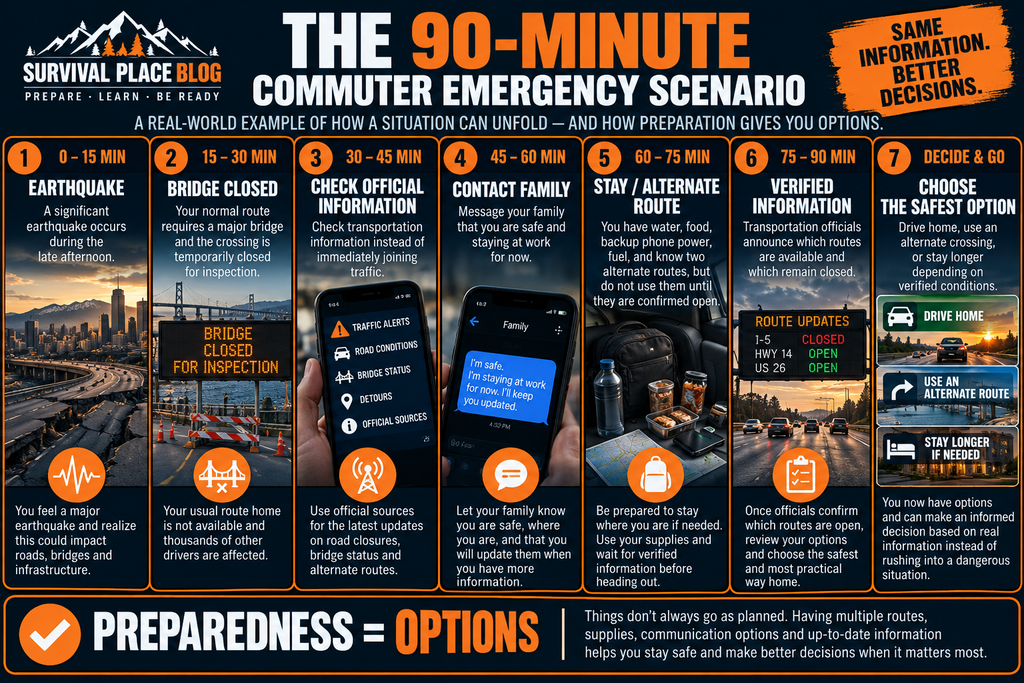
20. A Realistic Commuter Emergency Scenario
Imagine it’s late afternoon.
You’re 25 miles from home when a significant earthquake occurs.
The power flickers out. Cellular service becomes congested. Traffic immediately begins building.
Your normal route requires crossing a major bridge.
Instead of immediately joining thousands of other drivers heading toward it, you check official transportation information.
The crossing is temporarily closed for inspection.
Now your commuter emergency plan matters.
You message your family:
I’m safe. Bridge is closed for inspection. I’m staying at work for now. I’ll update you in an hour.
You have water.
You have food.
Your phone has backup power.
Your vehicle has fuel.
You know two alternate routes—but you don’t use either until you know they’re actually open.
An hour later, transportation officials announce which routes are available.
Maybe you drive home.
Maybe you take an alternate crossing.
Maybe you stay where you are longer.
The important part is that you still have choices.
That’s what preparedness is supposed to provide.
Not panic.
Options.
21. Your 10-Minute Commuter Emergency Audit
You can improve your preparedness today without buying anything.
Sit in your vehicle and answer these questions:
Navigation
- Do I know another way home?
- Do I know the major choke points?
- Do I have offline or paper maps?
Vehicle
- Is my fuel level reasonable?
- Are my tires in good condition?
- Do I know whether I have a spare tire?
- Do I have a way to handle a dead battery?
Supplies
- Do I have water?
- Food?
- Light?
- First aid?
- Phone power?
- Walking shoes?
- Weather protection?
Communication
- Does my family know what happens if I can’t get home?
- Do we have a backup meeting location?
- Do we have an out-of-area contact?
Decision-Making
- Where could I safely stay near work?
- At what point would I stop trying to drive home?
- If I had to leave the vehicle, where would I actually go?
Any question you can’t answer becomes something to improve.
Commuter Emergency Kit Checklist
In the Vehicle
- Drinking water
- Shelf-stable snacks
- First-aid kit
- Flashlight
- Headlamp
- Charging cable
- Vehicle charger
- Portable power bank
- Walking shoes
- Extra socks
- Work gloves
- Rain protection
- Warm layer
- Blanket or emergency blanket
- Paper map
- Emergency contact information
Automotive
- Tire-pressure gauge
- Tire inflator
- Spare tire or manufacturer repair kit
- Jumper cables or jump starter
- Basic tools
- Reflective vest
- Roadside-assistance information
Seasonal
- Ice scraper
- Warm gloves and hat
- Appropriate traction equipment
- Extra summer water
- Sun protection
- Wildfire smoke protection when appropriate
Your Plan
- Primary route
- Alternate driving route
- No-vehicle backup plan
- Safe location near work
- Family communication plan
- Backup meeting location
- Out-of-area contact
Your Goal Isn’t to Get Home Fast
When a major disruption happens during your commute, the natural instinct is to get home immediately.
Sometimes that’s exactly what you should do.
Other times, it’s the decision that puts you in the worst traffic, sends you toward a damaged bridge, or leaves you stranded somewhere less safe.
A good commuter emergency plan gives you something more valuable than speed:
options.
Know your routes.
Keep useful supplies in the vehicle.
Maintain enough fuel to remain flexible.
Have a family communication plan.
Know where you could safely wait.
And understand that sometimes the smartest way to get home safely is to wait until getting home is actually possible.
If an emergency becomes serious enough that you must leave your normal area for an extended period, our Ultimate Bug Out Bag Guide explains how to build a practical 72-hour evacuation kit.
Download the Free Commuter Emergency Plan Checklist
Want a simple checklist you can print and keep in your vehicle, at work, or with your emergency supplies? Download our free Commuter Emergency Plan Checklist.
It covers alternate routes, vehicle essentials, automotive readiness, family communication, seasonal hazards, what to do if you become stranded, and the supplies you should check regularly.