Affiliate Disclosure: This post contains affiliate links. If you purchase through these links, Survival Place Blog may earn a commission at no additional cost to you. As an Amazon Associate I earn from qualifying purchases.
Fall and winter storms can turn an ordinary week into an emergency surprisingly quickly.
Heavy rain can flood roads and basements. High winds can bring down trees and power lines. Snow and ice can make roads impassable. A prolonged cold snap can freeze pipes, strain heating systems, and turn a power outage into a much more serious problem.
Good fall and winter storm preparedness isn’t about preparing for every disaster imaginable. It’s about making sure your household can safely handle the problems these storms most commonly create: loss of electricity, loss of heat, difficult travel, damaged property, interrupted water service, and several days at home without normal services.
This guide walks through practical steps you can take before storm season, what supplies are worth keeping at home, and what to do when severe weather actually arrives.
The National Weather Service recommends preparing before severe winter weather arrives and having a plan for potential disruptions to heat, power, communications, and travel.
Start Preparing Before the Storm Is in the Forecast
The best time to prepare for a fall or winter storm isn’t when everyone else is buying batteries, bottled water, and ice melt.
Do it before the season begins.
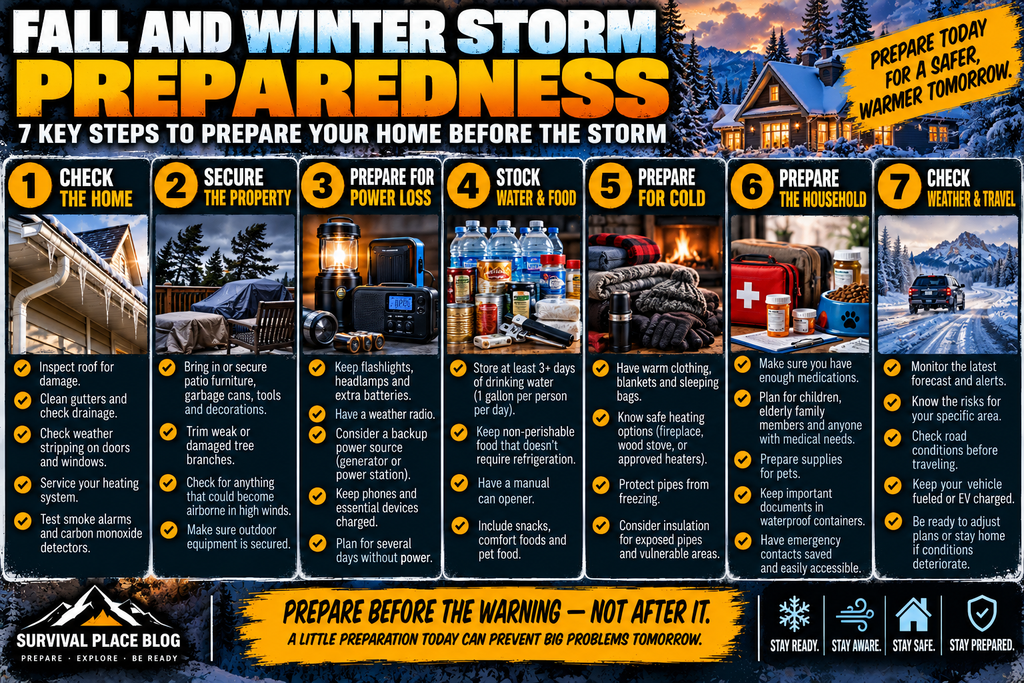
Start with a basic inspection of your home.
Check your roof for obvious damage. Clean gutters and make sure downspouts move water away from the foundation. Look for loose outdoor objects that could become airborne during high winds.
Inspect weather stripping around doors and windows. Small drafts may seem insignificant during normal weather but become much more noticeable during an extended cold snap or power outage.
Have your primary heating system inspected and maintained according to the manufacturer’s recommendations.
Test smoke alarms and carbon monoxide detectors and replace batteries when necessary.
If you use a fireplace or wood stove, make sure it is properly maintained before relying on it during an emergency.
The goal isn’t to turn your house into a fortress.
It’s simply to eliminate preventable problems before bad weather exposes them.
Know Which Storms Threaten Your Area
Winter preparedness looks different depending on where you live.
A household in the Pacific Northwest may be more concerned about prolonged rain, windstorms, falling trees, ice, and power outages.
A household in the Midwest may prepare for blizzards, extreme cold, and heavy snow.
Coastal areas may face strong winds and flooding.
Mountain communities may experience road closures and prolonged isolation.
Before buying gear, understand the hazards most likely to affect your area.
Ask yourself:
- Does our neighborhood flood?
- Are large trees close to the house or power lines?
- How often does our area lose electricity?
- Could snow or ice prevent us from driving for several days?
- Does our home rely heavily on electricity for heat?
- Could freezing temperatures damage exposed pipes?
- Where could we go if our home became unsafe?
Preparedness becomes much easier when you prepare for realistic local problems instead of generic disaster scenarios.
Prepare for Heavy Rain and Flooding
Fall storms often bring sustained rainfall, and drainage problems that go unnoticed during dry weather can become serious quickly.
Clean leaves and debris from gutters and drainage areas before the rainy season.
Make sure downspouts discharge water away from the foundation rather than allowing it to pool next to your home.
If you have a basement or crawl space that has experienced water intrusion before, inspect your sump pump and consider what happens if the electricity goes out while the pump is needed.
Move important documents, photographs, electronics, and valuables away from floors in areas vulnerable to flooding.
Store critical documents in waterproof containers or sealed bags.
Most importantly, never assume a flooded road is safe to cross.
Water can hide washed-out pavement, debris, or unexpectedly strong currents. If authorities close a road or warn against crossing a flooded area, find another route.
Your vehicle is replaceable.
You aren’t.
Prepare for High Winds
Windstorms can create problems long before snow arrives.
Walk around your property and look for anything that could become airborne.
Secure or bring inside:
- Patio furniture
- Garbage cans
- Garden tools
- Decorations
- Umbrellas
- Lightweight planters
- Children’s outdoor equipment
Inspect trees near your home for dead limbs, damaged trunks, or branches hanging over structures.
Large or hazardous trees should be evaluated by a qualified tree professional rather than handled as a DIY project.
During a severe windstorm, stay away from windows and exterior glass whenever possible.
If trees or power lines come down, assume downed electrical lines are energized. Keep people and pets away and report the hazard to the appropriate utility or emergency service.
Prepare for Snow and Ice
Snow creates obvious problems.
Ice can be worse.
Freezing rain can coat roads, sidewalks, trees, and power lines. Even a relatively small accumulation can make travel dangerous and contribute to widespread outages.
Before winter, keep basic snow and ice supplies available:
- Snow shovel
- Ice scraper
- Ice melt appropriate for your property
- Warm gloves
- Waterproof footwear
- Traction material for slippery walkways
Don’t wait until a major storm is forecast to buy these items. Stores often sell out precisely when everyone suddenly needs them.
Avoid unnecessary travel during severe snow or ice conditions.
If travel is unavoidable, your vehicle should have its own winter emergency supplies.
For a complete vehicle-specific plan, see our Winter Vehicle Preparedness guide for tires, batteries, emergency supplies, traction equipment, and stranded-driver safety.
The Biggest Winter-Storm Problem May Be the Power Outage
A winter storm becomes much more serious when electricity disappears.
Without power, you may lose:
- Heat
- Lighting
- Internet
- Refrigeration
- Cooking appliances
- Well pumps
- Medical equipment
- Garage-door operation
- Phone charging
Some outages last only minutes.
Others can last days.
That’s why winter storm planning and power-outage planning should be treated as part of the same preparedness problem.
If you want to prepare specifically for a longer blackout, our Extended Power Outage guide walks through what can happen during the first 48 hours and how to prepare for water, food, lighting, communication, and other essentials.
Before storm season, walk through your home and identify everything that depends on electricity.
Then decide what actually needs backup power.
For most households, priorities include communication, lighting, refrigeration, essential medical devices, and possibly limited heating equipment.
You don’t necessarily need to power your entire house.
You need a plan for keeping the most important systems functioning safely.
Have Multiple Ways to Light Your Home
Every household should have emergency lighting that doesn’t depend on the electrical grid.
Flashlights and headlamps should be your first choice.
A headlamp is especially useful because it keeps both hands free while checking a breaker panel, carrying supplies, dealing with a leak, or moving around outside.
Battery-powered lanterns can provide general room lighting.
Keep spare batteries with the lights rather than scattered around the house.
Rechargeable lights are useful too, but remember that rechargeable equipment eventually needs a power source.
A mixture of rechargeable and replaceable-battery lighting provides better redundancy.
A compact Energizer LED headlamp is a practical emergency-lighting option because it keeps both hands free during a power outage while checking equipment, carrying supplies, or moving around the house after dark.
Avoid relying on candles as your primary emergency lighting. Open flames introduce an unnecessary fire risk, especially when a household is already dealing with a power outage.
Keep a Reliable Emergency Radio
Cell phones are incredibly useful during storms, but they shouldn’t be your only source of information.
Cellular networks can become overloaded. Internet service may disappear even when your phone still works.
A battery-powered or hand-crank emergency radio gives you another way to receive weather information and emergency instructions.
A NOAA-capable weather radio is particularly useful during severe weather because it can provide alerts and official forecasts without relying on your home’s internet connection.
The Midland ER310 Emergency Crank Weather Radio is a solid option for a home emergency kit, providing NOAA weather alerts along with multiple ways to keep the radio powered during an outage.
Keep the radio somewhere everyone in the household knows how to find it.
An emergency radio buried in a garage cabinet doesn’t help much when the lights go out at 2:00 a.m.
Store Enough Water Before You Need It
Most winter storms won’t interrupt municipal water service.
But some will.
Frozen pipes, broken water mains, flooding, well-pump outages, and infrastructure damage can all interrupt safe water access.
Store emergency drinking water before storm season rather than trying to fill containers after a warning is issued.
Your household’s water plan should account for:
- Drinking
- Cooking
- Medications
- Basic hygiene
- Pets
- Household members with additional needs
For a deeper look at building your household water supply, our Home Water Storage System guide explains how much emergency water to keep, container options, treatment, rotation, and larger-capacity storage.
If your home uses a private well, remember that the well pump probably won’t operate during a power outage unless you have backup power.
That makes stored water even more important.
Build a Storm Pantry
You don’t need expensive freeze-dried survival meals to prepare for winter storms.
Start with foods your household already eats.
Choose shelf-stable foods that require little or no cooking.
Examples include:
- Canned soups and chili
- Canned meats
- Peanut butter
- Crackers
- Granola
- Nuts
- Dried fruit
- Shelf-stable milk
- Canned vegetables
- Canned fruit
- Protein bars
- Instant foods that require only hot water
Keep a manual can opener with your emergency food.
A pantry full of canned food isn’t very useful if the only can opener is electric.
Try to maintain enough food that your household can comfortably stay home for several days without making a last-minute grocery run.
For households building deeper preparedness, gradually extend that supply.
If you want to expand beyond canned and packaged foods, our Dehydrate Food for Long-Term Storage guide explains how to safely dehydrate, condition, package, and store food for a longer-term emergency pantry.
Rotate emergency food into normal meals before it expires and replace what you use.
That’s cheaper and more practical than buying food that sits untouched for years.
Don’t Forget Medications and Household Needs
Storm preparedness is about more than food and flashlights.
Think through what your household uses every day.
That may include:
- Prescription medications
- Baby supplies
- Pet food
- Hygiene products
- Hearing-aid batteries
- Mobility equipment
- Medical devices
- Eyeglasses or contact-lens supplies
- Feminine hygiene products
If someone depends on electrically powered medical equipment, make backup-power planning a priority.
Know where you could go if your home loses electricity for longer than your backup system can support.
Prepare for Loss of Heat
Losing electricity during mild weather is inconvenient.
Losing electricity during freezing weather can become dangerous.
Know how your home heating system works and what components require electricity.
Even a natural-gas furnace may need electricity for the blower and controls.
If you have an approved secondary heat source, understand how to operate it safely before an emergency.
Never improvise indoor heating with equipment designed for outdoor use.
Do not use a gas oven or stovetop to heat your home.
Grills, camp stoves, and similar fuel-burning equipment should never be used inside a home, garage, or other enclosed space.
Carbon monoxide is colorless and odorless and can become deadly without warning.
Generator Safety Is Non-Negotiable
Portable generators can make extended outages much easier to manage, but improper generator use can be deadly.
A portable generator belongs outside, not in a garage, basement, carport, porch enclosure, or other enclosed or partially enclosed space.
Place it well away from doors, windows, and vents and follow current official safety guidance and the generator manufacturer’s instructions.
Use working carbon monoxide detectors with battery backup inside the home.
he CDC’s carbon monoxide safety guidance explains how to reduce the risk of CO poisoning during power outages and when using portable generators
Follow the generator manufacturer’s instructions for electrical connections, grounding, fuel storage, weather protection, and load limits.
Never attempt to power your home’s wiring by plugging a portable generator into a wall outlet.
If you want a generator connected directly to household circuits, have the system properly installed with appropriate transfer equipment by a qualified professional.
Protect Your Pipes
Extended freezing temperatures can damage plumbing and create a major mess after temperatures rise again.
Before winter:
- Insulate vulnerable pipes where appropriate.
- Disconnect outdoor hoses.
- Know where your main water shutoff valve is located.
- Make sure household members know how to shut off the water.
- Keep garage doors closed if plumbing runs through the garage.
- Address drafts around exposed plumbing.
If you’re leaving home during freezing weather, don’t simply shut off the heat without considering the plumbing.
If a pipe freezes, don’t use an open flame to thaw it.
If a pipe bursts, shut off the water supply as quickly as possible and be alert for electrical hazards around standing water.
Keep Phones and Communication Equipment Powered
A storm is a bad time to discover every portable battery in the house is dead.
Charge phones and power banks before severe weather arrives.
Keep charging cables together with your emergency supplies.
A good communication plan should also include important phone numbers written on paper.
Most of us no longer memorize phone numbers.
If your phone dies or becomes damaged, you may not be able to access the contacts stored inside it.
A portable power bank gives you another way to keep a phone and other small USB devices running when household power is unavailable.
During a widespread emergency, text messaging can be useful when a voice call isn’t necessary or won’t connect.
Designate an out-of-area contact if your household may become separated.
Make sure children know who that person is and how to reach them.
Have a Plan for Several Days at Home
A strong storm-preparedness plan should allow you to avoid unnecessary travel.
Before a major storm arrives:
- Refill necessary prescriptions.
- Top off vehicle fuel or charge an EV.
- Charge phones and battery banks.
- Bring pets indoors.
- Secure outdoor objects.
- Check emergency lighting.
- Check weather-radio batteries.
- Confirm your food and water supply.
- Prepare your normal safe heating equipment.
- Locate snow and ice equipment.
- Check on family members who may need help.
Don’t wait until roads become dangerous to discover you’re missing something essential.
Know When Staying Home Is No Longer the Safe Option
Preparedness doesn’t always mean sheltering at home.
There are situations where leaving is safer.
Consider relocating when conditions or official instructions indicate your home is no longer a safe place to remain—for example:
- Your home cannot maintain a safe temperature.
- Flooding threatens the structure.
- Authorities issue an evacuation order.
- A tree or structural failure makes the home unsafe.
- Someone depends on medical equipment you can no longer power.
- A carbon monoxide alarm activates or CO exposure is suspected.
- Your household cannot safely remain without essential utilities.
Identify possible destinations before you need them.
That could include relatives, friends, hotels, warming centers, or public shelters.
Keep your vehicle reasonably fueled during periods of severe weather so leaving remains an option.
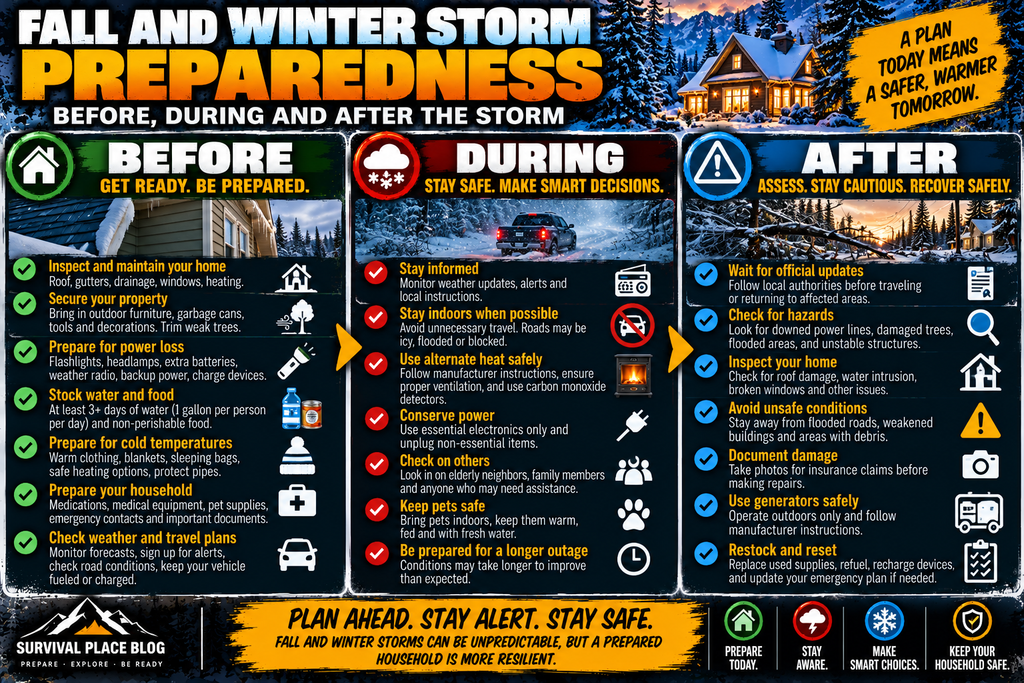
During the Storm
Once severe weather begins, your priority shifts from preparation to avoiding unnecessary risk.
Stay informed through official weather information and local emergency alerts.
Remain indoors during severe winds, heavy snow, or dangerous ice unless leaving is necessary for safety.
Keep children and pets away from downed trees and power lines.
Conserve phone batteries.
Use emergency supplies deliberately rather than waiting until something runs out.
Keep refrigerator and freezer doors closed as much as possible during an outage.
If the house begins getting dangerously cold and you don’t have a safe backup heat source, consider relocating rather than improvising with unsafe heating methods.
If You Must Go Outside
Dress in layers.
Protect your hands, feet, head, and exposed skin.
Wear footwear with good traction.
Move carefully around ice.
Avoid overexertion when shoveling heavy snow, particularly if you’re not accustomed to strenuous activity.
Take breaks and pay attention to how you’re feeling.
Cold temperatures combined with strenuous work can create serious health risks.
If local emergency officials are telling people to remain indoors, take those warnings seriously.
The National Weather Service winter safety guidance also covers cold-weather hazards, winter-storm preparation, and steps to take before, during, and after severe winter weather.
Check on Neighbors and Family
Storm preparedness works better when people look out for each other.
Older adults, people with disabilities, households with young children, and anyone dependent on medical equipment may need additional help during prolonged outages or extreme cold.
A simple phone call can identify a problem early.
You don’t need to become responsible for everyone on the block.
But knowing who might need help—and who might be able to help you—makes a neighborhood more resilient.
After the Storm
Danger doesn’t disappear when the snow stops falling or the wind dies down.
Watch for:
- Downed electrical lines
- Damaged trees
- Falling branches
- Roof damage
- Floodwater
- Icy walkways
- Damaged utility equipment
- Carbon monoxide hazards
- Spoiled refrigerated food
- Frozen or broken pipes
Don’t approach downed power lines.
Don’t enter standing water where electrical equipment may be energized.
Follow local guidance concerning drinking water if flooding or infrastructure damage has occurred.
If refrigerated food has been without safe cooling for an extended period, follow current food-safety guidance rather than relying solely on smell or appearance.
Restock Immediately
One of the easiest preparedness mistakes is using emergency supplies and forgetting to replace them.
After the storm:
Replace used batteries.
Recharge power banks.
Restock food and water.
Refill medications.
Dry wet equipment.
Replace damaged gear.
Restock safely stored fuel if applicable.
Then ask one important question:
What did we wish we had?
Every real storm is a test of your preparedness plan.
Use what you learned to improve it.
Build Preparedness in Layers
You don’t need to buy everything at once.
Start with the basics.
Layer 1 — Immediate safety
Flashlights, weather information, medications, smoke alarms, carbon monoxide detectors.
Layer 2 — Several days at home
Food, water, hygiene supplies, pet supplies, batteries, charging capability.
Layer 3 — Extended outage
Backup power, additional water, alternative cooking options that can be used safely, and deeper food storage.
Layer 4 — Longer disruptions
Expanded household supplies, additional safely stored fuel where appropriate, stronger communication options, and plans for relocating if your home becomes unsafe.
Build each layer gradually.
If you want to build beyond short-term storm readiness, our 90-Day Emergency Preparedness Checklist provides a practical framework for expanding your household’s water, food, power, medical supplies, and essential gear.
Preparedness should improve your household’s resilience without wrecking your budget.
Fall and Winter Storm Preparedness Checklist
Before storm season, make sure you can answer yes to these questions:
Home
- Are the gutters and downspouts clear?
- Are loose outdoor objects secured?
- Have obvious roof and drainage problems been addressed?
- Is the heating system ready for cold weather?
- Do we know where the main water shutoff is?
- Are vulnerable pipes protected?
- Are smoke and carbon monoxide detectors working?
Power and Lighting
- Do we have working flashlights?
- Do we have headlamps or hands-free lighting?
- Do we have spare batteries?
- Are portable power banks charged?
- Do we have a way to receive weather information without internet service?
- If we own a generator, do we know how to operate it safely?
Food and Water
- Do we have several days of drinking water?
- Do we have shelf-stable food?
- Do we have a manual can opener?
- Do we have food and water for pets?
- Can we prepare at least some meals if the electricity is out?
Health and Communication
- Do we have necessary medications?
- Are important phone numbers written down?
- Does everyone know the household emergency plan?
- Do we have a backup plan for essential medical equipment?
- Do we know where we could relocate if the house becomes unsafe?
Winter Weather
- Do we have a snow shovel?
- Do we have ice-control supplies?
- Do we have warm clothing and blankets?
- Is the vehicle prepared for winter driving?
- Do we know which local weather and emergency-alert sources to monitor?
If several answers are no, that’s your preparedness shopping and maintenance list.
You don’t have to solve everything this weekend.
Fix the most important gaps first.
A Storm Doesn’t Have to Become a Crisis
Fall and winter storms are normal parts of life in much of the country.
What turns them into emergencies is often the secondary effects: electricity disappears, roads close, heat stops working, water becomes unavailable, or a household realizes too late that basic supplies are missing.
A little preparation changes that equation.
Start with water, food, lighting, communication, warmth, medications, and a realistic plan for losing power.
Then build from there.
You don’t need a bunker.
You don’t need thousands of dollars of specialized gear.
You need enough preparation that when the weather turns ugly, your household isn’t starting from zero.
That’s the real goal of fall and winter storm preparedness.