Affiliate Disclosure: This post contains affiliate links. If you purchase through these links, Survival Place Blog may earn a commission at no additional cost to you. As an Amazon Associate I earn from qualifying purchases.
A wilderness hike can change in an instant. One misplaced step on loose rocks, a fall on a steep trail, or an unexpected injury can leave someone unable to continue walking.
What began as an ordinary outdoor adventure may suddenly become a situation requiring emergency assistance, shelter, and careful decisions.
Being injured on a wilderness trail is especially serious when you cannot safely walk back to the trailhead. The immediate challenge is not simply treating an injury. It is preventing additional harm, communicating your location, protecting yourself from exposure, and managing the situation until help arrives.
Whether you are hiking alone or with companions, knowing how to respond can make a significant difference.
This guide explains the practical decisions to make when an injury prevents a safe return. It is not a substitute for professional medical care or hands-on wilderness first-aid training.
1. How an Ordinary Hike Can Become a Medical Emergency
Most hikers do not begin their trip expecting an emergency.
A familiar trail, comfortable weather, and a short planned distance can create a sense of security. However, an injury several miles from the trailhead introduces complications that may not exist closer to home.
Consider a hiker who slips while descending a rocky trail and suffers a painful lower-leg injury.
The person is conscious and breathing normally but cannot bear weight without severe pain.
The trailhead is four miles away, daylight is fading, and cellular reception is unreliable.
The immediate question becomes: What should happen next?
Attempting to walk out could worsen the injury. Remaining in place without adequate clothing or shelter could create an exposure problem. Sending someone for help may introduce additional risks.
The situation requires deliberate decisions rather than an automatic attempt to keep moving.
Even experienced hikers can face these challenges. Preparation and judgment are essential.
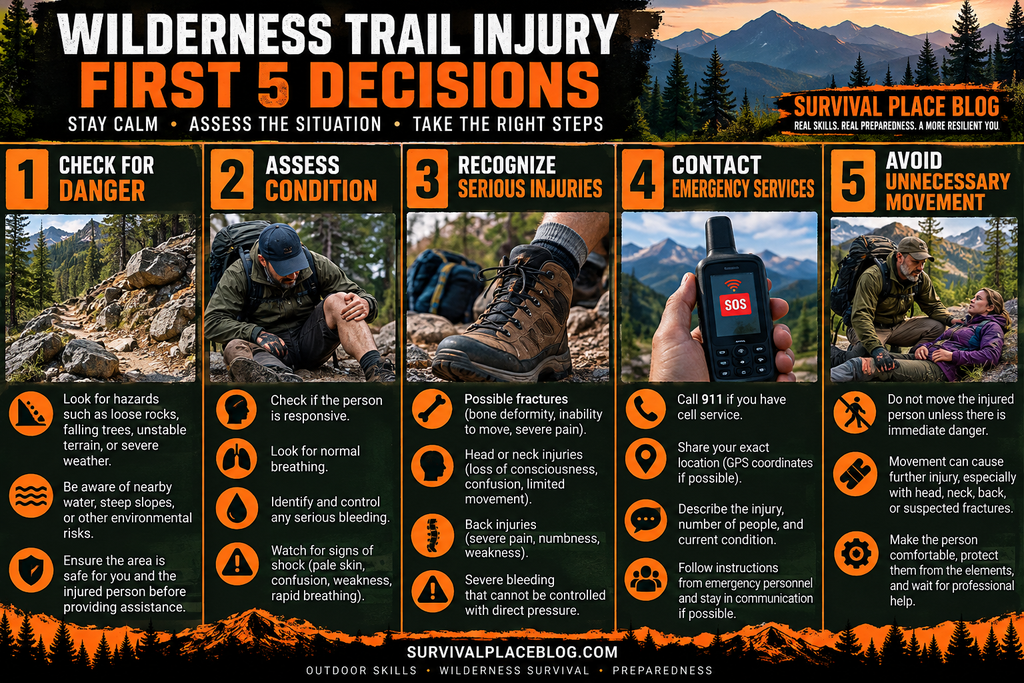
2. Stop and Assess Immediate Dangers
Before focusing entirely on the injured person, determine whether the surrounding location is safe.
An injury can happen on a narrow trail, beneath unstable rocks, near a river, or on exposed terrain during deteriorating weather.
Look for immediate threats such as:
- Falling rocks or unstable slopes.
- Fast-moving water or rising flood levels.
- Dangerous trail edges or steep drop-offs.
- Approaching thunderstorms.
- Falling branches or damaged trees.
- Extreme heat, cold, or wind exposure.
- Other hazards that could injure rescuers or companions.
Wildlife can also create a safety concern, particularly if an injury occurs near a large predator, its young, or a carcass. For guidance on recognizing potentially dangerous animal behavior and responding appropriately, see our guide, Dangerous Wildlife Encounters: How to Survive Cougars, Bears, and Other Threats.
Do not rush into a hazardous location and create another victim.
If the area is reasonably safe, avoid unnecessary movement while assessing the injured person.
If remaining in place presents an immediate threat, movement may be necessary. However, the risks of moving someone with a possible head, neck, spine, pelvis, or major limb injury must be weighed against the danger of remaining where they are.
The American Red Cross teaches a practical emergency approach: check the scene and person, call for appropriate assistance, and provide care within your training.
3. Evaluate the Injured Person’s Condition
Once immediate hazards have been considered, assess the person’s condition without causing unnecessary pain or movement.
Start with simple observations.
Is the Person Responsive?
Speak clearly and determine whether they can answer questions appropriately.
Notice whether they seem alert, confused, unusually sleepy, or unable to respond.
Is the Person Breathing Normally?
Look for normal breathing and obvious signs of respiratory distress.
If someone is unresponsive and not breathing normally, call emergency services and begin CPR and AED use according to recognized training and dispatcher instructions.
Is There Severe Bleeding?
Life-threatening bleeding requires immediate attention.
Call for emergency help and apply direct pressure as appropriate. Use other bleeding-control techniques only according to your training and current emergency guidance.
What Happened?
If the person is alert, ask:
- Where does it hurt?
- Did you strike your head?
- Did you lose consciousness?
- Can you feel your hands and feet normally?
- Are you dizzy, nauseated, or having difficulty breathing?
- Do you have relevant medical conditions, allergies, or medications?
Do not ask someone with a potentially serious injury to stand or walk simply to test whether they can continue.
The purpose of this assessment is to recognize immediate threats and communicate useful information to rescuers, not to diagnose the injury.
4. Recognize Serious Injuries and Warning Signs
Some injuries require emergency assistance even when the person initially appears stable.
Important warning signs include:
- Loss of consciousness or altered mental status.
- Difficulty breathing.
- Severe or uncontrolled bleeding.
- Suspected head, neck, or spinal injury.
- Severe pain, deformity, or inability to use an injured limb.
- Numbness, tingling, weakness, or loss of sensation.
- Signs of shock, including pale, cool skin, weakness, confusion, or rapid breathing.
- Severe chest or abdominal pain.
- Rapid deterioration in the person’s condition.
If a serious injury is suspected, request emergency assistance rather than attempting an improvised evacuation.
The American Red Cross provides additional guidance on recognizing serious injuries and responding to potentially life-threatening bleeding.
Why First-Aid Training Matters
A basic first-aid kit is useful, but equipment cannot replace the ability to recognize a medical emergency.
Hikers should learn first aid and CPR before traveling into remote areas.
For a more comprehensive introduction, read our guide, Wilderness First Aid: Essential Skills for Outdoor Emergencies.
A well-organized first-aid kit makes it easier to locate essential supplies during an emergency. The EVERLIT 250 Pcs Survival First Aid Kit combines basic first-aid materials with additional emergency supplies in a portable pouch, making it a practical option to consider for hiking and outdoor preparedness.
5. Decide Whether Movement Is Necessary or Unsafe
One of the most difficult decisions after a wilderness injury is whether the injured person should move.
There is no single rule that applies to every situation.
When Remaining in Place May Be Safer
Avoid unnecessary movement when:
- A serious head, neck, or spinal injury is suspected.
- The person has severe limb pain or obvious deformity.
- Walking causes significant pain or instability.
- Movement could worsen the injury.
- The current location is reasonably safe while assistance is arranged.
Do not attempt to straighten a visibly deformed limb or perform improvised medical procedures beyond your training.
When Movement May Be Necessary
An immediate environmental threat may make remaining in place more dangerous.
Examples include rising floodwater, falling rocks, active fire, or an unstable trail edge.
When movement is unavoidable, minimize unnecessary motion and follow emergency dispatcher guidance whenever possible.
Avoid the Temptation to Push Through
An injured hiker may insist they can continue because they do not want to delay companions or request rescue.
Pain, embarrassment, and concern about inconvenience can affect judgment.
A suspected serious injury is not something to test by walking several miles.
The safest decision may be to stop, communicate your location, and wait for trained assistance.
6. Contact Emergency Services and Communicate Your Location
When an injury prevents a safe return, obtaining help should be a priority.
In the United States, call 911 when emergency medical assistance is needed.
Provide the dispatcher with:
- Your name and callback information.
- The trail or recreation area.
- Your current location or GPS coordinates.
- The nature of the injury.
- The injured person’s condition.
- The number of people in your group.
- Nearby hazards and weather conditions.
- Any available access information.
Do not delay a needed emergency call simply because you cannot identify the exact injury.
Use Every Appropriate Communication Option
A cellular phone may work even when ordinary data service is limited, but coverage is not guaranteed.
If available, use a phone’s emergency SOS or satellite emergency features according to the manufacturer’s instructions.
A registered personal locator beacon, such as the Ocean Signal rescueME PLB1 Personal Locator Beacon, can provide an additional way to send an emergency distress alert when cellular service is unavailable. A PLB is intended for genuine emergencies and does not provide routine two-way text messaging.
A PLB is intended for genuine emergencies. It does not provide routine two-way text messaging.
Share Accurate Coordinates
A map application or GPS receiver may provide useful coordinates even when cellular data is unavailable.
Read coordinates carefully, including their format, and confirm them with the dispatcher.
For hikers who want to improve their understanding of maps, route planning, and position identification, our guide, Wilderness Navigation: How to Navigate Without GPS, explains essential navigation skills.
Once rescuers know your location, follow their instructions. Avoid changing locations unnecessarily unless remaining there is unsafe.
7. What Companions Should Do
Companions can be extremely valuable during an emergency, but poor coordination can make the situation worse.
If you are hiking with others, assign simple responsibilities based on their abilities and the conditions.
One person may:
- Contact emergency services.
- Communicate the group’s location.
- Monitor the injured person’s condition.
- Organize available clothing and shelter.
- Watch for changing weather.
- Help guide rescuers when instructed.
Should Someone Leave to Get Help?
Leaving an injured person alone is a serious decision.
Before separating, consider:
- Can emergency services already be contacted?
- Is the injured person medically stable?
- Does the person remaining have adequate shelter and supplies?
- Can the departing companion navigate safely?
- Is daylight sufficient?
- Are weather and trail conditions suitable?
- Could separating create a second emergency?
If reliable communication is available, ask rescuers for guidance.
If communication is impossible and someone must travel for help, the decision should account for the injured person’s condition, the available resources, and the risks of the route.
Do not send an inexperienced person into dangerous terrain simply because someone needs to do something.
Maintain Calm Communication
Explain what is happening to the injured person.
Reassurance, clear responsibilities, and regular condition checks can help everyone remain focused.
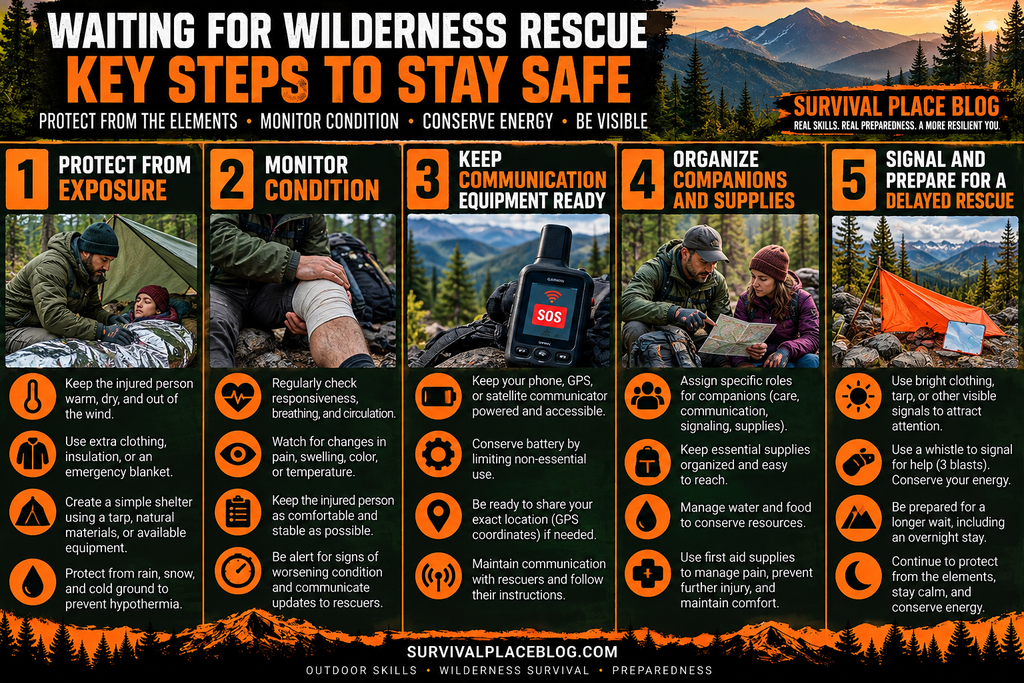
8. Protect the Injured Person From Weather and Exposure
An injured hiker who cannot move normally may become vulnerable to cold, rain, wind, or direct sunlight.
Even mild temperatures can become problematic when someone is wet, immobile, or unable to generate enough body heat.
Reduce Exposure
When appropriate and safe:
- Add dry insulating layers.
- Protect the person from rain and wind.
- Insulate them from cold ground using available pads or clothing.
- Provide shade in hot conditions.
- Avoid overheating or unnecessary wrapping in warm weather.
- Continue monitoring breathing, responsiveness, and comfort.
Do not move a seriously injured person solely to reach a more comfortable shelter location if movement could worsen the injury.
Instead, consider bringing suitable protection to the person.
Emergency Shelter Options
A compact emergency bivy, such as the S.O.L. Survive Outdoors Longer Emergency Bivvy, can help reduce heat loss and provide some protection from wind and precipitation while an injured hiker waits for assistance.
An emergency bivy is not a substitute for medical care, suitable insulation, or a properly selected shelter location. It is also not lightning-safe shelter.
For additional information about choosing shelter locations and managing exposure, see Emergency Outdoor Shelter: How to Choose, Build, and Survive the Night.
9. Manage Water, Food, Clothing, and Equipment
A delayed rescue can turn a short hike into a much longer outdoor stay.
Managing supplies becomes especially important when someone is injured and unable to travel.
Water
Account for the group’s available drinking water and environmental conditions.
Do not withhold needed water simply to conserve supplies.
However, if the injured person has altered consciousness, difficulty swallowing, significant nausea, or may require urgent surgery or anesthesia, avoid giving food or drink unless emergency medical personnel advise otherwise.
Food
For alert, stable individuals who can safely eat, available food may help support comfort and energy during a prolonged delay.
Food is generally a lower immediate priority than emergency communication, serious injury management, and protection from exposure.
Clothing
Use available layers strategically.
Dry insulation, waterproof protection, spare socks, and an insulating pad may help protect someone who cannot move around normally.
Equipment
Keep essential items accessible:
- Communication devices.
- Headlamps.
- First-aid supplies.
- Emergency shelter.
- Water.
- Navigation equipment.
- Signaling devices.
Avoid scattering supplies across the surrounding area or exhausting equipment batteries unnecessarily.
10. Signal for Help and Improve Rescue Visibility
After contacting rescuers, make it easier for them to locate your group without creating additional hazards.
Useful signaling tools include:
- A whistle.
- A brightly colored jacket or emergency shelter.
- A flashlight or headlamp.
- A signaling mirror in appropriate daylight conditions.
- An electronic emergency signaling device.
A compact emergency whistle, such as the LuxoGear Emergency Whistles with Lanyard, is a practical addition to a hiking survival kit. Its bright orange color improves visibility, and its battery-free design allows hikers to signal for help without relying on electronic equipment.
Make Yourself Visible Safely
Brightly colored equipment may help rescuers identify your location.
However, do not move an injured person onto exposed terrain or near unstable slopes simply to improve visibility.
Do not start an uncontrolled fire or create smoke as a rescue signal.
If you can communicate with rescuers, follow their instructions about lighting, signaling, and location.
Conserve energy and maintain awareness of your surroundings.
11. Prepare for Delayed Rescue or an Unexpected Overnight Stay
Even after emergency assistance has been requested, rescue may take time.
Distance, terrain, weather, darkness, and available rescue resources can affect how quickly responders reach your location.
Establish Priorities
While waiting:
- Monitor the injured person’s breathing, responsiveness, and other important changes.
- Follow emergency medical instructions.
- Protect the group from weather and exposure.
- Maintain communication when possible.
- Keep essential supplies organized.
- Avoid unnecessary movement and additional risks.
Prepare for Darkness
If daylight is fading, locate headlamps, organize clothing, and identify immediate hazards.
Do not assume rescuers will arrive before sunset.
If an overnight delay becomes likely, focus on maintaining a safe location and protecting the injured person rather than attempting unnecessary survival projects.
Avoid Creating Additional Problems
An improvised shelter, fire, or relocation effort may consume valuable energy or introduce hazards.
Choose actions that address an actual need and remain within your abilities.
For more guidance on managing an unexpected night outdoors, see our guide, Stranded Overnight in the Wilderness: What to Do When You Can’t Get Home. It covers shelter decisions, exposure management, emergency communication, and preparing safely for daylight or rescue.
12. Common Mistakes, Prevention Strategies, and a Real-World Scenario
Several common mistakes can turn an already difficult situation into a more serious emergency.
Mistakes to Avoid
Trying to walk out with a potentially serious injury: Continuing may worsen the injury and make eventual rescue more complicated.
Moving someone unnecessarily: Suspected spinal, pelvic, or major limb injuries require particular caution.
Delaying emergency assistance: Waiting until daylight fades or the injured person deteriorates may reduce available options.
Separating without a plan: Sending companions away without navigation skills, supplies, or clear responsibilities can create another emergency.
Ignoring exposure: A person who cannot move normally may become cold or overheated faster than expected.
Relying on one communication device: Batteries, reception, and equipment limitations can affect rescue communications.
Taking unnecessary risks to signal rescuers: Visibility is important, but it does not justify entering dangerous terrain.
Real-World Scenario: An Injury Four Miles From the Trailhead
Two hikers are returning from a mountain viewpoint when one slips on loose rocks.
The injured hiker experiences severe ankle pain and cannot bear weight.
Rather than trying to continue, the pair stop and assess the surroundings.
The injured person is alert, breathing normally, and has no obvious life-threatening bleeding, but the injury may be serious.
They determine that the immediate location is reasonably safe.
One hiker uses a phone to contact emergency services and provides the trail name, approximate distance from the trailhead, and available GPS coordinates.
They follow the dispatcher’s instructions and avoid unnecessary movement.
As temperatures begin falling, the companion provides an insulating layer and protects the injured hiker from wind and cold ground.
The pair organize their equipment, conserve phone battery power, and monitor the injured person’s condition while waiting for assistance.
Rescuers reach their location later that evening.
What Made the Difference?
The successful response did not depend on an elaborate wilderness survival technique.
It depended on a series of practical decisions:
- Recognizing that walking out was unsafe.
- Checking immediate environmental hazards.
- Requesting assistance promptly.
- Communicating an accurate location.
- Avoiding unnecessary movement.
- Preventing additional exposure.
- Remaining organized while awaiting rescue.
The objective was not to overcome the injury through determination. It was to prevent further harm until trained help arrived.
Wilderness Injury Emergency Checklist
Use this checklist as a quick reminder when an injury prevents a safe return.
Immediate Safety
- Stop and check the surrounding area for hazards.
- Avoid unnecessary movement.
- Check responsiveness, breathing, and severe bleeding.
- Recognize signs requiring emergency medical assistance.
Communication
- Contact emergency services when needed.
- Share the trail name and accurate location.
- Describe the injury and the person’s condition.
- Follow dispatcher or rescue-team instructions.
Protection
- Protect the injured person from cold, wind, rain, or excessive heat.
- Use available clothing and shelter appropriately.
- Monitor the person’s condition.
- Keep essential equipment accessible.
Rescue Preparation
- Organize companions and responsibilities.
- Use appropriate signaling equipment.
- Avoid unnecessary relocation.
- Prepare for a possible delay or overnight stay.
Conclusion: When You Cannot Walk Out, Make Safety the Priority
Being injured on a wilderness trail can transform an ordinary hike into a serious emergency.
When walking out is no longer safe, the most important actions are often straightforward: assess danger, recognize serious medical concerns, request help, prevent exposure, and avoid unnecessary risks.
A first-aid kit, emergency shelter, navigation equipment, and communication device can all contribute to preparedness. However, knowing when to stop and ask for assistance is equally important.
Before your next hike, review your route, tell someone where you are going, carry appropriate equipment, and consider completing recognized first-aid training.
When an injury prevents a safe return, survival begins with protecting the injured person and making careful decisions until help arrives.