A Practical Everyday Carry Guide for Real-World Preparedness
Affiliate Disclosure: This post contains affiliate links. If you purchase through these links, Survival Place Blog may earn a commission at no additional cost to you. As an Amazon Associate I earn from qualifying purchases.
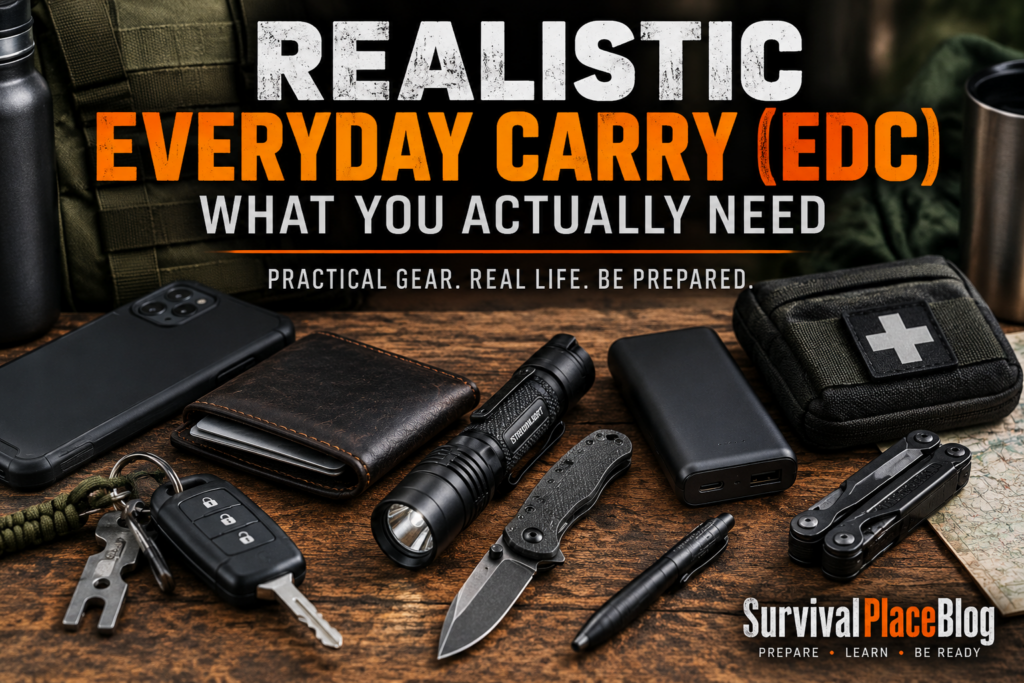
Everyday carry doesn’t need to mean tactical backpacks, pockets full of gadgets, or preparing for the end of the world.
A realistic everyday carry setup is much simpler.
It’s the small collection of useful items you keep with you because they solve problems you’re actually likely to encounter: a dead phone, power outage, minor injury, unexpected delay, dark parking lot, vehicle problem, payment-system outage, severe weather, or another disruption to your normal routine.
The goal isn’t to carry everything.
The goal is to carry a few things that consistently make you more capable without weighing you down.
This guide will help you build an everyday carry setup around your actual lifestyle rather than someone else’s gear list.
If you want a more complete emergency kit for situations that require more than everyday essentials, see our 72-Hour Go-Bag Checklist.
What Is Everyday Carry?
Everyday carry—usually shortened to EDC—simply means the items you routinely carry with you.
Everyone already has an EDC whether they call it that or not.
For most people, it starts with:
- Phone
- Wallet
- Keys
Preparedness-oriented EDC adds a few carefully selected items that help solve common problems or provide basic capability during an emergency.
The important word is everyday.
If your setup is so heavy, complicated, uncomfortable, or inconvenient that you leave it at home, it isn’t accomplishing much.
A useful EDC should fit naturally into your normal routine.
Build Your EDC Around Your Real Life
Before buying anything, think about an ordinary day.
Where do you spend most of your time?
How far are you from home?
Do you commute by car or public transportation?
Do you work in an office, warehouse, shop, outdoors, or from home?
Are you regularly responsible for children or another family member?
Do you travel frequently?
What weather conditions are common where you live?
The answers matter because someone commuting 30 miles through winter weather has different needs than someone who works five blocks from home.
Your everyday carry should reflect your environment, responsibilities, commute, health needs, and local rules.
That’s much more useful than copying a gear photo from the internet.
The Three Layers of a Realistic EDC
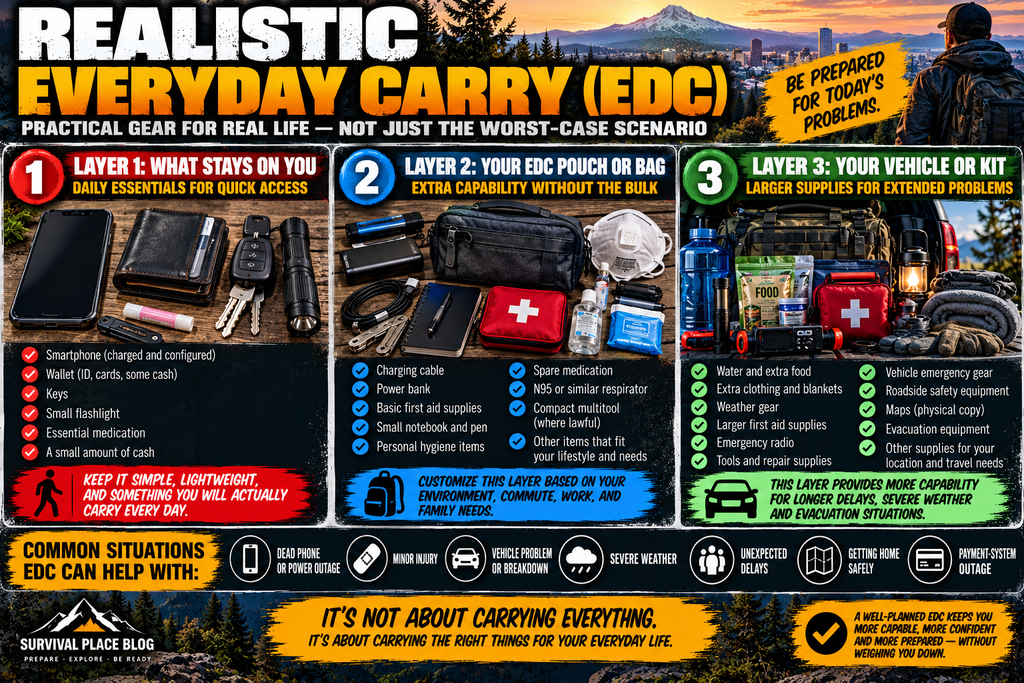
A practical everyday carry system can be divided into three layers.
Layer 1: What Stays on You
These are the essentials you normally keep in your pockets, purse, or immediately accessible.
Examples include:
- Smartphone
- Wallet
- Keys
- Small flashlight
- Essential medication
- A small amount of cash
These items should be lightweight enough that carrying them becomes automatic.
Layer 2: Your Small EDC Pouch or Work Bag
This layer provides additional capability without stuffing everything into your pockets.
Depending on your lifestyle, it might include:
- Charging cable
- Power bank
- Basic first aid supplies
- Small notebook
- Personal hygiene items
- Spare medication
- N95 or similar respirator
- Compact multitool where lawful and appropriate
Layer 3: Your Vehicle or Emergency Bag
This is where larger preparedness equipment belongs.
Water, extra food, clothing, blankets, weather gear, larger first aid supplies, emergency radios, and evacuation equipment generally make more sense in a vehicle kit or emergency bag than in your pockets.
Trying to turn your EDC into a miniature bug-out bag usually defeats the purpose.
The Realistic Everyday Carry Essentials
Let’s start with the items that provide the most everyday usefulness without adding unnecessary bulk.
1. A Prepared Smartphone
For most people, the smartphone is the most capable piece of equipment they carry.
It provides:
- Emergency communication
- Navigation
- Weather information
- Flashlight capability
- Camera
- Emergency alerts
- Banking and payment access
- Transportation information
- Stored documents
- Medical information
But a phone is only useful while it has power and while the services you need remain available.
Prepare yours before an emergency.
Consider:
- Setting up emergency contacts
- Configuring your phone’s Emergency SOS features
- Adding medical information where appropriate
- Downloading offline maps before travel
- Keeping important phone numbers somewhere besides your contact list
- Protecting the device with a strong passcode
- Keeping the operating system and emergency features updated
Don’t assume you’ll always have cellular service, internet access, or unlimited battery power.
2. Wallet, Identification and Backup Cash
Your wallet doesn’t need to be complicated.
Carry the identification and payment methods you normally need, along with any important medical or insurance information appropriate for your situation.
A modest amount of cash can also be useful.
Electronic payment systems can become temporarily unavailable because of power failures, network outages, merchant problems, or other disruptions.
You don’t need to carry a large amount of money. The purpose is simply to have another payment option if a card or phone doesn’t work.
Keep cash discreet and separate from unnecessary cards or documents.
3. Compact Flashlight
Your phone has a flashlight, but a dedicated light has several advantages.
It doesn’t consume your phone battery, it’s easier to hold while performing a task, and many small flashlights provide significantly better illumination.
A compact light can be useful for:
- Walking through a dark parking area
- Looking under a vehicle
- Finding something during a power outage
- Checking an electrical panel
- Navigating stairs
- Roadside problems
- Signaling for attention
Choose something small enough that you’ll actually carry it.
You don’t need an enormous tactical flashlight for ordinary EDC.
A simple, dependable light with an easy-to-use switch is usually enough.
If you want a dedicated light without adding much bulk, a compact rechargeable flashlight can be an easy addition to an everyday carry setup.
4. Phone Charging Cable and Portable Power Bank
A dead phone can turn a minor inconvenience into a significant problem.
Without it, you may lose access to communication, navigation, transportation apps, digital tickets, emergency alerts, and important information.
A short charging cable and compact power bank provide a simple backup.
For everyday use, you don’t necessarily need the largest battery available. Balance capacity against weight and size so you’ll actually carry it.
Recharge the power bank periodically instead of discovering during an outage that it has been sitting empty for month
A compact portable power bank is an easy way to keep backup phone power available without adding much weight to your everyday carry.
5. Basic First Aid Supplies
You don’t need a trauma bag in your pocket.
For ordinary everyday carry, a few basic supplies may be more useful:
- Adhesive bandages
- Antiseptic wipes
- Blister treatment
- Small gauze pads
- Medical tape
- Any personal medication you may need
Choose supplies based on your own needs and activities. For a ready-made option, the EVERLIT 250-Piece Survival First Aid Kit combines basic first-aid supplies with several additional emergency items in a portable organized bag. It’s a practical kit to keep in a vehicle.
Someone working around tools or machinery may carry different supplies than someone working in an office.
More advanced medical equipment should match your training. Buying specialized emergency medical gear doesn’t replace knowing how to use it.
Consider taking a recognized first aid and CPR course if you want to improve your emergency medical capability.
6. Essential Medications
If you depend on medication during the day, consider how an unexpected delay could affect you.
A road closure, severe storm, transit interruption, vehicle breakdown, or other event could keep you away from home longer than expected.
Carry necessary medication according to your healthcare provider’s instructions and applicable storage requirements.
When traveling, keep important medication accessible rather than buried in checked luggage.
7. Pen and Small Notebook
A pen seems almost too simple to mention—until you need one.
It can be useful for:
- Writing down an address
- Leaving a note
- Recording information after an accident
- Taking instructions
- Writing a phone number
- Filling out paperwork
A small notebook adds another layer of usefulness if your phone is unavailable or conserving battery becomes important.
You don’t need a tactical pen or specialized notebook.
A dependable pen and a few pieces of paper work.
Optional EDC Tools
This is where everyday carry becomes personal.
These items aren’t necessary for everyone, but they may make sense depending on your work, commute, hobbies, and environment.
Multitool
A compact multitool can provide pliers, screwdrivers, scissors, a file, and other useful tools in a small package.
However, some multitools contain blades.
That means workplace policies, schools, government buildings, transportation systems, event venues, and local laws may restrict where certain tools can be carried.
Choose your tool based on where you actually spend your day.
A small bladeless or limited-function tool may make more sense in some environments.
Pocket Knife
A pocket knife can be a useful cutting tool, but it isn’t a universal EDC recommendation.
Knife laws and carry restrictions vary by jurisdiction, blade design, blade length, location, and circumstances.
Your employer or a private venue can also have rules that are more restrictive than local law.
If you choose to carry one, understand the laws and policies that apply where you live, work, and travel.
Don’t assume something legal at home is legal everywhere you go.
Personal Safety Alarm
A small personal alarm can attract attention during an emergency and may be appropriate for people who don’t want to carry other defensive tools.
Like any emergency device, keep it somewhere you can actually reach rather than buried at the bottom of a bag.
Respiratory Protection
A properly selected respirator can be useful during wildfire smoke, heavy dust, cleanup work, and certain other airborne hazards.
An N95 respirator is compact enough to keep in many work bags, purses, or vehicle kits.
Fit and correct use matter.
Tracking Device
Bluetooth trackers can help locate keys, bags, luggage, and other frequently misplaced items.
They’re convenience tools rather than emergency locators and shouldn’t be confused with satellite emergency communication devices.
What About Water?
Water is important, but carrying a water purification system in your pants pocket every day isn’t necessary for most people.
A better approach is usually layered.
Carry a reusable water bottle when practical.
Keep additional water in your work area or vehicle where conditions allow.
For longer trips, hiking, evacuation, or situations where safe water may be uncertain, a compact filter or appropriate treatment method can become much more valuable.
For a more complete approach to emergency water planning at home, see our Home Water Storage System guide.
For travel, hiking, or emergency backup, a compact water filter like the Sawyer MINI can provide another option when safe drinking water isn’t readily available.
What About Fire?
Older EDC lists often automatically included a lighter.
For some people—especially those who work outdoors, camp frequently, or live in rural areas—a lawful fire-starting method may be useful.
For many office workers and urban commuters, it provides little everyday value.
Don’t carry something simply because traditional survival lists tell you to.
Build around the situations you actually encounter.
And never use an open flame for supposed wound sterilization or similar improvised medical treatment.
Everyday Carry for Different Lifestyles
There is no single perfect EDC.
A better approach is to start with the basics and then adjust them around your normal day.
Office and Corporate Workers
A practical office setup might include:
- Phone
- Wallet
- Keys
- Small flashlight
- Charging cable
- Compact power bank
- Basic first aid supplies
- Pen
- Small notebook
- Essential medication
Check workplace policies before adding knives or multitools.
Parents and Caregivers
Parents often need less tactical gear and more practical redundancy.
Consider:
- Phone and charging backup
- Basic first aid supplies
- Wipes
- Small snacks
- Water
- Essential family medication
- Emergency contact information
- Small comfort item for younger children
Your EDC should account for the people who depend on you.
Drivers and Commuters
Drivers have an advantage: the vehicle can carry equipment that doesn’t belong in your pockets.
Your personal EDC might include:
- Phone
- Wallet
- Flashlight
- Charging cable
- Power bank
- Basic first aid
- Cash
Then build a separate vehicle emergency kit with weather gear, water, food, roadside equipment, and other supplies appropriate for your region.
This keeps your pockets light while dramatically increasing your overall preparedness.
Outdoor and Rural Workers
People working outdoors or far from immediate services may benefit from additional capability.
Depending on the job and environment:
- Durable flashlight
- Work gloves
- Multitool
- Additional water
- Weather protection
- First aid supplies
- Charging backup
- Whistle
- Appropriate communication equipment
Medical equipment beyond basic first aid should match your training and workplace requirements.
Travelers
Travel EDC should emphasize documents, communication, power, and redundancy.
Consider:
- Passport or required identification
- Phone
- Charging cable
- Power bank
- Backup payment method
- Small amount of local currency
- Essential medications
- Copies or secure backups of important travel information
International travel adds another complication: laws and regulations change when you cross borders.
Items that are routine at home—including knives, tools, medications, sprays, and other equipment—may be restricted elsewhere.
For a more complete plan for handling flight cancellations, transportation shutdowns, or being stranded abroad, see our Emergency Travel Survival Guide.
Everyday Carry vs. a Go-Bag
These serve different purposes.
Your EDC handles routine problems and short disruptions while staying light enough to carry every day.
A 72-hour go-bag is designed for situations where you may need to leave home or remain away from normal supplies for an extended period.
A vehicle emergency kit supports roadside emergencies and situations where your vehicle becomes a temporary source of supplies.
And your home preparedness supplies cover longer disruptions when staying home is the better option.
You don’t need to cram all four systems into one backpack.
Layering preparedness is more practical.
What NOT to Carry
EDC can become a hobby, and that’s where people sometimes lose sight of its purpose.
More equipment doesn’t automatically mean more preparedness.
Be cautious about carrying:
- Multiple tools that perform the same job
- Several knives
- Oversized equipment you rarely use
- Gadgets purchased because they look useful but aren’t
- Heavy equipment that belongs in your vehicle or emergency bag
- Medical equipment you don’t know how to use
- Items prohibited by your workplace or local law
Every item adds weight and takes up space.
Ask a simple question:
Do I actually use this, or does it solve a realistic problem I might encounter?
If the answer is no, it probably doesn’t need to be in your everyday carry.
The 10-Minute EDC Audit
You can improve your setup without buying anything.
Empty your pockets, purse, backpack, or work bag onto a table.
Look at every item.
Then ask:
Did I use this during the last month?
What problem does it solve?
Would I know how to use it under stress?
Is there another item already doing the same job?
Is it legal and permitted everywhere I normally carry it?
Would this be better stored in my vehicle or emergency bag?
Remove unnecessary duplicates.
Replace dead batteries.
Recharge your power bank.
Check medication and first aid expiration dates.
Update emergency contacts on your phone.
That’s a much more useful EDC upgrade than simply buying another gadget.
Realistic Everyday Carry Checklist
Bare Minimum
☐ Smartphone
☐ Wallet and identification
☐ Keys
☐ Essential medication
☐ Small amount of backup cash
Practical Everyday Setup
☐ Compact flashlight
☐ Charging cable
☐ Portable power bank
☐ Basic first aid supplies
☐ Pen
☐ Small notebook
Optional — Based on Your Lifestyle
☐ Multitool where permitted
☐ Pocket knife where lawful and appropriate
☐ Personal safety alarm
☐ N95 respirator
☐ Water bottle
☐ Bluetooth tracker
☐ Work gloves
☐ Additional medication
☐ Small hygiene supplies
Better Stored in Your Vehicle or Emergency Bag
☐ Additional water
☐ Emergency food
☐ Extra clothing
☐ Blanket or weather protection
☐ Larger first aid kit
☐ Emergency radio
☐ Roadside equipment
☐ Larger tools
☐ Evacuation supplies
Download the Free Realistic EDC Checklist
Want a simple version you can print and use to build or review your everyday carry setup? Download our free Realistic Everyday Carry (EDC) Checklist.
It includes everyday essentials, optional items, gear that’s better kept in your vehicle or go-bag, and a quick 10-minute EDC audit.
Maintain Your EDC
Preparedness equipment isn’t useful if it doesn’t work.
Every few months:
- Recharge stored batteries and power banks.
- Replace depleted flashlight batteries.
- Check first aid supplies.
- Review medication dates and storage requirements.
- Update emergency contacts.
- Check cables for damage.
- Remove equipment you no longer use.
- Adjust your setup when your job, commute, season, or responsibilities change.
Your EDC should evolve with your life.
Final Thoughts: Carry What Solves Real Problems
The best everyday carry isn’t the one with the most equipment.
It’s the one you actually carry.
Start with your phone, identification, keys, necessary medication, and basic financial backup. Then add a few items that solve realistic problems in your daily routine.
For many people, a flashlight, small first aid kit, charging cable, power bank, pen, and notebook provide far more practical value than a pocket full of specialized survival gadgets.
Keep larger preparedness equipment where it belongs—in your vehicle, at work, at home, or in an emergency bag.
Your EDC should be:
- Lightweight
- Useful
- Legal where you carry it
- Appropriate for your lifestyle
- Easy to maintain
- Comfortable enough to carry every day
Preparedness doesn’t require carrying everything.
It means thinking ahead about the problems you’re realistically likely to encounter and having a few dependable ways to deal with them.
Carry what you use. Know how to use what you carry. Keep the rest where it belongs.