
Practical preparedness for protests, riots, crowd disturbances, transportation shutdowns, and unexpected unrest.
Affiliate Disclosure: This post contains affiliate links. If you purchase through these links, Survival Place Blog may earn a commission at no additional cost to you. As an Amazon Associate I earn from qualifying purchases.
Most people don’t leave home expecting to encounter civil unrest.
You may simply be commuting home from work, picking up your kids, traveling through an unfamiliar city, attending an event, or running errands when a demonstration, confrontation, road closure, or large crowd suddenly changes the situation around you.
That’s why civil unrest safety isn’t about politics.
It’s about recognizing when an ordinary environment is becoming unpredictable and knowing how to get yourself and the people with you somewhere safer.
The best outcome usually isn’t fighting your way through trouble. It’s recognizing trouble early enough that you never become trapped inside it.
This guide focuses on practical steps ordinary people can take before, during, and after a period of civil unrest.
A practical everyday carry setup, a charged phone, situational awareness, and a simple family communication plan can make a significant difference when normal routines suddenly stop working.
What Civil Unrest Can Actually Disrupt
Civil unrest covers a wide range of situations.
A peaceful demonstration may cause nothing more than temporary traffic delays. A larger disturbance may involve blocked roads, overwhelmed public transportation, damaged property, fires, confrontations, police activity, or temporary business closures.
The mistake is assuming every crowd is dangerous—or assuming every crowd will remain peaceful.
Your job isn’t to predict what people will do.
Your job is to recognize changes around you and maintain options.
Potential disruptions can include:
- Road closures
- Public transit delays or shutdowns
- Large crowds
- Police-controlled areas
- Closed businesses
- Interrupted cellular service
- Traffic congestion
- Emergency response delays
- Fires or smoke
- Chemical irritants
- Separation from family members
- Difficulty reaching home
The earlier you recognize those problems, the more choices you usually have.
1. Know What’s Happening Before You Leave
One of the easiest ways to stay out of a dangerous situation is to avoid walking or driving into it.
Before heading downtown, attending a major event, commuting through a known demonstration area, or traveling during a period of instability, spend a few minutes checking current conditions.
Look at:
- Local emergency alerts
- Transportation agency notices
- Local government information
- School or university alerts
- Road closures
- Transit service changes
- Reputable local news
- Weather conditions if severe weather is also affecting the area
Social media can provide fast information, but rumors can spread just as quickly.
Treat unverified posts as leads—not facts.
Whenever possible, confirm important information through official emergency alerts or multiple reliable sources.
2. Always Have More Than One Way Home
Your normal route may not be available.
A blocked intersection, police perimeter, disabled vehicle, fire, crowd, or transit shutdown can turn a routine commute into a complicated trip home.
Before entering an area where disruption is possible, know:
- Your primary route
- At least one alternate route
- A route that avoids the downtown core
- Another bridge or major crossing if applicable
- Where you could safely wait
- Where family members should meet if communication fails
Don’t wait until you’re surrounded by stopped traffic to begin looking for alternatives.
If conditions ahead appear unstable, rerouting early is usually easier than trying to escape once thousands of other people make the same decision.
Don’t Let Your Fuel Tank Become the Emergency
During a major disruption, gas stations may become congested or temporarily inaccessible.
For regular commuters, keeping the vehicle reasonably fueled is a simple preparedness habit.
You don’t need to keep the tank completely full every day.
But routinely driving on fumes removes one of your escape options.
3. Recognize When a Crowd Is Changing
A large gathering isn’t automatically dangerous.
What matters is how the environment is changing.
Pay attention to warning signs such as:
- People suddenly running
- Rapid movement in one direction
- Shouting or confrontations increasing
- Objects being thrown
- Fires starting
- Windows being broken
- Police rapidly repositioning
- Barriers being moved
- Streets becoming blocked
- Businesses suddenly locking doors
- People putting on protective equipment
- Smoke or chemical irritants appearing
You don’t need to know exactly what caused the change.
If the environment is deteriorating, start creating distance.
Waiting to see what happens can turn an easy exit into a difficult one.
4. Move Toward the Edge, Not the Center
If you unexpectedly encounter a demonstration or disturbance, avoid moving deeper into the crowd simply because that is the direction everyone else is going.
Look for a safe route toward the perimeter.
Your goal is usually to increase distance from:
- Dense crowds
- Active confrontations
- Fires
- Broken glass
- Police lines
- Moving vehicles
- Barricades
- Bottlenecks
Don’t stop nearby to watch.
Don’t move closer to get better photos.
Don’t assume being across the street means you’re outside the affected area.
Conditions can change quickly.
Once you have a safe route away, use it.
5. Crowd Density Can Become a Hazard by Itself
You don’t need violence for a crowd to become dangerous.
A tightly packed group moving through a narrow area can create crushing and falling hazards.
Be especially cautious around:
- Doorways
- Gates
- Stairways
- Narrow streets
- Fences
- Barricades
- Transit entrances
- Tunnels
- Bridges
If crowd density is increasing, don’t intentionally push deeper into it.
Stay aware of exits and open areas.
If people around you begin moving suddenly, focus on staying upright and avoiding obstacles rather than trying to force your way directly against a mass of people.
Children should remain close to an adult rather than being allowed to move independently through a dense crowd.
6. Keep a Low Profile
This is sometimes described in preparedness circles as the “gray man” concept.
The useful part is simple:
Don’t unnecessarily attract attention during an unstable situation.
You don’t need special clothing or secret tactics.
Ordinary, practical behavior works.
Consider:
- Neutral everyday clothing
- Comfortable walking shoes
- Keeping expensive equipment out of sight
- Avoiding unnecessary arguments
- Avoiding political symbols when your objective is simply getting through the area
- Keeping your phone secured when you’re moving
- Remaining calm and purposeful
This isn’t about hiding who you are.
It’s about avoiding unnecessary interaction while you’re trying to leave an unpredictable environment.
7. Don’t Become Part of the Confrontation
If two groups are arguing, fighting, throwing objects, or confronting law enforcement, your safest role as a bystander is generally no role at all.
Move away.
Trying to mediate between angry strangers can put you directly between opposing groups.
Likewise, yelling, arguing, threatening, or challenging people can transform a situation that had nothing to do with you into a personal confrontation.
Your objective is simple:
Create distance and get somewhere safer.
8. Be Careful Around Police-Controlled Areas
During major disturbances, law enforcement may establish barriers, restricted zones, evacuation routes, or crowd-control lines.
Don’t assume your normal street or sidewalk remains accessible.
Follow lawful directions from authorities and don’t attempt to force your way through a restricted area.
If you’re told to leave an area, move calmly toward the indicated exit when you can safely do so.
Avoid positioning yourself between a police line and a large crowd.
Even if you aren’t involved in the demonstration, being physically located between opposing groups can put you in a dangerous position.
9. What to Do if Chemical Irritants Are Used
Riot-control agents such as tear gas can irritate the eyes, skin, nose, throat, and lungs. Symptoms can include tearing, burning, coughing, chest tightness, and difficulty breathing.
If you’re exposed, your first priority is to leave the affected area and get to fresh air.
If the release occurred outside, move away from the contaminated area. If exposure occurred inside a building, get outside when you can do so safely.
Once you’re somewhere safe:
- Avoid rubbing your eyes.
- Remove contaminated clothing when practical.
- Wash exposed skin with plenty of soap and water.
- If your eyes are burning or your vision is blurred, rinse them with plain water for 10–15 minutes.
- Remove contact lenses and don’t put contaminated contacts back in.
- Seek medical attention for significant breathing difficulty, persistent symptoms, severe exposure, or other concerning symptoms.
CDC guidance also advises removing contaminated clothing and washing exposed skin as soon as possible after chemical exposure.
For more detailed exposure and decontamination information, see the CDC guidance on riot-control agents.
Important: Don’t rely on internet “home remedies” for chemical exposure. Follow current medical/public-health guidance and emergency instructions.
10. Decide Whether to Leave or Shelter Temporarily
Sometimes leaving immediately is the right decision.
Sometimes walking directly into the disturbance is worse.
If the route outside is temporarily unsafe, a secure indoor location may provide a better short-term option while conditions change.
Possible temporary locations might include:
- Your workplace
- A hotel
- A staffed public building
- A business that is remaining open
- A friend’s home
- Another secure indoor location away from the disturbance
This isn’t an invitation to hide indefinitely.
It’s a decision between two immediate risks.
Ask yourself:
Is my current location safer than the route I would have to take to leave?
Continue monitoring conditions and be prepared to move when a safer route becomes available or authorities direct you to evacuate.
11. If You’re Driving When Unrest Develops
A vehicle gives you mobility, but it can also become trapped.
If you see a large crowd, roadblock, police activity, fire, or disturbance ahead, don’t intentionally drive toward it to see whether you can get through.
Turn around or reroute while you still have room.
If traffic stops:
- Keep doors locked.
- Keep windows closed.
- Leave space between your vehicle and the vehicle ahead when possible.
- Avoid confrontations with pedestrians or other drivers.
- Don’t use your vehicle to threaten or intimidate people.
- Follow police or emergency directions.
- Reroute before conditions become worse when a safe alternative exists.
If a road is clearly blocked, treat it as blocked.
A few minutes spent finding another route is preferable to becoming trapped in the center of a disturbance.
12. Have a Family Communication Plan
During emergencies, family members may be at work, school, home, or somewhere else entirely.
Don’t make the first discussion about your plan happen during the emergency.
Decide beforehand:
- Who contacts whom
- Where you’ll meet if home isn’t accessible
- Who picks up children
- What happens if cellular calls don’t work
- Which relative or friend outside the immediate area can serve as a contact
- When family members should shelter where they are rather than attempting to travel
FEMA preparedness guidance recommends establishing family communication plan and meeting plans before emergencies, including an out-of-area contact who can help family members reconnect if local communications are disrupted.
Text Before You Call
When cellular networks are congested, a short text may sometimes be easier than a lengthy phone conversation.
Keep messages simple:
I’m safe. I’m at work. Staying here until roads clear. Will update at 7:00.
That tells your family what they actually need to know.
13. Carry a Small Civil Unrest Safety Kit
You don’t need to walk around carrying a giant tactical backpack.
For most commuters and everyday situations, a few basic items cover many of the problems you’re likely to encounter.
Consider carrying:
- Charged smartphone
- Identification
- Some cash
- Essential medication
- Compact flashlight
- Small first-aid kit
- Portable power bank
- Charging cable
- Water
- Small snack
- Emergency contact information
- Weather-appropriate clothing
A compact portable power bank can be particularly useful because navigation, messaging, emergency alerts, and news updates can drain a phone battery quickly during a prolonged disruption.
For a more complete breakdown of what makes sense to carry every day—and what should stay in your vehicle or larger emergency kit—see our Realistic Everyday Carry guide.
14. Your Vehicle Can Carry the Heavier Gear
Your pockets shouldn’t have to solve every emergency.
If you commute regularly, your vehicle can carry supplies that would be annoying or impractical to carry every day.
A basic vehicle kit might include:
- Walking shoes
- Extra water
- Shelf-stable food
- First-aid supplies
- Flashlight or headlamp
- Phone charging equipment
- Seasonal clothing
- Rain gear
- Blanket
- Paper map
- Basic hygiene supplies
- Essential medications when appropriate and safely stored
If conditions become severe enough that you may need to leave the area for an extended period, our 72-Hour Go-Bag Checklist covers a more complete emergency loadout.
15. What If You’re at Work When Things Escalate?
Don’t automatically assume leaving immediately is safer.
Check:
- Conditions around the building
- Road closures
- Transit status
- Official alerts
- Whether your route home passes through the affected area
If your workplace is secure and the disturbance is between you and home, waiting may be safer than walking directly into it.
Tell your family where you are and what you’re doing.
Then reassess as conditions change.
The goal isn’t to get home at any cost.
The goal is to get home safely.
16. What If Your Children Are at School?
This is one reason family emergency planning matters.
Schools may restrict access, change dismissal procedures, or shelter students temporarily during nearby emergencies.
Know your school’s emergency procedures before you need them.
Make sure:
- Emergency contacts are current.
- Authorized pickup information is correct.
- Children know who may pick them up.
- Family members know who has primary pickup responsibility.
- You understand how the school communicates emergency information.
Don’t create an additional hazard by rushing into an affected area without first checking the school’s instructions.
17. What If You’re Traveling?
Civil disturbances become more complicated when you’re unfamiliar with the city, transportation system, or local language.
Travelers should know:
- Hotel address and phone number
- Alternate route back to lodging
- Local emergency number
- How to access official travel information
- Where identification and travel documents are stored
- How to contact family
- How to reach an airport, train station, or alternate transportation hub
Our Emergency Travel Survival Guide goes deeper into flight cancellations, transportation shutdowns, civil disturbances, severe weather, documents, communication, and getting home when you’re stranded away from home.
18. Don’t Depend Entirely on Your Phone
Phones are incredibly useful until the battery dies, the network becomes congested, or you lose service.
Have basic information available without depending entirely on an internet connection.
That might include:
- Important phone numbers
- Home address
- Meeting location
- Hotel information when traveling
- Basic route knowledge
- Emergency contacts
- A small paper map for unfamiliar areas
Downloading offline maps before traveling is also a useful precaution.
Technology should improve your preparedness—not become your only plan.
19. Know When a Small Problem Is Becoming a Bigger Emergency
Civil unrest may begin as a localized event but create secondary problems.
Pay attention if you’re seeing:
- Multiple transportation routes closing
- Widespread business closures
- Fuel shortages
- Extended curfews or emergency restrictions
- Cellular or internet disruption
- Fires spreading
- Hospitals or emergency services becoming overwhelmed
- Long-term power outages
- Supply deliveries being interrupted
At that point, you’re no longer dealing only with crowd avoidance.
You’re dealing with a broader emergency.
If conditions ever become serious enough that remaining home is unsafe and authorities direct evacuation—or you otherwise must leave for safety—our Ultimate Bug Out Bag Guide explains how to build a practical 72-hour evacuation kit.
20. What NOT to Do During Civil Unrest
Good decisions are often less about doing something dramatic and more about avoiding unnecessary mistakes.
Don’t go sightseeing
If you know a disturbance is happening, don’t travel toward it simply to watch.
Don’t stop to record everything
Recording may distract you from changing conditions and can draw attention when your priority should be leaving.
Don’t argue with strangers
You don’t know their intentions, emotional state, or whether others nearby are involved.
Don’t drive aggressively through crowds
A vehicle isn’t a crowd-control tool.
Avoid the area whenever possible and follow emergency directions.
Don’t assume your normal route will remain open
Conditions can change quickly.
Don’t spread rumors
Unverified claims can make emergencies worse.
Don’t wait until your phone is almost dead
Preserve battery power before you desperately need it.
Don’t carry gear you don’t understand
Preparedness equipment is useful only when you know how and when to use it safely.
21. A Simple Civil Unrest Safety Plan
You don’t need a complicated tactical plan.
You need a few decisions made before something happens.
Before
- Monitor local conditions.
- Charge your phone.
- Keep your vehicle fueled.
- Know alternate routes.
- Carry basic emergency supplies.
- Establish family communication procedures.
- Know where you could safely wait if travel becomes impossible.
If You Encounter Unrest
- Stop moving toward the disturbance.
- Assess what’s changing.
- Identify an exit route.
- Move toward a safer perimeter.
- Avoid confrontations.
- Follow emergency instructions.
- Contact family when safe.
If You’re Temporarily Stranded
- Find a safer location.
- Preserve phone battery.
- Monitor official information.
- Stay hydrated.
- Tell someone where you are.
- Reassess your route periodically.
After You Leave
- Don’t immediately return because the crowd appears smaller.
- Check road and transit conditions.
- Let family know you’re safe.
- Replace supplies you used.
- Review what worked and what didn’t.
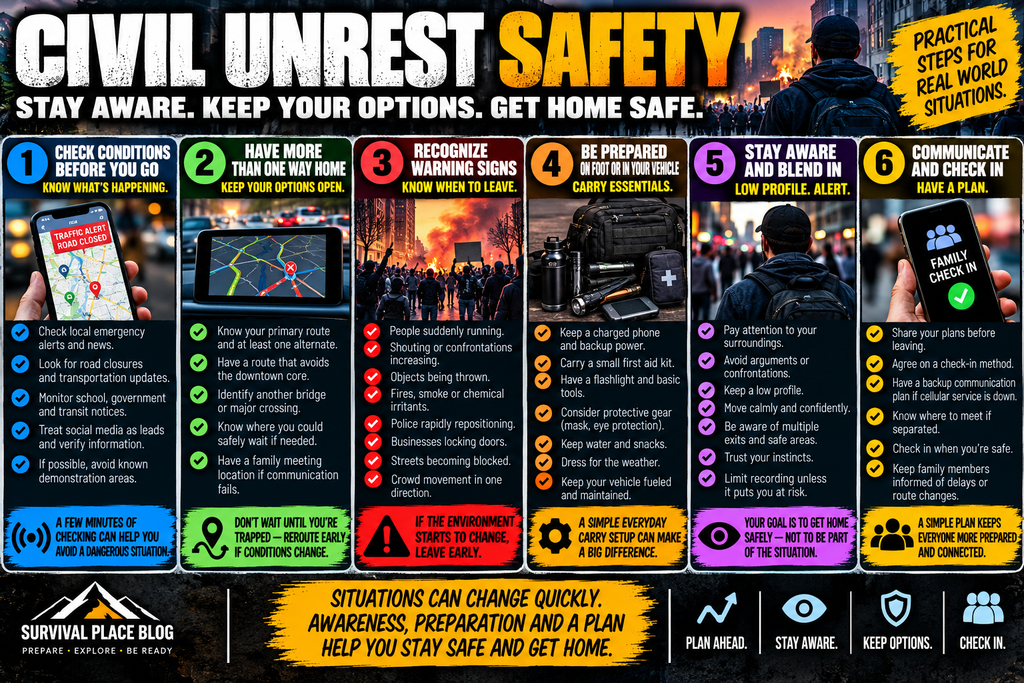
Civil Unrest Safety Checklist
Before leaving home during a period of heightened disruption, ask:
- Is my phone charged?
- Do I have identification?
- Do I have some cash?
- Do I have essential medication?
- Do I have water?
- Do I have a flashlight?
- Do I have a power bank and cable?
- Do I know what’s happening along my route?
- Do I have an alternate route?
- Does someone know where I’m going?
- Does my family know the communication plan?
- Do I know where I could safely wait if necessary?
If several answers are no, fix what you reasonably can before leaving.
Preparedness Beats Improvisation
Civil unrest is unpredictable, but your response doesn’t have to be.
You can’t control whether a protest forms, a street closes, a crowd changes direction, or transportation shuts down.
You can control whether your phone is charged.
You can control whether you know another way home.
You can control whether your family knows what to do.
And you can control whether you move away from trouble instead of toward it.
That’s the heart of practical civil unrest safety.
Stay informed. Maintain options. Avoid unnecessary confrontation. Get yourself and the people who depend on you somewhere safer.
Download the Free Civil Unrest Safety Checklist
Want a simple checklist you can print and keep at home, at work, or with your emergency supplies? Download our free Civil Unrest Safety Checklist.
It covers what to check before you leave, essential carry items, family communication, vehicle preparedness, what to do if you encounter unrest, and what to do if you’re temporarily stranded.