Affiliate Disclosure: This post contains affiliate links. If you purchase through these links, Survival Place Blog may earn a commission at no additional cost to you. As an Amazon Associate I earn from qualifying purchases.
You do not need a bunker, pallets of freeze-dried food or thousands of dollars in specialized survival equipment to become better prepared.
In fact, much of what an average household needs for an emergency can be purchased during normal trips to a grocery store, Walmart, Costco, Sam’s Club or another warehouse club.
Water. Canned food. Rice. Peanut butter. Medicine. Soap. Trash bags. Batteries. Pet food. First-aid supplies.
The key isn’t buying everything at once. It’s knowing what is actually useful, how much your household needs, and how to build your supplies without wasting money on things you’ll never use.
This emergency preparedness shopping list will help you do exactly that.
Preparedness works best when supplies are part of a larger plan. Our Five Pillars of Prepping guide explains how food, water, shelter, security, health, communication and practical skills work together to create a more resilient household.
Why Grocery Stores Are One of the Best Places to Start Prepping
Emergency preparedness sometimes gets presented as if you need specialized survival equipment for everything.
You don’t.
Your neighborhood grocery store already contains an enormous amount of useful emergency gear disguised as ordinary household products.
A warehouse club can be even better for supplies your family regularly consumes because larger packages can reduce the cost per serving.
The important distinction is this:
Preparedness shopping isn’t panic buying.
Panic buying happens after everyone realizes there may be a problem.
Preparedness means slowly building supplies before you need them.
That approach costs less, creates less waste and leaves emergency inventory available for people who genuinely need it when a disaster is approaching.
Federal emergency guidance recommends households maintain basic supplies including water, nonperishable food, first aid, lighting, communications and sanitation equipment.
Federal emergency guidance recommends keeping basic emergency supplies such as water, nonperishable food, first-aid supplies, lighting, communications equipment and sanitation items as part of a household emergency kit.
1. Water: Your First Preparedness Purchase
Food gets most of the attention in emergency preparedness, but water becomes a serious problem much faster.
A major earthquake, flood, winter storm, power failure or water-system contamination could interrupt safe drinking water.
The CDC recommends storing at least one gallon of water per person per day for at least three days. That water needs to cover drinking, cooking, brushing teeth and other basic needs. Commercially bottled water is considered the safest and most reliable emergency source when available.
For a family of four, the three-day minimum is:
4 people × 1 gallon × 3 days = 12 gallons.
That’s the minimum.
If you have room, building beyond three days provides a much stronger cushion.
What to Buy at the Grocery Store
Look for:
- Gallon water jugs
- Bottled water cases
- Shelf-stable beverages
- Unscented household bleach appropriate for water disinfection when directed by authorities
- Disposable cups
Warehouse clubs can make cases of bottled water inexpensive, but don’t overlook the weight and storage space involved.
Water weighs roughly 8.3 pounds per gallon.
Twenty gallons is already more than 160 pounds.
Don’t stack large quantities somewhere the floor, shelving or containers cannot safely support them.
Add Larger Water Containers
Once you’ve established bottled water, reusable emergency water containers make it easier to build a larger reserve.
For households that want to build beyond cases of bottled water, a reusable container makes larger quantities easier to organize and store. The FastRack 5-Gallon Hedpak is a BPA-free, food-grade container with a built-in carrying handle, making it a practical size for gradually expanding a household emergency water supply.
Add a Backup Water Filter
Stored water should be your first line of defense.
A filter is your backup.
A compact filter can be valuable if stored water runs low and you have access to an appropriate source that requires treatment.
For a compact backup, the Sawyer MINI Water Filtration System is small enough to keep with household emergency supplies, a vehicle kit or go-bag. I personally keep Sawyer MINI filters in my own preparedness supplies b
For households ready to build beyond a few cases of bottled water, our complete Home Water Storage System guide covers how much water to store, container options, treatment, rotation and ways to build a larger emergency reserve safely.
2. Build an Emergency Food Supply You Will Actually Eat
One of the biggest preparedness mistakes is buying food because it has a long shelf life rather than because anyone in the house wants to eat it.
A better rule is:
Store what you eat. Eat what you store.
That turns your emergency pantry into an extension of your normal pantry.
Instead of letting food sit untouched for years, you continuously use older products and replace them with newer ones.
This is often called a first-in, first-out rotation system, or FIFO.
Put newly purchased food behind older food.
Eat the older food first.
Replace what you use.
That simple system dramatically reduces waste.
3. Canned Foods
Canned food is one of the easiest preparedness purchases because it is inexpensive, widely available and requires little preparation.
Good options include:
Proteins
- Tuna
- Chicken
- Salmon
- Spam or canned luncheon meat
- Chili
- Beef stew
- Beans
- Refried beans
Vegetables
- Corn
- Green beans
- Peas
- Carrots
- Tomatoes
- Mixed vegetables
Fruits
- Peaches
- Pears
- Pineapple
- Mandarin oranges
- Applesauce
Meals
- Soups
- Chili
- Ravioli
- Pasta meals
- Stews
Whenever possible, choose foods your family already eats.
A disaster is a terrible time to discover that nobody likes the 24 cans of something you bought because they were on sale.
USDA considers commercially canned and many other packaged foods shelf-stable, although consumers should always follow storage instructions because some canned products require refrigeration.
And remember one extremely inexpensive piece of preparedness equipment:
A manual can opener.
A manual can opener is one of those inexpensive preparedness items that’s easy to overlook until the power is out and dinner is sealed inside a can. The Zulay Kitchen Heavy Duty Manual Can Opener uses a straightforward manual design with stainless-steel cutting components, making it a practical addition to both the kitchen and emergency food supplies.
4. Dry Foods Worth Stocking
Dry foods can dramatically expand your emergency pantry.
Consider:
- Rice
- Pasta
- Oatmeal
- Lentils
- Dry beans
- Quinoa
- Flour
- Sugar
- Pancake mix
- Instant potatoes
- Powdered drink mixes
Warehouse clubs can offer excellent prices on large bags of rice, flour and other staples.
But bigger isn’t automatically better.
A 25-pound bag of rice isn’t a bargain if moisture, insects or rodents ruin half of it.
Only buy bulk quantities when you have a realistic plan for storage and rotation.
5. Foods That Require Little or No Cooking
Your pantry shouldn’t depend entirely on having a working stove.
Power outages and utility disruptions may leave you unable to cook normally.
Keep some food that can be eaten immediately.
Examples include:
- Peanut butter
- Crackers
- Granola
- Protein bars
- Trail mix
- Nuts
- Dried fruit
- Canned tuna or chicken
- Ready-to-eat canned meals
- Shelf-stable milk
- Applesauce
- Fruit cups
- Jerky
- Breakfast bars
USDA recommends planning emergency food supplies that don’t require refrigeration and can be eaten cold or prepared using alternative methods.
Don’t build your emergency food plan around foods requiring large amounts of water and fuel to prepare.
Rice and beans are excellent storage foods, but they shouldn’t be your only emergency foods.
6. Don’t Forget Comfort Foods
Preparedness isn’t only about calories.
Emergencies are stressful.
Children may be frightened. Adults may be exhausted. Normal routines disappear.
A few familiar foods can make an unpleasant situation considerably easier.
Consider keeping:
- Coffee
- Tea
- Hot chocolate
- Candy
- Chocolate
- Cookies
- Drink mixes
- Favorite snacks
These aren’t survival necessities.
They’re morale supplies.
And morale matters.
7. Buy for the People Who Actually Live in Your House
Generic emergency checklists can only take you so far.
Your supplies need to match your household.
Think about:
- Infants
- Children
- Older adults
- Food allergies
- Diabetes
- Medical diets
- Religious dietary restrictions
- Mobility limitations
- Prescription needs
If someone requires a particular food every day, that belongs in your preparedness plan.
8. Don’t Forget Your Pets
Pets need emergency supplies too.
Consider keeping extra:
- Dog or cat food
- Water
- Treats
- Medications
- Waste bags
- Cat litter
- Disposable litter pans
- Leashes
- Harnesses
- Pet carriers
Rotate pet food just like human food.
Don’t wait until an evacuation order or major storm warning to discover you’re almost out.
9. Build Your Pantry in Layers
You don’t need three months of food tomorrow.
Build progressively.
First Goal: 72 Hours
Start with enough food and water to comfortably handle three days.
Second Goal: One Week
Once three days feels easy, expand to seven.
Third Goal: Two Weeks
At this point you’re far better positioned for many realistic disruptions.
Fourth Goal: One Month
Now your emergency pantry begins providing significant resilience against prolonged outages, storms, supply interruptions and financial emergencies.
Longer-Term Goal
Households interested in greater preparedness can continue building toward several months.
If your goal is to move beyond a short-term emergency pantry, our 90-Day Survival Checklist provides a practical framework for building three months of water, food, medical supplies, sanitation, backup power and other household essentials without trying to purchase everything at once.
10. First Aid and Medical Supplies
Your grocery store, pharmacy or warehouse club can supply much of a basic household medical kit.
Consider:
- Adhesive bandages
- Sterile gauze
- Medical tape
- Antiseptic wipes
- Antibiotic ointment
- Tweezers
- Disposable gloves
- Thermometer
- Cold packs
- Pain relievers
- Allergy medication
- Anti-diarrheal medication
- Personal medications
Don’t randomly stock medications just because they appear on somebody else’s survival checklist.
Build around what your household actually uses and follow medication labels, storage requirements and medical advice.
Prescription medications deserve special attention.
Refill them on schedule and talk with your healthcare provider or pharmacist about appropriate emergency planning for essential prescriptions.
A Ready-Made First-Aid Kit
Individual supplies are useful, but having a dedicated kit keeps everything organized and easy to move.
For a ready-made option, the EVERLIT 250-Piece Survival First Aid Kit combines basic first-aid supplies with additional emergency items in a portable, organized bag. It’s a practical kit to keep with household emergency supplies or grab quickly if you need to evacuate.
And remember: owning medical supplies isn’t the same thing as knowing how to use them.
Basic first-aid and CPR training can be more valuable than adding another gadget to your emergency closet.
11. Hygiene and Sanitation Supplies
Sanitation problems become unpleasant very quickly when normal services fail.
Add extras of everyday products such as:
- Toilet paper
- Paper towels
- Soap
- Hand sanitizer
- Toothpaste
- Toothbrushes
- Dental floss
- Shampoo
- Feminine hygiene products
- Diapers
- Baby wipes
- Adult hygiene products
- Disinfectant
- Household cleaning products
These products are ideal for gradual preparedness because you’re going to use them anyway.
Buy an extra package when it’s on sale.
Rotate it into normal household use.
Replace it.
No waste required.
12. Trash Bags Are Surprisingly Useful
Heavy-duty garbage bags may be among the most underrated preparedness items in a grocery store.
They can be used for:
- Garbage
- Sanitation
- Keeping gear dry
- Separating contaminated clothing
- Protecting supplies
- Temporary rain protection
- Cleanup
- Transporting wet or dirty materials
Keep several sizes.
Contractor-grade bags can be especially useful for heavy cleanup work.
13. Work Gloves Belong With Cleanup Supplies
Storms, earthquakes and other disasters can leave broken branches, damaged fencing, glass and construction debris around a property.
A good pair of work gloves can protect your hands during basic cleanup.
For general household cleanup and emergency work, HANDLANDY Work Gloves provide a flexible utility-style option with added grip and touchscreen capability. They’re useful for moving branches, handling supplies, basic repairs and routine debris cleanup around the property.
Gloves aren’t armor.
Don’t assume ordinary utility gloves will protect against every sharp object, chemical or electrical hazard. Match protective equipment to the actual hazard.
14. Dust and Respiratory Protection
Smoke, ash, dust and airborne debris can become serious concerns after certain disasters.
Keeping appropriate respiratory protection with emergency supplies is sensible.
Ready.gov includes dust masks among recommended emergency-kit items.
For household emergency supplies, the 3M 8210 N95 Particulate Respirator is a NIOSH-approved option designed to filter at least 95% of certain non-oil-based airborne particles. A 20-pack provides enough to keep several respirators available for household members during dusty cleanup, wildfire ash or other situations where particulate protection is appropriate.
Respiratory protection is hazard-specific. No single mask protects against every smoke, chemical or airborne threat, so follow official instructions during an actual emergency.
15. Lighting: Don’t Depend on Candles
Candles are inexpensive, but they introduce an unnecessary fire hazard when better lighting options are available.
A safer emergency lighting plan includes several independent sources.
Keep:
- Flashlights
- Headlamps
- Battery lanterns
- Spare batteries
- Rechargeable lights
Headlamp
A headlamp leaves both hands available while you’re working, cooking, repairing something or moving around in darkness.
For hands-free emergency lighting, the Energizer Universal LED Headlamp is a simple option for power outages, household repairs and emergency kits. This two-pack also makes it easy to keep one with your home supplies and another in a vehicle or go-bag.
Battery Lantern
A lantern is better for lighting a room or shared living area.
For lighting a room during an outage, the Glocusent LED Rechargeable Camping Lantern provides a rechargeable 5000mAh power source in a portable area light. It gives a household another lighting option beyond flashlights and headlamps and can be kept charged with your emergency power supplies.
Having both gives you task lighting and area lighting.
16. Batteries
If emergency equipment uses replaceable batteries, keep extras.
Before buying a giant variety pack, check what your actual equipment uses.
Standardizing your gear around fewer battery sizes can make storage much simpler.
Store batteries according to manufacturer instructions and inspect them periodically for leakage, corrosion or damage.
Rechargeable batteries can also make sense for frequently used equipment, provided you maintain a way to recharge them.
17. Communication During an Emergency
Your smartphone is one of your most useful emergency tools.
But don’t assume it will always be enough.
Cell networks can become overloaded. Internet service may fail. Electricity may be unavailable.
Your communication plan should have layers.
Start with:
- Smartphone
- Charging cable
- Portable power bank
- Emergency contacts written on paper
- Battery or hand-crank radio
Backup Power
A portable power bank can keep a phone running when household electricity isn’t available. Keep it charged with your emergency supplies and periodically check its battery level so it’s ready when an outage occurs.
Keep power banks charged.
A dead backup battery stored in a drawer isn’t emergency equipment.
18. Add an Emergency Weather Radio
A NOAA-capable emergency radio gives you another way to receive weather warnings and emergency information when internet or cellular service is unreliable.
The Midland ER310 Emergency Crank Weather Radio provides NOAA weather alerts along with multiple charging options, making it a useful backup source of emergency information when normal communications or household power are disrupted.
Keep it somewhere accessible—not buried behind six boxes in the garage.
19. Cooking When the Power Is Out
Your emergency food supply needs to match your ability to prepare it.
Keep simple items such as:
- Manual can opener
- Pots
- Cooking utensils
- Disposable plates
- Cups
- Paper towels
- Aluminum foil
Outdoor grills and camp stoves may provide alternative cooking methods, but combustion equipment creates carbon monoxide.
Never use outdoor grills, generators or other fuel-burning equipment indoors simply because the weather is bad.
Plan your emergency meals so at least some require no cooking at all.
A long outage affects much more than cooking. Our Extended Power Outage guide walks through what can happen during the first 48 hours without electricity and how to prepare for water, food, refrigeration, lighting, communications and other household problems.
20. Protect Refrigerated and Frozen Food
A power failure can turn hundreds of dollars of groceries into waste.
USDA says an unopened refrigerator generally keeps food safely cold for about four hours. A full freezer can maintain temperature for approximately 48 hours, while a half-full freezer is closer to 24 hours, assuming the door stays closed.
Useful preparedness purchases include:
- Refrigerator/freezer thermometers
- Large coolers
- Frozen gel packs
- Reusable ice packs
During an outage, resist the temptation to repeatedly open the refrigerator to check the food.
Every opening releases cold air.
And never taste questionable food to decide whether it is safe.
When in doubt, throw it out.
21. Fire Safety
Preparedness also means preventing a small emergency from becoming a major one.
Every household should think about:
- Smoke alarms
- Carbon-monoxide alarms
- Replacement batteries
- Fire extinguishers
- Household evacuation plans
A fire extinguisher is exactly the type of preparedness purchase you hope never to use.
A multipurpose household fire extinguisher is a practical addition to home emergency supplies. The First Alert Standard Home Fire Extinguisher provides a straightforward option for common household fire risks and can be mounted in an accessible location so it’s available quickly when needed.
Buy the appropriate extinguisher for its intended location, learn how to operate it, and follow manufacturer recommendations for inspection and replacement.
22. Warmth and Emergency Blankets
Cold becomes a serious problem when heating systems stop working.
Your preparedness supplies should include:
- Regular blankets
- Sleeping bags
- Warm clothing
- Hats
- Gloves
- Extra socks
Compact emergency blankets can provide another lightweight backup layer and take up very little storage space.
For an inexpensive backup layer, the Primacare HB-10 Emergency Mylar Thermal Blankets come in a 10-pack of individually packaged blankets that can be divided between household emergency supplies, vehicles and go-bags. Their compact size makes them easy to store for evacuations, cold-weather emergencies or situations where someone needs additional protection from heat loss.
They supplement proper clothing and shelter; they don’t replace them.
23. Tarps, Plastic Sheeting and Duct Tape
A heavy-duty tarp can become extremely useful after storm damage.
Possible uses include:
- Covering damaged property
- Protecting supplies
- Creating temporary weather protection
- Covering equipment
- Separating damaged areas
- Cleanup
For household storm and recovery supplies, the GUARD SHIELD 12 × 16 ft Heavy Duty Tarp is a 10-mil waterproof poly tarp with reinforced edges and grommets. It can be kept on hand for temporarily covering damaged property, protecting equipment or keeping exposed belongings out of additional rain after a storm.
Never climb onto a damaged or unstable roof just to install a tarp.
Property can be replaced.
You can’t.
Duct tape and plastic sheeting also deserve space in household emergency supplies, but don’t treat improvised solutions as substitutes for professional repairs.
24. Protect Important Documents
A disaster can destroy more than physical possessions.
It can also destroy the documents you need to recover afterward.
Consider protecting copies of:
- Identification
- Insurance policies
- Medical information
- Medication lists
- Emergency contacts
- Property records
- Vehicle information
- Pet vaccination records
Digital backups are useful, but having protected physical copies provides another layer.
Keeping important paperwork together can make evacuation and disaster recovery much easier. A two-pocket fire-resistant document bag provides an organized place for copies of identification, insurance information, medical records and other important documents while adding another layer of protection against water, heat and everyday damage.
Don’t keep every original document in an easily portable emergency bag. Decide which documents should be originals, which should be copies and which can be securely backed up digitally.
25. Keep Some Emergency Cash
Electronic payments depend on electricity, communications and payment networks.
A widespread outage may temporarily make cards or mobile payments difficult to use.
Keep some emergency cash in a secure location.
Smaller denominations can be more practical than large bills.
The amount is personal.
You don’t need a suitcase of money hidden under the mattress.
The goal is simply to have another payment option if electronic systems temporarily aren’t available.
26. Basic Tools
A few basic tools can solve a surprising number of problems.
Consider:
- Adjustable wrench
- Pliers
- Screwdrivers
- Utility knife
- Hammer
- Multi-tool
- Work gloves
- Flashlights
- Duct tape
- Zip ties
- Rope or utility cord
Know where your household utility shutoffs are located and how they work before an emergency.
Don’t wait for a disaster to learn.
27. Build a Household Cleanup Kit
Recovery supplies are often forgotten because most emergency lists focus on surviving the first 72 hours.
But what happens afterward?
Consider keeping:
- Heavy-duty trash bags
- Work gloves
- Safety glasses
- Dust masks or appropriate respirators
- Tarps
- Buckets
- Disinfectant
- Paper towels
- Brooms
- Shovels
- Basic tools
This isn’t exciting gear.
It’s the stuff you’ll be thankful you already own when a storm leaves branches, water, dirt or debris across your property.
28. Warehouse Clubs: What Makes Sense to Buy in Bulk?
Costco, Sam’s Club and similar stores can be excellent preparedness resources.
But bulk purchasing only saves money when you actually use what you buy.
Good Bulk Candidates
Depending on your household:
- Bottled water
- Rice
- Pasta
- Oatmeal
- Canned food
- Peanut butter
- Coffee
- Toilet paper
- Paper towels
- Trash bags
- Soap
- Batteries
- Pet food
- Cleaning supplies
Be Careful With
- Foods nobody normally eats
- Giant containers that spoil after opening
- Products you cannot properly store
- Huge quantities purchased only because they’re cheap
The goal isn’t to fill your garage.
It’s to increase resilience.
29. Grocery Store vs. Warehouse Club vs. Online
Each has advantages.
Grocery Store
Best for:
- Gradual purchasing
- Sales
- Smaller households
- Normal pantry rotation
- Fresh replacement inventory
Warehouse Club
Best for:
- Larger families
- Bulk staples
- Water
- Paper products
- Household consumables
- Frequently used food
Online
Often better for specialized preparedness equipment such as:
- Water filters
- Emergency radios
- Specialized first-aid kits
- Emergency lighting
- Protective equipment
- Water-storage containers
- Emergency blankets
- Document protection
Use all three strategically.
There’s no reason every preparedness purchase has to come from a survival store.
30. The $25 Preparedness Shopping Trip
You can start small.
Suppose you have $25 beyond your normal grocery budget.
You might buy:
- Extra bottled water
- Several cans of food
- Peanut butter
- Oatmeal
- Pasta
- Flashlight batteries
- Trash bags
Next trip, buy different categories.
The objective isn’t a perfect $25 list.
It’s progress.
31. The $50 Preparedness Shopping Trip
With approximately $50, you can start filling gaps more quickly.
For example:
- Case of water
- Canned proteins
- Canned vegetables
- Rice
- Pasta
- Peanut butter
- Shelf-stable snacks
- Hygiene supplies
- Basic first-aid items
- Batteries
Again, choose products your household already uses.
If pasta is already overflowing from your pantry but you’re short on first-aid supplies, don’t buy more pasta just because a preparedness checklist says so.
32. The $100 Warehouse Run
Once the basics are established, a warehouse trip can help increase quantities.
Think in categories rather than randomly filling the cart:
Water
Food
Hygiene
Sanitation
Medical
Household supplies
Buying a little from each category creates a more balanced emergency supply than spending the entire budget on food.
33. The One-Extra Method
For households on a tighter budget, this may be the easiest preparedness strategy of all.
Every grocery trip, buy one extra item.
If you normally buy one jar of peanut butter, buy two.
If you need one box of pasta, buy an extra.
If canned soup is on sale, add several.
If you buy toothpaste, put an extra tube into emergency storage.
One item doesn’t feel significant.
But one additional item every week becomes 52 preparedness purchases in a year.
That adds up.
34. Shop the Sales, Not the Fear
Preparedness becomes expensive when everything is purchased immediately before a disaster.
That’s also when stores may be crowded and inventory limited.
Instead:
Watch sales.
Use coupons.
Take advantage of warehouse promotions.
Stock seasonal items when prices are favorable.
Slow preparation generally beats last-minute panic buying.
35. Organize Your Supplies So You Can Actually Find Them
Emergency supplies aren’t very helpful when nobody knows where they are.
Organize by category:
Water
Food
Medical
Hygiene
Lighting
Power
Communications
Tools
Documents
Pet supplies
You don’t need a dedicated survival room.
A pantry shelf, closet, cabinet and several clearly labeled containers may be enough.
36. Keep an Inventory
You don’t need complicated software.
A notebook or simple spreadsheet works.
Track:
- Product
- Quantity
- Purchase date
- Expiration or best-by date where relevant
- Storage location
This becomes more valuable as your supplies grow.
Otherwise, you eventually end up buying your fifth flashlight while forgetting that you’re almost out of stored water.
37. Rotate Instead of Throwing Food Away
Emergency food shouldn’t be a museum collection.
Use it.
If canned soup is approaching its normal rotation point, move it into your kitchen pantry and eat it.
Replace it with newer cans.
Do the same with:
- Pasta
- Rice
- Peanut butter
- Snacks
- Pet food
- Drinks
- Other everyday foods
This creates a living pantry rather than a forgotten emergency stash.
38. Store Supplies Where the Environment Makes Sense
Most dry emergency supplies do best in areas protected from:
- Excessive heat
- Moisture
- Direct sunlight
- Pests
- Flooding
- Freezing where inappropriate
Avoid assuming the garage is automatically a good storage location.
Garages can experience major temperature swings.
Basements can flood.
Attics can become extremely hot.
Choose storage locations based on the product and your home’s conditions.
39. Don’t Put Everything in One Place
A single storage location creates a single point of failure.
Consider distributing supplies appropriately between:
- Home
- Vehicle
- Workplace
- Go-bag
Ready.gov recommends considering both a primary household kit and smaller portable kits for places where you spend significant time.
Your household supplies should stay at home, but a smaller portable kit gives you essential gear if evacuation becomes necessary. Our 72-Hour Go-Bag Checklist covers the water, food, first aid, clothing, lighting, documents and other essentials worth keeping ready to grab.
40. Build Your Emergency Supplies Around Realistic Problems
Don’t prepare only for dramatic disasters.
A good household supply system can help during:
- Power outages
- Winter storms
- Earthquakes
- Hurricanes
- Tornadoes
- Wildfires
- Flooding
- Water contamination
- Evacuations
- Supply disruptions
- Temporary financial hardship
- Illness
That’s one of the biggest advantages of practical preparedness.
The same supplies solve multiple problems.
A case of water doesn’t care why the faucet stopped working.
A flashlight doesn’t care why the lights went out.
A stocked pantry doesn’t care why you can’t get to the store.
41. Common Emergency Shopping Mistakes
Buying Everything at Once
Preparedness doesn’t need to wreck your budget.
Build gradually.
Buying Food Nobody Eats
Long shelf life doesn’t matter if everyone hates it.
Forgetting Water
Twenty cases of food aren’t much help without adequate drinking water.
Depending Entirely on Frozen Food
A long outage can quickly create a food-safety problem.
Buying Gear Without Testing It
Open equipment.
Read the instructions.
Test it.
Forgetting Batteries
Make sure your battery-powered equipment can actually operate.
Forgetting the Manual Can Opener
It’s funny until you’re staring at dinner inside a sealed can.
Storing Everything in the Garage
Heat, freezing temperatures, moisture and pests may damage supplies.
Never Rotating Anything
Emergency supplies aren’t “buy once and forget forever.”
Buying Because You’re Scared
Preparedness works best when it’s deliberate.
Emergency Preparedness Shopping List: Complete Checklist
Use this as a starting point and customize it for your household.
Water
☐ Bottled drinking water
☐ Larger emergency water containers
☐ Backup water filter
☐ Water-treatment supplies where appropriate
Food
☐ Canned proteins
☐ Canned vegetables
☐ Canned fruit
☐ Ready-to-eat meals
☐ Rice
☐ Pasta
☐ Oatmeal
☐ Peanut butter
☐ Nuts and trail mix
☐ Dried fruit
☐ Shelf-stable snacks
☐ Comfort foods
☐ Manual can opener
Medical
☐ First-aid kit
☐ Bandages
☐ Gauze and tape
☐ Antiseptic supplies
☐ Disposable gloves
☐ Thermometer
☐ Household medications
☐ Prescription planning
Hygiene and Sanitation
☐ Toilet paper
☐ Soap
☐ Hand sanitizer
☐ Toothpaste
☐ Feminine hygiene products
☐ Baby supplies if needed
☐ Heavy-duty garbage bags
☐ Disinfectant
Lighting and Power
☐ Flashlights
☐ Headlamps
☐ Lantern
☐ Batteries
☐ Power banks
☐ Charging cables
Communication
☐ Emergency weather radio
☐ Written emergency contacts
☐ Local maps
Home and Cleanup
☐ Work gloves
☐ Dust masks/respiratory protection
☐ Fire extinguisher
☐ Tarps
☐ Duct tape
☐ Plastic sheeting
☐ Basic tools
Warmth
☐ Blankets
☐ Sleeping bags
☐ Warm clothing
☐ Emergency blankets
Documents and Money
☐ Emergency cash
☐ Identification copies
☐ Insurance information
☐ Medical information
☐ Emergency contacts
☐ Protected document storage
Pets
☐ Pet food
☐ Pet water
☐ Medications
☐ Carrier
☐ Leash/harness
☐ Waste supplies
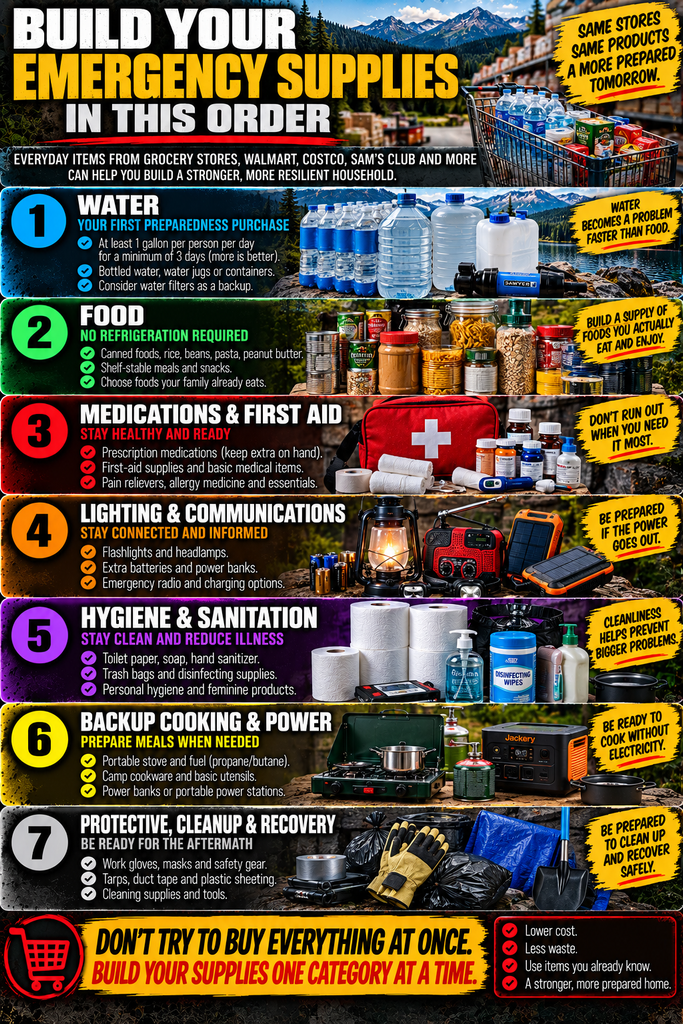
Build Your Supplies in This Order
If you’re starting from almost nothing, don’t become overwhelmed by the size of this list.
Prioritize.
First: Water.
Second: Food that doesn’t require refrigeration.
Third: Essential medications and first aid.
Fourth: Lighting and communications.
Fifth: Hygiene and sanitation.
Sixth: Backup cooking and power.
Seventh: Protective, cleanup and recovery equipment.
Then continue expanding quantities and redundancy.
You aren’t trying to finish preparedness.
You’re trying to become more prepared than you were yesterday.
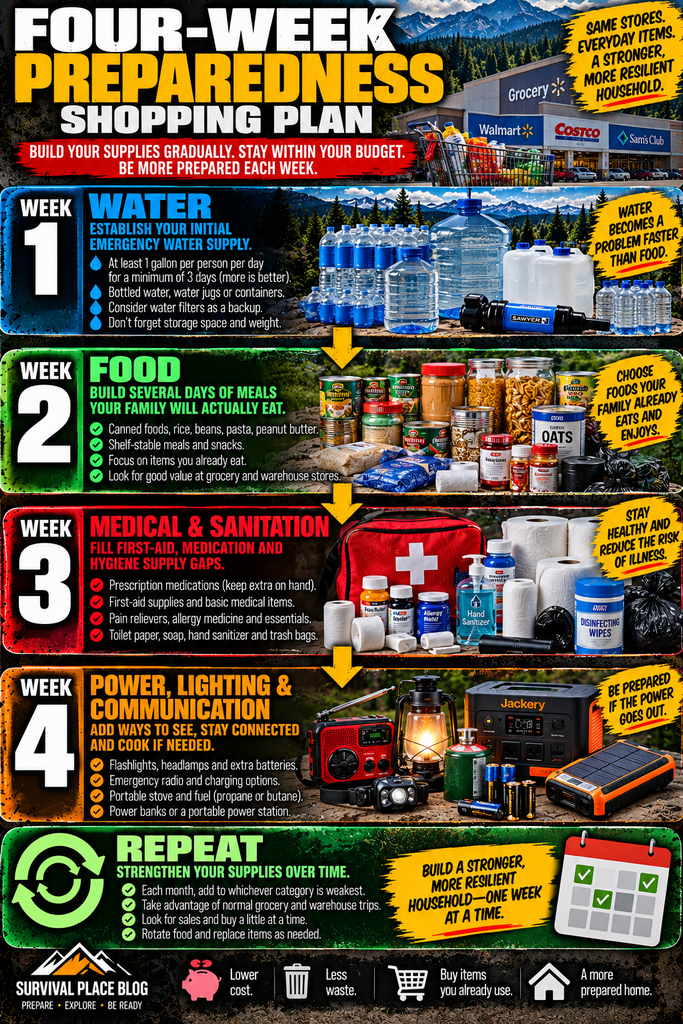
A Practical Four-Week Shopping Plan
Week 1 — Water
Establish your initial emergency drinking-water supply.
Add storage containers or filtration as your budget allows.
Week 2 — Food
Build several days of meals using food your family already eats.
Include options requiring little or no cooking.
Week 3 — Medical and Sanitation
Fill first-aid, medication, hygiene and waste-management gaps.
Week 4 — Power, Lighting and Communication
Add flashlights, batteries, charging capability and an emergency radio.
After four weeks, repeat the process and strengthen the weakest category.
Take the Next Step
Once you have the basics, don’t simply keep buying more stuff.
Preparedness also requires:
- A family emergency plan
- Evacuation routes
- Communication plans
- Basic skills
- Knowledge of local hazards
- Regular equipment checks
- Practice
Supplies buy you time.
Planning determines how well you use that time.
If you’re ready to build a more complete evacuation kit, our Ultimate Bug Out Bag Guide goes beyond a basic checklist and explains how to choose and organize water, food, shelter, first aid, clothing, navigation, communication and other 72-hour emergency gear.
Final Thoughts: Preparedness Can Start With Your Next Grocery Trip
Emergency preparedness doesn’t have to begin with an enormous shopping list or an expensive trip to a survival store.
It can begin the next time you buy groceries.
One extra case of water.
Several extra cans of food.
Another jar of peanut butter.
A package of batteries.
Extra medicine and hygiene supplies.
Then you do it again.
Over time, those ordinary purchases become something much more valuable: a household that can handle disruptions without immediately depending on outside help.
That’s the real objective.
Not fear.
Not hoarding.
Not owning the most survival gear.
Having enough water, food, supplies, equipment and planning to take care of the people who depend on you when normal life stops being normal.
And most of that preparation can begin in the same aisles you already walk every week.