Affiliate Disclosure: This post contains affiliate links. If you purchase through these links, Survival Place Blog may earn a commission at no additional cost to you. As an Amazon Associate I earn from qualifying purchases.
Survival preparedness is not about trying to predict the next catastrophe. It is about understanding the emergencies most likely to affect you, preparing for their consequences, and having enough flexibility to deal with the unexpected.
That means preparedness should look different depending on where you live.
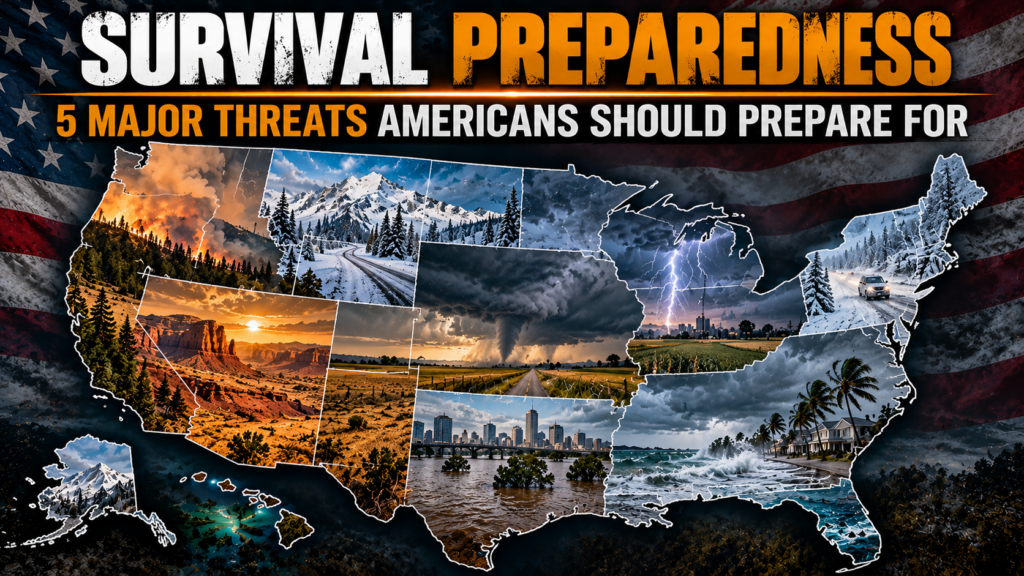
A family in Florida may put hurricanes, storm surge, flooding, and extended power outages near the top of its list. Someone in the Upper Midwest may be more concerned about winter storms, extreme cold, tornadoes, and prolonged outages. In parts of the West, wildfire, extreme heat, drought, earthquakes, or flash flooding may deserve greater attention.
Federal preparedness guidance makes the same basic point: floods, home fires, and power outages can happen almost anywhere, while hazards such as hurricanes, earthquakes, snowstorms, and tornadoes are more common in particular parts of the country.
To identify the hazards most relevant to your area and build a plan around them, the Federal Emergency Management Agency’s Ready.gov preparedness resources provide practical guidance for disasters and emergencies across the United States.
The goal isn’t to prepare equally for every disaster imaginable.
The goal is to prepare for the emergencies most likely to happen where you live while building a basic preparedness foundation that works across many different situations.
That starts with understanding your local risks.
The Federal Emergency Management Agency (FEMA) provides tools to help households identify the hazards that may affect their community and plan for emergencies based on where they live.
Your Biggest Threat Depends on Where You Live
There is no single list of disasters that applies equally to every American.
NOAA’s historical disaster data shows that different parts of the country experience different combinations of severe weather and climate hazards. Severe storms are especially common across the Plains, Midwest, and Southeast, while Gulf and Atlantic states face hurricane risk and Western states regularly experience significant wildfire hazards. Flooding can affect communities across numerous regions.
That makes location one of the first things you should consider when deciding what to prepare for.
Northeast
Depending on location, major concerns can include:
- Winter storms
- Extreme cold
- Flooding
- Severe thunderstorms
- Hurricanes and tropical storms in coastal areas
- Extended power outages
Southeast and Gulf Coast
Common concerns can include:
- Hurricanes
- Storm surge
- Flooding
- Tornadoes
- Severe thunderstorms
- Extreme heat
- Extended power outages
If hurricanes are one of the primary hazards where you live, our Hurricane Preparedness Guide: What to Do Before, During and After a Hurricane walks through evacuation, emergency supplies, storm surge, power outages, flooding, and what to do as a storm approaches.
Great Plains and Midwest
Depending on the area, households may face:
- Tornadoes
- Severe thunderstorms
- Hail and damaging winds
- Flooding
- Winter storms
- Extreme cold
- Extreme heat
For households in tornado-prone areas, our Tornado Preparedness: How to Survive a Tornado and Find Safe Shelter guide explains warning signs, shelter options, emergency supplies, and what to do before, during, and after a tornado.
West and Southwest
Regional hazards can include:
- Wildfires
- Extreme heat
- Drought
- Earthquakes
- Flash flooding
- Smoke and poor air quality
If wildfire is one of the major hazards in your area, our Wildfire Preparedness: How to Protect Your Home and Evacuate Safely guide covers defensible space, evacuation planning, emergency supplies, pets, family safety, and preparing your home before wildfire threatens your community.
Pacific Northwest
Depending on location, significant hazards can include:
- Earthquakes
- Wildfires and smoke
- Flooding
- Winter storms
- Extreme heat
- Extended power outages
For people living in earthquake-prone areas, our Earthquake Preparedness Guide: Before, During and After an Earthquake explains how to prepare your home, what to do when shaking begins, emergency supplies to keep available, and what to expect after an earthquake.
These aren’t rigid boundaries. A hurricane can cause destructive flooding far inland. Wildfire smoke can travel hundreds of miles. Severe winter weather can reach areas that rarely experience it.
The point is simple:
Learn what happens where you live and prepare for those emergencies first.
Once those regional risks are covered, there are broader disruptions every household should consider.
1. Severe Weather and Natural Disasters
Natural disasters remain one of the most practical places to begin survival preparedness because they happen every year.
In 2025 alone, the United States experienced destructive California wildfires, historic flooding in Texas and other states, a verified EF-5 tornado in North Dakota, extreme temperatures, and significant atmospheric-river events affecting the West Coast.
For a deeper look at how severe weather and climate-related disasters vary across the country, NOAA’s National Centers for Environmental Information (NCEI) provides historical U.S. disaster data showing how hazards differ by region and season.
You don’t need to prepare for every one of these hazards equally.
You do need to understand which ones could realistically affect your home.
Start With the Consequences
Different disasters often create many of the same problems:
- Electricity goes out
- Roads become blocked
- Stores close
- Water service may be disrupted
- Cell networks become overloaded
- Fuel becomes difficult to obtain
- Refrigerated food begins spoiling
- Emergency services become stretched
- Families may need to evacuate
That overlap is important.
A flashlight purchased for an earthquake is just as useful during a hurricane. Stored water doesn’t care whether the faucet stopped working because of a flood, earthquake, winter storm, or infrastructure failure.
Good preparedness builds capabilities, not just disaster-specific kits.
Flooding is a good example because it can develop from several different weather events and affect communities far beyond traditional flood zones. Our Flash Flood Survival: What to Do Before, During and After a Flash Flood guide covers warning signs, evacuation decisions, driving hazards, and what to do when water begins rising quickly.
Build a Basic All-Hazards Foundation
Every household should have enough basic supplies to handle at least the first several days of an emergency without depending entirely on stores or immediate outside assistance.
Start with:
- Drinking water
- Shelf-stable food
- Prescription medications
- First aid supplies
- Flashlights and headlamps
- Backup batteries
- Phone charging capability
- Battery or emergency radio
- Hygiene supplies
- Copies of important information
- Appropriate clothing and blankets
- Basic tools
- Pet supplies when needed
If you’re building your emergency supplies from the ground up, Start Here: Your 72-Hour Preparedness Plan walks through the essential food, water, lighting, communication, first aid, and household preparations to tackle first.
Don’t feel like you need to buy everything at once.
Use what you already own, organize it, identify the important gaps, and improve your supplies over time.
2. Extended Power and Utility Outages
A prolonged power outage isn’t always the original emergency.
Often, it is what happens after the emergency.
Hurricanes, severe thunderstorms, winter storms, wildfires, floods, earthquakes, equipment failures, and other events can interrupt electricity.
Because outages often accompany larger disasters, FEMA’s Ready.gov power outage guidance explains how households can prepare for extended outages and stay safer when electricity is unavailable.
A short outage can be inconvenient.
A long outage can affect almost everything in the house.
What Starts Going Wrong?
As an outage continues, households may begin dealing with:
- Refrigeration loss
- Freezer temperatures rising
- Dead phones
- Limited internet access
- Loss of lighting
- Heating or cooling problems
- Medical equipment concerns
- Closed gas stations
- Electronic payment problems
- Limited access to local information
During extreme heat or cold, losing electricity can become much more serious.
To see how quickly the problems can build during a longer outage, our 48 Hours Without Power: What Actually Happens When the Grid Goes Down guide walks through the first two days without electricity, including refrigeration, lighting, communications, water, charging, and household safety.
Prepare for the Outage, Not Just the Storm
Keep several independent ways to handle basic needs.
That might include flashlights instead of depending entirely on phone lights, portable battery banks for communications, shelf-stable food that doesn’t require cooking, and an emergency radio for receiving information when internet service becomes unreliable.
The Midland ER310 Emergency Crank Weather AM/FM Radio provides NOAA weather alerts along with multiple power options, making it a useful backup for receiving information when internet or cellular service is unavailable.
For households building more advanced backup capability, portable power stations can provide another layer of resilience for charging electronics and operating certain compatible devices.
For basic charging and smaller electronics, the Jackery Explorer 300 Portable Power Station — 292Wh offers a compact backup-power option that can be stored with household emergency supplies.
Never operate a fuel-burning generator indoors, in a garage, or near doors, windows, or vents where carbon monoxide can enter occupied spaces.
3. Cyberattacks and Infrastructure Disruptions
Cybersecurity may sound like something for corporations and government agencies, but ordinary households depend on digital and physical infrastructure every day.
Electricity.
Communications.
Banking.
Fuel distribution.
Healthcare.
Transportation.
Water systems.
Supply chains.
A disruption doesn’t have to permanently shut down one of these systems to create problems. Even temporary interruptions can affect how people purchase necessities, communicate, travel, or access services.
For the average household, the preparedness question isn’t:
How do I defend the electrical grid from hackers?
It is:
How do I function temporarily if a service I normally depend on isn’t available?
Build Some Redundancy
Consider keeping:
- Some emergency cash in a secure location
- Printed emergency contact numbers
- Paper copies of critical information
- Offline copies of important documents
- Backup phone charging
- More than one way to receive emergency information
- Several days of essential household supplies
You should also protect your own digital accounts with strong unique passwords, multifactor authentication when available, current software updates, and regular backups of important data.
For practical guidance on protecting personal accounts, devices, and data from common cyber threats, the Cybersecurity and Infrastructure Security Agency (CISA) provides straightforward cybersecurity recommendations for individuals and families.
The objective isn’t to disconnect yourself from modern technology.
It’s to avoid being completely helpless when technology temporarily doesn’t work.
4. Public Health and Supply Disruptions
The COVID-19 pandemic demonstrated how quickly normal routines and supply systems can change during a widespread health emergency.
But pandemic preparedness shouldn’t be limited to preparing for another COVID-like event.
Public health emergencies can create challenges involving:
- Medication access
- Healthcare availability
- Household supplies
- Food availability
- Sanitation
- Transportation
- Workplace or school disruptions
- Caring for sick family members
For guidance on preparing for health-related emergencies, the CDC’s Prepare Your Health resources cover emergency food and water, prescription medicines, medical supplies, important documents, and other household health needs.
Build a Deeper Household Buffer
One of the simplest forms of preparedness is gradually increasing the amount of essential food and household supplies you normally keep at home.
You don’t need a basement filled with survival food.
Start with foods your household already eats.
When practical, keep extras of:
- Rice
- Pasta
- Canned foods
- Soups
- Oats
- Peanut butter
- Shelf-stable milk
- Cooking basics
- Toiletries
- Cleaning supplies
- Pet food
- Necessary medications
Rotate what you store so it becomes part of your normal household inventory rather than a forgotten emergency stash.
If you want to build beyond a short-term emergency pantry, our 3-Month Survival Plan: What to Stock for 90 Days breaks longer-term preparedness into practical food, water, household supplies, medications, sanitation, and other essentials.
Water Deserves Special Attention
People can improvise meals from whatever food remains in the pantry.
Water is much less forgiving.
Maintain an emergency drinking-water supply appropriate for your household and have a way to treat additional water if your stored supply runs low.
For a compact backup treatment option, the Sawyer Products SP128 Mini Water Filtration System can filter water from a variety of freshwater sources and takes up very little room in household, vehicle, or evacuation supplies.
For households that want a larger gravity-fed option for treating more water at home, the Big Berkey 2.25-Gallon Gravity Water Filter System provides greater capacity than a compact personal filter and can serve as a more practical household water-filtration option during longer disruptions.
Longer-term preparedness doesn’t have to happen overnight. A household that gradually builds from three days to a week, then two weeks and eventually longer is far better positioned than one that keeps waiting until it can afford the “perfect” emergency stockpile.
For a step-by-step way to expand those supplies over time, our 90-Day Emergency Preparedness Checklist: How to Prepare Your Home for Three Months covers food, water, medications, sanitation, backup power, household security, communication, and other longer-term needs.
5. Civil Unrest, Transportation Disruptions and Local Emergencies
Not every emergency affects an entire state or country.
Sometimes the problem is highly localized.
A protest may block your normal route home. A major accident may close a highway. Police activity may shut down several blocks. A wildfire may trigger an evacuation. Flooding may make your normal route impassable. A local emergency may disrupt transit or strand you away from home.
The practical response is not political.
It is situational awareness and having alternatives.
Avoid Trouble Whenever Possible
If you know an area is becoming unstable or unsafe, avoiding it is generally preferable to entering it.
Stay aware of:
- Local emergency alerts
- Road closures
- Changing crowd behavior
- Transit interruptions
- Evacuation notices
- Weather warnings
- Alternate routes home
If you unexpectedly encounter a disturbance, don’t argue with strangers or stop to investigate unnecessarily.
Create distance and move toward a safer location when possible.
For a more detailed look at recognizing developing problems, avoiding confrontation, protecting your home, and deciding when it may be safer to leave an area, see our Civil Unrest Preparedness: How to Stay Safe During Protests, Riots and Disruptions guide.
Don’t Advertise That You’re Prepared
There are also situations where being prepared without drawing unnecessary attention can be useful.
You don’t need military-looking clothing or an overloaded tactical backpack to carry emergency essentials.
Ordinary clothing, a normal-looking backpack, good situational awareness, and calm behavior often make more sense—especially in crowded urban environments.
For more on staying prepared without unnecessarily advertising your supplies or capabilities, our The Grey Man Concept: How to Blend In During an Emergency guide explains how clothing, backpacks, behavior, situational awareness, and everyday gear can help you maintain a lower profile.
Always Have More Than One Way Home
Your normal route may not be available during an emergency.
Know alternate roads.
Keep your vehicle maintained.
Try not to routinely run the fuel tank nearly empty.
Keep basic emergency supplies in the vehicle.
And if you regularly work or travel significant distances from home, think about what you would need if you had to remain where you are temporarily—or make your way home without your normal transportation.
Your vehicle can also serve as an important layer of emergency preparedness. Our Bug-Out Vehicle Guide: How to Prepare Your Vehicle for an Emergency covers vehicle maintenance, fuel, emergency supplies, evacuation gear, route planning, and preparing the vehicle you already drive.
The Common Thread: Most Emergencies Create the Same Basic Problems
When you step back, something becomes obvious.
A hurricane, earthquake, winter storm, cyber disruption, wildfire, flood, or local emergency may begin very differently, but households often end up dealing with many of the same problems:
No power.
Limited water.
Closed stores.
Blocked roads.
Communication problems.
Limited access to fuel.
A need to shelter in place or evacuate.
That is why good survival preparedness isn’t about owning a separate pile of equipment for every disaster imaginable.
It’s about developing the ability to handle those basic problems.
Build Preparedness in Layers
A practical approach is to build preparedness gradually.
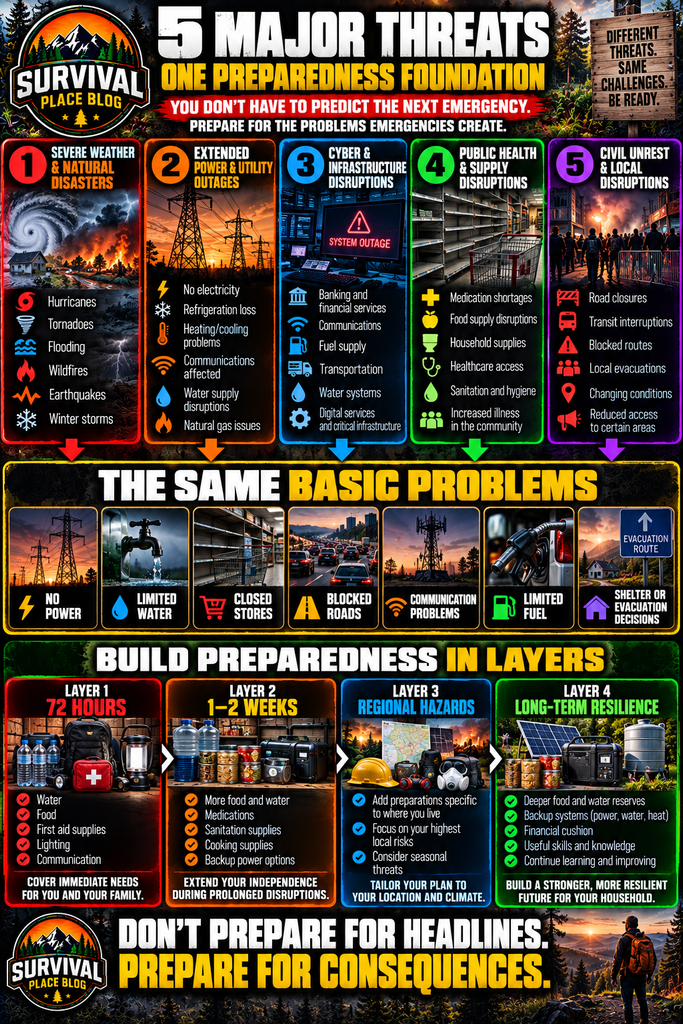
Layer 1: Get Through 72 Hours
Have the essentials necessary to remain reasonably safe and functional for the first three days.
Layer 2: Build Toward One to Two Weeks
Increase food, water, medications, sanitation supplies, backup power, and other household necessities.
Layer 3: Prepare for Your Regional Hazards
Add whatever your location requires.
That could mean hurricane shutters and evacuation planning in one state, wildfire preparation in another, or serious cold-weather supplies somewhere else.
Layer 4: Build Longer-Term Resilience
Expand food and water reserves, improve backup power, strengthen your financial emergency cushion, learn useful skills, and improve your ability to operate when normal systems are unavailable.
Building that resilience doesn’t require buying everything at once. Our Prepping on a Budget: How to Start Preparing Without Spending a Fortune guide shows how to use what you already own, organize your existing supplies, fill the most important gaps first, and upgrade over time.
Don’t Prepare for Headlines — Prepare for Consequences
One of the easiest preparedness mistakes is jumping from one frightening headline to another.
A major cyberattack is in the news, so people buy electronics.
A hurricane approaches, so everyone rushes for bottled water.
Wildfire season begins, so emergency supplies suddenly become important again.
Then the news cycle changes and preparedness gets forgotten.
A better approach is much less dramatic.
Look at where you live.
Identify your realistic hazards.
Think through what those hazards would actually do to your household.
Then prepare for those consequences.
A Simple Personal Risk Assessment
Ask yourself:
What disasters regularly occur in my region?
Could I lose electricity for several days?
Do I have enough water if the tap stops working?
Could I safely stay home for a week without shopping?
Do I have somewhere to go if I must evacuate?
Do I know more than one route out of my neighborhood?
Can I receive emergency information if the internet is down?
What happens if I’m at work when the emergency begins?
What does my family do if we’re separated?
Want to work through those questions on paper? Download our free Personal Emergency Risk Assessment & Regional Preparedness Checklist to identify your most likely local hazards, find gaps in your current preparations, and choose your next three preparedness priorities.
Those questions will tell you more about what you need than almost any generic survival gear list.
Preparedness Should Make Life More Manageable, Not More Fearful
You cannot eliminate every risk.
You also don’t need to.
Preparedness is about improving your options.
Stored water gives you an option when water service fails.
Emergency food gives you an option when stores are closed.
Backup lighting gives you an option when electricity disappears.
An evacuation plan gives you an option when remaining home is no longer safe.
Useful skills give you options when equipment fails.
And understanding the hazards where you live helps you spend your time and money on preparations you’re actually likely to use.
Final Thoughts
The United States faces hurricanes, tornadoes, floods, wildfires, earthquakes, winter storms, extreme temperatures, infrastructure disruptions, public health emergencies, and localized civil disturbances.
But that doesn’t mean every American should prepare for every threat in exactly the same way.
Start with what is most likely where you live.
Then prepare for the common consequences—power outages, water interruptions, supply shortages, communication problems, transportation disruptions, sheltering in place, and evacuation.
Build from 72 hours toward greater resilience as your time and budget allow.
You don’t have to predict the next emergency.
You need enough preparation and flexibility to handle the one that reaches you.