Affiliate Disclosure: This post contains affiliate links. If you purchase through these links, Survival Place Blog may earn a commission at no additional cost to you. As an Amazon Associate I earn from qualifying purchases.
In an emergency, looking prepared can sometimes attract exactly the kind of attention you would rather avoid.
A tactical backpack, expensive outdoor gear, conspicuous equipment, or even nervous behavior can make you stand out in a crowd. During an evacuation, extended power outage, transportation disruption, civil disturbance, or other uncertain situation, that attention may be unnecessary.
The grey man concept takes a different approach.
The idea is to remain prepared and aware while appearing ordinary enough that people have little reason to pay particular attention to you.
It isn’t about becoming invisible. It isn’t about disguises, secret-agent techniques, or wearing gray clothing from head to toe.
It’s about blending naturally into your surroundings while maintaining the ability to take care of yourself and the people with you.
Put simply:
Be prepared without advertising that you’re prepared.
That same low-profile approach applies to what you carry every day. Our Realistic Everyday Carry (EDC): What You Actually Need guide focuses on practical everyday items without turning your pockets or backpack into a tactical gear collection.
What Is the Grey Man Concept?
The grey man concept is based on a simple observation: people tend to notice things that are unusual.
Someone dressed dramatically different from everyone else attracts attention. So does someone behaving strangely, displaying expensive equipment, appearing extremely nervous, or openly carrying specialized gear.
Someone who looks and behaves much like everyone else is easier to overlook.
In preparedness, the goal isn’t to fool people. It’s to avoid unnecessarily broadcasting information about yourself.
You may be carrying emergency water, first-aid supplies, a flashlight, backup power, food, or other useful equipment. That doesn’t mean everyone around you needs to know it.
The most effective grey man often looks completely unremarkable.
Grey Man Doesn’t Mean Wearing Gray
One of the biggest misunderstandings about the concept is that there’s a particular way a grey man should dress.
There isn’t.
Gray pants, a gray jacket, sunglasses, boots, and a tactical backpack could actually make someone extremely noticeable in the wrong environment.
The better rule is:
Look normal for where you are.
What blends into downtown Seattle may look unusual in a small rural community. Clothing appropriate for an airport may look completely different from clothing worn on a hiking trail.
Weather matters.
Culture matters.
Location matters.
The people around you matter.
The objective isn’t to create a uniform. It’s to avoid looking dramatically different from everyone else.
Why Blending In Can Matter During an Emergency
Most everyday emergencies aren’t going to resemble scenes from a survival movie.
People may be trying to get home during a transportation shutdown. Families may be evacuating ahead of a wildfire or hurricane. Neighborhoods may be dealing with an extended blackout. Travelers may find themselves stranded somewhere unfamiliar.
During these situations, people can become tired, frustrated, confused, and stressed.
Supplies may become harder to find.
Transportation can become crowded.
Information may be incomplete.
Under those circumstances, there is usually little advantage in advertising that you’re carrying valuable equipment or emergency supplies.
The grey man approach simply adds another layer to preparedness:
Have what you need without unnecessarily drawing attention to it.
Don’t Look Like the Most Prepared Person in the Crowd
Preparedness culture sometimes encourages equipment that looks unmistakably tactical.
There is nothing inherently wrong with tactical equipment. Some of it is exceptionally durable and useful.
But appearance communicates information.
Imagine two people walking through a crowded transit station after a major power outage.
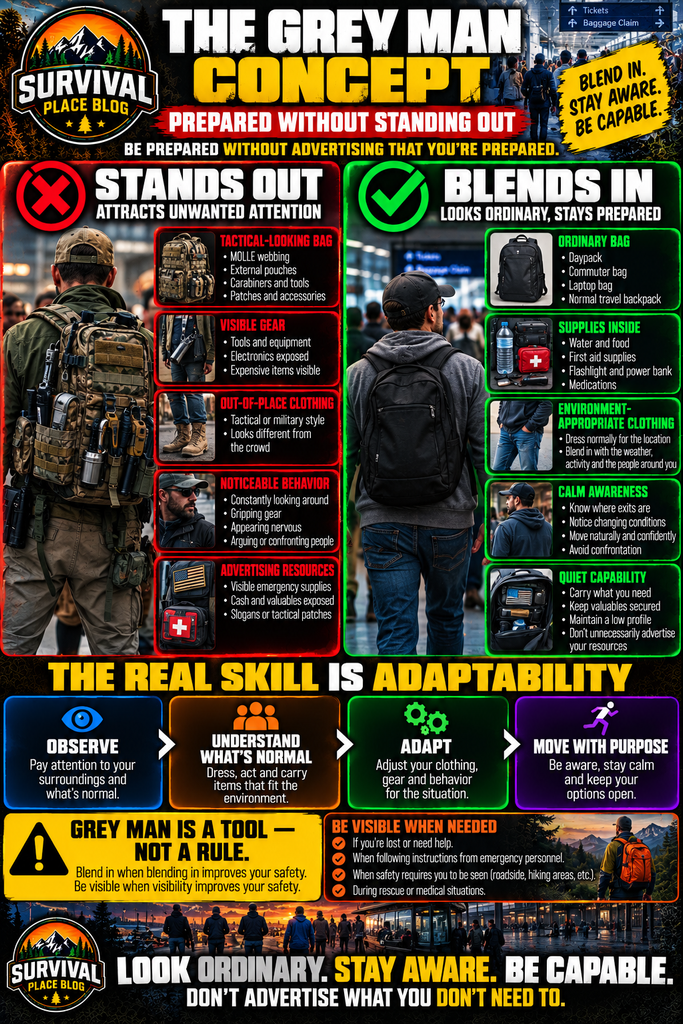
One carries a large camouflage backpack covered in MOLLE webbing, external pouches, carabiners, tools, patches, and equipment.
The other carries an ordinary dark-colored daypack.
A pack like the Maelstrom 40L Hiking Backpack offers useful emergency carrying capacity while maintaining the appearance of an ordinary hiking or travel backpack rather than an overtly tactical bag.
Both backpacks may contain almost identical emergency supplies.
But one tells everyone who sees it:
I probably have gear.
The other looks like something thousands of commuters carry every day.
That difference is the grey man concept in practice.
Your Backpack Can Give You Away
Your bag is one of the easiest ways to unintentionally advertise preparedness.
Large tactical packs may be excellent for wilderness trips, vehicle kits, or situations where appearance doesn’t matter. But they can attract attention in crowded urban environments.
A plain backpack, messenger bag, laptop bag, or ordinary daypack may carry everything needed for a basic emergency kit without looking unusual.
You don’t necessarily need to buy another bag.
Look around your house first.
You may already own an old school backpack, commuter pack, laptop bag, gym bag, or small travel backpack that works perfectly.
What matters is whether it comfortably carries what you actually need.
The bag doesn’t have to look prepared. The person carrying it needs to be prepared.
Clothing Should Match the Environment
Grey man clothing isn’t about buying special clothing.
In fact, buying a complete wardrobe marketed as “tactical” can work against the entire idea.
Ordinary jeans, work pants, hoodies, jackets, athletic clothing, hats, and everyday footwear often blend better because they’re what ordinary people already wear.
Neutral colors can help, but even that isn’t an absolute rule.
If everyone around you is wearing colorful rain jackets, the person dressed entirely in muted tactical colors may be the one who stands out.
Choose clothing based on three things:
- Environment
- Weather
- What people around you normally wear
Avoid unnecessary messages or symbols that could provoke reactions or make you particularly memorable.
Comfort matters too.
During an emergency, you may need to walk farther than expected, wait outside, climb stairs, carry supplies, or spend hours getting home.
Looking ordinary shouldn’t mean being poorly equipped for the conditions.
Footwear Is More Important Than Looking Tactical
A good pair of shoes may be more useful during an emergency than a surprising amount of specialized survival equipment.
You could end up walking several miles because public transportation stopped, roads became impassable, or your vehicle couldn’t continue.
Your footwear should be comfortable, broken in, appropriate for the weather, and capable of handling extended walking.
Again, ordinary can be an advantage.
You don’t necessarily need military boots.
A dependable pair of walking shoes, work shoes, hiking shoes, or boots appropriate for your normal environment may be exactly what you need.
Body Language Can Make You Stand Out
Clothing is only part of blending in.
People notice behavior.
Someone constantly looking over their shoulder, gripping a backpack tightly, staring at everyone around them, repeatedly checking equipment, or moving dramatically differently from the crowd can attract attention regardless of what they’re wearing.
The goal is calm awareness.
Walk with purpose without looking aggressive.
Observe what’s happening without staring.
Keep your head up enough to understand your surroundings.
Avoid unnecessary arguments and confrontations.
Don’t broadcast panic.
You don’t need to look fearless. You simply want to avoid making yourself the most interesting person nearby.
Situational Awareness Without Looking Paranoid
Situational awareness is one of the most valuable preparedness skills because it doesn’t weigh anything and doesn’t require batteries.
Start with simple questions:
What is happening around me?
Where are the exits?
Is the crowd becoming more agitated?
Is traffic suddenly changing direction?
Are businesses closing unexpectedly?
Is there somewhere safer nearby?
What would I do if I needed to leave?
You don’t need to constantly scan the environment like a security professional.
Simply pay attention.
That awareness becomes especially important when crowds or public disturbances begin changing quickly. Our Civil Unrest Preparedness: How to Stay Safe During Protests, Riots and Disruptions guide covers recognizing trouble early, avoiding confrontation, choosing safer routes, and getting away from deteriorating situations.
One useful habit is occasionally looking farther ahead instead of focusing only on the few feet directly in front of you. That can give you more time to notice changing conditions and choose another route.
Don’t Advertise Your Supplies
In normal life, nobody cares very much if you’re carrying a flashlight, food, water, batteries, or a first-aid kit.
During a prolonged emergency, some of those ordinary items may become much more valuable.
There’s usually no reason to display them.
Keep useful supplies inside your bag rather than hanging equipment from the outside.
Avoid unnecessary gear attached to belts or packs.
If you stop to use something, put it away when you’re finished.
This doesn’t mean refusing to help someone in genuine need. It simply means recognizing that publicly displaying everything you have may create problems you didn’t need.
Keep Everyday Carry Simple
Grey man preparedness works especially well with a realistic everyday carry setup.
Your EDC doesn’t need to resemble a hardware store attached to your belt.
A useful everyday setup might include:
- Phone
- Wallet
- Identification
- Keys
- Small flashlight
- Charging cable
- Compact power bank
- Basic first-aid supplies
- Necessary medications
- Small amount of emergency cash
- Water when practical
For a simple, inexpensive light that doesn’t add much bulk to an everyday bag, the Lepro LED White Light Flashlight provides adjustable focus and runs on standard AAA batteries.
The exact contents should reflect your daily routine.
Someone commuting 40 miles to work has different needs from someone who works three blocks from home.
Your Phone Is Useful — Until It Isn’t
A smartphone may be your most useful everyday emergency tool.
It provides maps, communication, weather information, emergency alerts, contact information, a camera, flashlight, documents, and access to transportation information.
But phones depend on power and communications infrastructure.
During emergencies, networks may become overloaded or unavailable.
Keep important phone numbers somewhere other than only in your contacts.
Download useful offline maps when appropriate.
Keep your phone charged.
And if you regularly travel significant distances from home, consider carrying a small power bank.
The INIU 10,000mAh 45W Portable Charger is compact enough for an everyday backpack while providing backup power for compatible phones and other small electronics during an outage, evacuation, or long trip home.
The goal isn’t to abandon technology.
It’s to avoid depending entirely on one device.
Be Careful What Your Gear Says About You
Gear can communicate more than people realize.
Patches, slogans, expensive watches, specialized equipment, visible electronics, and certain styles of clothing can reveal interests, affiliations, occupations, or resources.
In normal circumstances that may not matter at all.
In uncertain circumstances, there may be little benefit in volunteering that information to strangers.
A useful question is:
Does anything I’m carrying make me unnecessarily memorable?
If the answer is yes, decide whether it actually needs to be visible.
Grey Man During an Evacuation
Evacuations are one of the situations where this concept makes the most practical sense.
Thousands of people may be moving simultaneously.
Gas stations can become crowded.
Hotels fill.
Transportation hubs become busy.
People are carrying luggage, backpacks, pets, children, food, and personal belongings.
Your objective isn’t to sneak through the evacuation.
It’s simply to look like another ordinary person trying to reach a safer location.
Have your route planned.
Know alternate routes.
Keep your supplies organized.
Keep valuables secured.
Avoid displaying large amounts of cash.
Keep important documents protected.
Know where you’re going whenever possible.
Preparedness allows you to remain calmer because you’ve already thought through many of these decisions.
For a more complete approach to deciding when to leave, choosing destinations, planning alternate routes, transportation, communication, and household evacuation, see Bugging Out: How to Build an Emergency Evacuation Plan.
Grey Man During Civil Unrest
Civil disturbances present a different challenge because circumstances can change quickly.
The safest strategy is generally to avoid demonstrations, confrontations, and areas where violence or property damage is occurring whenever possible.
If you unexpectedly encounter a disturbance, creating distance may be more useful than trying to determine what everyone involved is doing.
Avoid clothing, signs, gestures, or behavior that unnecessarily associates you with opposing groups if your objective is simply to leave safely.
Don’t stop to argue.
Don’t approach confrontations to record them.
Don’t allow curiosity to keep you somewhere conditions are deteriorating.
Your goal isn’t to participate.
Your goal is to recognize the changing environment and move away before you’re trapped in it.
Grey Man During a Power Outage
An extended blackout creates another useful example.
Imagine most of your neighborhood has been without electricity for two days.
At night, houses are dark.
Then one house is brightly illuminated while generators, large battery systems, and other equipment are clearly visible outside.
That home has unintentionally advertised something:
We have resources.
That doesn’t mean you should sit in darkness simply to hide.
It means thinking about unnecessary visibility.
Close curtains or blinds when using indoor lighting at night.
Keep portable equipment secure.
Don’t leave expensive gear unattended outside.
Avoid broadcasting exactly what supplies or backup systems you have.
Preparedness and discretion can coexist.
For a closer look at the problems that begin developing as an outage continues, see 48 Hours Without Power: What Actually Happens When the Grid Goes Down, including lighting, refrigeration, communications, water, charging, and household security.
Grey Man While Traveling
Travel can place you in environments where you’re unfamiliar with local patterns.
That makes observation even more important.
Pay attention to how people dress, where crowds move, which areas become quiet after certain hours, and how transportation normally operates.
Avoid displaying large amounts of cash.
Keep passports and important documents secure.
Don’t advertise expensive electronics unnecessarily.
Know how to get back to your hotel or lodging without relying entirely on your phone.
And understand that what looks completely ordinary at home may look unusual somewhere else.
Adaptability is more important than any specific piece of clothing.
Don’t Confuse Grey Man With Looking Weak
Blending in doesn’t mean appearing frightened, confused, or helpless.
Those behaviors can attract their own kind of attention.
You want to appear like someone who belongs where they are and knows what they’re doing.
Move naturally.
Know where you’re going.
Stay aware.
Make decisions early.
Quiet confidence generally attracts less attention than either aggressive behavior or obvious fear.
Don’t Become So Focused on Blending In That You Ignore Safety
There is a limit to every preparedness strategy.
Sometimes standing out is exactly what you should do.
If you’re lost and rescuers are searching for you, visibility is an advantage.
If you’re stranded along a road, reflective clothing or emergency markers can help prevent you from being struck.
If you’re hiking during hunting season, high-visibility clothing may be important.
If emergency personnel instruct evacuees to identify themselves in a particular way, follow those instructions.
The grey man concept is a tool, not a rule that overrides common sense.
Blend in when blending in improves your safety. Be visible when visibility improves your safety.
Your Vehicle Can Advertise Preparedness Too
The same principle applies to vehicles.
A vehicle covered in survival stickers, political slogans, equipment mounts, fuel cans, expensive outdoor gear, and visible supplies tells strangers quite a bit about the owner.
Again, none of those things are automatically bad.
But if your goal is maintaining a low profile, an ordinary-looking vehicle may attract less attention.
Keep emergency supplies secured and preferably out of sight.
Don’t leave valuable equipment visible through windows.
Maintain the vehicle mechanically.
Keep enough fuel available that you aren’t forced to search for a gas station during the worst possible moment.
A reliable ordinary vehicle can be an excellent preparedness tool.
For a complete look at preparing the vehicle you already drive for evacuation and other emergencies, see Bug-Out Vehicle Guide: How to Prepare Your Vehicle for an Emergency.
Your Home Can Follow the Same Principle
Preparedness doesn’t have to be displayed around your property.
Food storage, emergency water, backup power, medical supplies, tools, and other preparations can remain organized and accessible without being visible to everyone who visits or walks past.
Basic home security can also be relatively unobtrusive.
Good exterior lighting, strong locks, trimmed landscaping, secured windows, and ordinary-looking cameras can improve security without making your home resemble a fortress.
Maintaining good relationships with neighbors can be even more valuable.
People who know one another are more likely to notice when something isn’t right.
At the same time, you don’t need to give everyone an inventory of your emergency supplies.
Digital Privacy Is Part of Keeping a Low Profile
The original grey man idea is primarily about physical appearance and behavior, but modern life adds another consideration.
People routinely share their possessions, travel plans, locations, purchases, and daily routines online.
You don’t need to disappear from the internet to improve privacy.
Simply think before broadcasting information that doesn’t need to be public.
Consider whether you’re revealing:
- When your home will be empty
- Where expensive equipment is stored
- Large emergency stockpiles
- Regular travel patterns
- Personal documents
- Detailed information about family routines
Digital privacy is a much larger subject than the grey man concept itself, but the underlying principle is similar:
Don’t unnecessarily advertise information that could make you vulnerable.
Skills Are Easier to Conceal Than Equipment
One of the best things about preparedness skills is that nobody can tell you’re carrying them.
First aid knowledge doesn’t require a tactical backpack.
Navigation skills don’t hang from your belt.
Physical fitness doesn’t require specialized survival equipment.
Knowing how to shut off utilities, change a tire, purify water properly, cook without normal utilities, recognize dangerous weather, or respond to an injury can be enormously valuable.
Skills also don’t run out of batteries.
If you’re still building the basics behind those skills and supplies, Start Here: Your 72-Hour Preparedness Plan provides a practical foundation for getting your household through the first three days of an emergency.
Practice Being Observant
You can practice parts of the grey man concept during normal life without doing anything unusual.
The next time you’re in a grocery store, airport, shopping center, sporting event, or busy downtown area, pay attention to the environment.
What are most people wearing?
What types of bags are common?
Where are the exits?
What behavior attracts your attention?
Who seems out of place?
Then ask yourself another question:
Would I stand out here?
This isn’t about becoming suspicious of everyone.
It’s simply practicing awareness.
The more naturally you observe your surroundings during ordinary life, the easier it becomes during stressful situations.
Adaptability Is the Real Grey Man Skill
There is no perfect grey man backpack.
There is no perfect grey man jacket.
There is no list of clothing colors that works everywhere.
And there certainly isn’t a piece of equipment that magically makes someone blend into a crowd.
The real skill is adaptability.
Notice the environment.
Understand what normal looks like.
Carry what you need without advertising it.
Remain calm enough to recognize when conditions are changing.
And be willing to adjust your behavior when the situation changes.
The person who blends naturally into one environment may stand out immediately in another.
That’s why the mindset matters more than the equipment.
The Grey Man Concept Isn’t About Fear
Living constantly worried about being noticed isn’t preparedness.
The goal isn’t paranoia.
The goal is having another option.
Sometimes you want rescuers to see you.
Sometimes you want neighbors to know you need help.
Sometimes you need to speak up, call attention to an emergency, or make yourself highly visible.
But there are also circumstances where being the loudest, most heavily equipped, most visibly prepared person in the crowd provides no advantage.
Knowing the difference is part of good judgment.
Final Thoughts
The grey man concept is ultimately about discretion.
You can carry emergency supplies without looking like you’re heading into combat.
You can stay aware without acting paranoid.
You can be capable without advertising your capabilities.
You can prepare for emergencies without telling everyone around you exactly what you own.
During an evacuation, power outage, transportation disruption, civil disturbance, travel emergency, or other survival situation, looking ordinary may sometimes be an advantage.
There is no special uniform and no magic piece of gear.
Observe the people around you. Understand the environment. Carry what you genuinely need. Stay calm. Adapt when circumstances change.
And remember the principle behind the entire concept:
Be prepared without advertising that you’re prepared.