Affiliate Disclosure: This post contains affiliate links. If you purchase through these links, Survival Place Blog may earn a commission at no additional cost to you. As an Amazon Associate I earn from qualifying purchases.
Personal safety for women isn’t about living in fear, assuming everyone is dangerous, or constantly looking over your shoulder.
It’s about having options.
It means noticing when something doesn’t feel right, knowing where your exits are, having a way to call for help, understanding how to create distance, and having a plan for situations you hope never happen.
Most personal-safety situations don’t begin with an obvious attack. They may start with someone ignoring a boundary, following too closely, repeatedly appearing where you are, trying to isolate you, refusing to take no for an answer, or simply creating a situation that makes you uncomfortable.
The earlier you recognize a problem, the more options you generally have.
This guide isn’t intended to turn everyday life into a threat assessment. It’s designed to help you build practical habits that can become part of normal life without consuming it.
We’ll cover:
- Situational awareness
- Boundaries and intuition
- Parking lots and garages
- Walking alone
- Rideshare and public transportation
- Dating and meeting new people
- Commuting and workplace safety
- Hotels and travel
- Home security
- Stalking and repeated unwanted contact
- Digital privacy and unwanted tracking
- Phones and emergency communication
- Personal-safety tools
- Less-lethal defensive options
- Physical self-defense
- What to do if you’re followed
- What to do after an incident
- Building your own personal safety plan
The goal isn’t paranoia.
The goal is preparedness without fear.
The RAINN safety-planning resources emphasize practical steps such as identifying safe places, building a trusted support network, planning routes, using code words, and keeping communication available. A personal safety plan should be adapted to your circumstances rather than treated as a one-size-fits-all checklist.
Personal Safety for Women Starts With Awareness
When people hear “self-defense,” they often think about fighting.
Physical defense matters, but it should usually be much farther down the list.
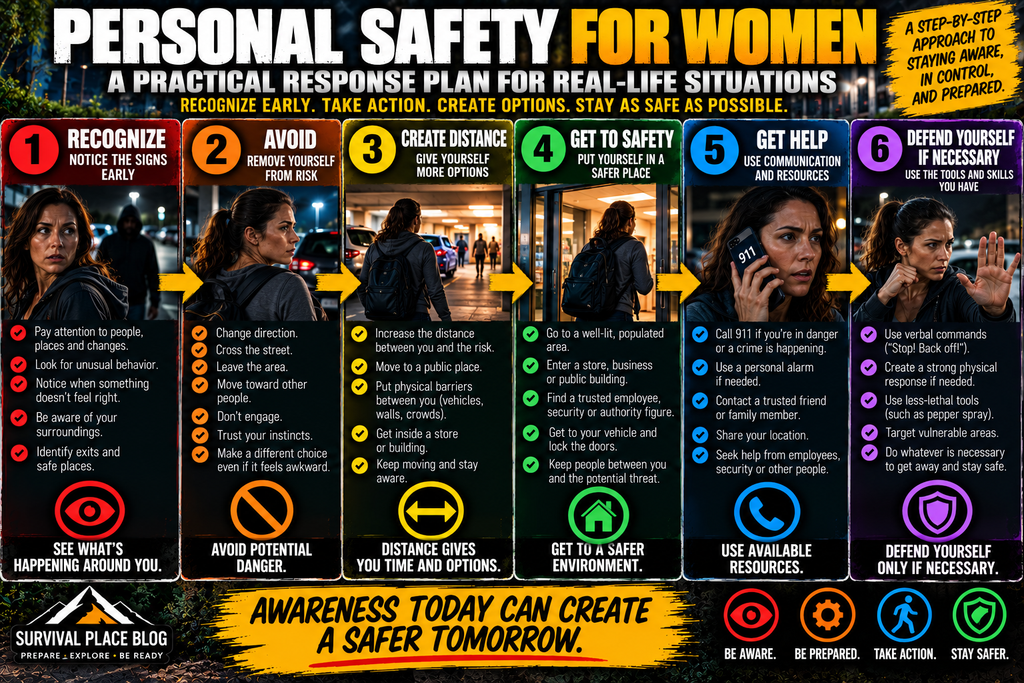
A more useful personal-safety sequence is:
Recognize → Avoid → Create Distance → Get to Safety → Get Help → Defend Yourself if Necessary
Every situation is different, and there are no guarantees. But whenever you can recognize a developing problem early and leave before it becomes physical, you’ve avoided the most dangerous part of the encounter.
Awareness doesn’t mean staring suspiciously at everyone around you.
It means periodically asking simple questions:
Who’s around me?
What’s changing?
Where would I go if I needed to leave?
Is someone paying unusual attention to me?
Am I becoming isolated?
Is there something distracting me from what’s happening nearby?
Those questions can become automatic without taking over your life.
When Something Feels Wrong but You Can’t Explain Why
“Trust your gut” is common safety advice.
There’s something useful behind it, but it needs context.
Sometimes you notice details before you consciously understand why they matter.
Someone may be standing too close.
A stranger may ask questions that seem unusually personal.
Someone may repeatedly appear in the same places.
A person may be testing whether you’ll enforce a boundary.
A vehicle may have made the same turns you have.
Someone may be watching you rather than simply looking in your direction.
You don’t need to prove that somebody is dangerous before creating distance.
If something feels wrong, you can:
- Cross the street.
- Leave the store.
- Move closer to other people.
- Ask an employee or security officer for help.
- Call someone.
- Change where you’re going.
- Cancel the date.
- Refuse the ride.
- Go back inside.
- Lock the door.
Maybe it was nothing.
That’s okay.
Personal safety doesn’t require certainty before you take a reasonable precaution.
Politeness Is Not a Safety Requirement
Many people hesitate because they don’t want to appear rude.
Someone asks for help.
Someone wants you to come closer.
Someone won’t stop talking to you.
Someone insists on walking you to your vehicle.
Someone wants your phone number.
Someone asks where you live.
You are allowed to say no.
You are allowed to walk away.
You are allowed to close the door.
You are allowed to end a conversation.
You are allowed to change your mind.
A complete explanation isn’t required.
Clear phrases are often better than complicated ones:
“No.”
“Stay back.”
“I don’t need help.”
“Don’t follow me.”
“Leave me alone.”
If someone ignores a clear boundary, that itself is useful information.
Distance Gives You Options
Distance is one of the simplest safety advantages you can create.
The farther someone is from you, the more time you generally have to recognize movement and respond.
Avoid letting a stranger unnecessarily close the distance between you.
This matters particularly around:
- Vehicles
- Elevators
- Stairwells
- Doorways
- ATMs
- Parking garages
- Isolated sidewalks
- Hotel corridors
You don’t have to stand still while deciding whether someone is a threat.
Move.
Create space.
Position yourself closer to an exit, other people, employees, security, or a locked barrier.
Keep Your Hands Available
Your phone is an incredible safety tool.
It’s also one of the biggest distractions we carry.
Walking through an unfamiliar parking garage while staring at a screen reduces your awareness of what’s around you.
When you’re moving through an environment where you want greater awareness:
Put the phone away or hold it without becoming absorbed in it.
Consider using only one earbud—or none.
Keep your keys accessible.
Avoid carrying so much that both hands are occupied.
Look around periodically.
None of this means you caused anything that happens because you were distracted.
It’s simply about preserving options.
Parking Lots and Parking Garages
Parking areas deserve extra attention because they combine vehicles, blind spots, changing lighting, and people moving in multiple directions.
Before leaving a building, have your keys ready.
Look toward your vehicle as you approach.
Notice whether anyone appears to be lingering nearby.
Avoid digging through your purse while standing beside the vehicle.
If something feels wrong, go back inside.
Ask security or an employee to walk with you if that option is available.
When you reach the vehicle:
Check the area around it.
Get inside.
Lock the doors.
Then organize your belongings, set navigation, answer messages, or make calls.
Sitting in an unlocked vehicle while distracted by your phone unnecessarily reduces the barrier between you and someone outside.
If another vehicle is parked extremely close to your driver’s side and the situation makes you uncomfortable, consider entering from another side or returning inside for assistance.
If Someone Approaches Your Vehicle
You generally don’t need to roll down the window or unlock the door to talk to a stranger.
Keep the barrier between you.
If someone says they need help, you can offer to call assistance without opening the vehicle.
If their behavior concerns you:
Lock the doors.
Start the vehicle if it isn’t already running.
Leave if you safely can.
Use the horn to attract attention if necessary.
Call 911 if you believe you’re in immediate danger.
Walking Alone
Walking alone isn’t automatically unsafe, and women shouldn’t have to organize their lives around fear.
Still, simple habits can improve your options.
Choose populated, well-lit routes when practical.
Know approximately where you’re going before you start walking.
Periodically look behind you.
Avoid shortcuts that leave you isolated if a safer alternative is available.
Keep enough battery on your phone to make an emergency call.
If you think someone may be following you, don’t automatically walk home.
Your home shouldn’t become the place where the person learns you live.
Instead, move toward a populated location such as:
- An open business
- Hotel lobby
- Fire station
- Police station
- Hospital
- Busy restaurant
- Well-populated store
Call someone and, if you believe you’re in danger, call 911.
If You Think Someone Is Following You on Foot
Don’t worry about proving it first.
You can change direction.
Cross the street.
Enter a business.
Stop near other people.
Call someone.
If the person changes direction with you or continues following, treat that as additional information.
Avoid confronting the person simply to find out what they want.
Your objective isn’t to solve the mystery.
Your objective is to get somewhere safer.
If You Think a Vehicle Is Following You
Don’t drive home.
Continue toward a populated area or, when appropriate, a police or fire station.
Keep the doors locked.
Don’t stop somewhere isolated to confront the driver.
If you believe you’re being followed and are in immediate danger, call 911 and follow the dispatcher’s directions.
Provide useful information if you can do so safely:
- Your location
- Direction of travel
- Vehicle description
- License plate
- Number of occupants
Your priority is driving safely, not collecting evidence while moving.
Rideshare Safety
Rideshare services are convenient, but you’re getting into a stranger’s vehicle.
Before entering, compare the vehicle and driver information displayed in the app.
Check the license plate.
Confirm the vehicle description.
A simple practice is to ask the driver:
“Who are you here to pick up?”
rather than giving your name first.
Sit where you feel comfortable and where you have access to an exit.
Follow the route on your own phone when appropriate.
Use the app’s trip-sharing or safety features when available.
If something feels seriously wrong, ask to be let out in a safe, populated location and contact emergency services when necessary.
What you carry can also support everyday personal safety without turning your pockets or purse into a survival kit. Our Realistic Everyday Carry (EDC) guide covers practical essentials for communication, lighting, backup power, first aid, and everyday emergencies.
Public Transportation
On buses and trains, awareness still matters.
Know approximately where you’re getting off.
Keep valuables controlled.
If another passenger makes you uncomfortable, move.
Sit closer to the driver, conductor, employees, security, or other passengers.
You don’t owe someone continued conversation simply because you’re sharing a public space.
At a station late at night, consider waiting in visible, populated areas rather than isolated ends of a platform.
Dating and Meeting Someone New
Personal safety shouldn’t make dating frightening, but meeting someone new naturally involves uncertainty.
For early meetings:
Choose a public location.
Arrange your own transportation when practical.
Tell someone where you’re going.
Consider sharing the person’s name and where you’re meeting.
Keep control of your phone.
Watch your own drink.
Have a plan for getting home that doesn’t depend entirely on the other person.
You can also establish a check-in with a friend.
Something as simple as:
“I’ll text you by 10:30. If you don’t hear from me, call me.”
creates another layer.
A code word can also communicate that you want help without explaining the situation in front of someone else.
And remember:
Agreeing to a date doesn’t create an obligation to continue it.
You can leave.
Alcohol and Personal Safety
Alcohol can affect judgment, coordination, and awareness.
That doesn’t make someone responsible for another person’s behavior.
The responsibility for assault always belongs to the person committing it.
From a preparedness standpoint, however, maintaining control over your transportation, phone, drink, and ability to make decisions can preserve more options.
If a friend appears unusually impaired, confused, or unable to care for herself, stay with her and seek appropriate help.
Workplace and Commuting Safety
Many women spend more time commuting and at work than almost anywhere else.
Learn the security resources available where you work.
That may include:
- Security escorts
- Controlled-access parking
- Cameras
- Emergency phones
- Badge access
- Reception/security staff
- Employee emergency notification systems
If someone is repeatedly waiting for you, following you to work, contacting coworkers about you, or appearing at your workplace unexpectedly, don’t automatically dismiss the pattern.
Tell someone you trust.
Depending on the circumstances, that may include a supervisor, HR, security, law enforcement, or a victim advocate.
Personal safety is also part of being prepared for a disrupted commute. Our Commuter Emergency Plan covers alternate routes, vehicle preparedness, communication, and practical ways to get home when normal roads or transportation aren’t available.
Hotels and Travel
Travel changes your normal routines.
You may be navigating unfamiliar streets, transportation systems, hotels, and languages.
At a hotel:
Don’t announce your room number publicly.
Use available door locks.
Know where the nearest exits are.
Don’t automatically open the door because someone claims to be hotel staff.
If you’re unsure, call the front desk using the hotel’s official number.
Avoid leaving identification, room keys, or travel documents exposed unnecessarily.
When traveling internationally, know how to contact local emergency services and your country’s embassy or consulate.
For a more complete plan for dealing with emergencies away from home, see our Emergency Travel Survival Guide, including communication, documents, transportation disruptions, lodging, food, water, and getting home safely.
Home Safety Starts Before the Door
Home should feel safe.
A few layers can make it more difficult for someone to gain access without turning your home into a fortress.
Start with basics:
Use quality door and window locks.
Keep exterior doors locked even when you’re home.
Make sure sliding doors and accessible windows are properly secured.
Use exterior lighting where appropriate.
Trim landscaping that creates hiding areas around doors and windows.
Don’t leave spare keys in obvious locations.
Know who is at the door before opening it.
If you live in an apartment, understand how building access works and report doors or gates that aren’t securing properly.
Don’t Open the Door Just Because Someone Knocks
A closed, locked door is a valuable barrier.
If someone claims to be:
- A utility worker
- Delivery driver
- Maintenance worker
- Police officer
- Contractor
- Neighbor you’ve never met
you can verify before opening the door.
Use a peephole, camera, window, intercom, or phone.
For unexpected service personnel, contact the organization independently rather than relying solely on information the visitor provides.
If someone refuses to leave and you’re concerned for your safety, contact law enforcement.
Living Alone
Living alone doesn’t need to mean appearing vulnerable.
Avoid casually broadcasting that you’re alone to strangers.
Consider how much personal information is visible through social media, mail, vehicle decals, or conversations.
Have at least one nearby person you could contact in an emergency if possible.
That could be:
- A neighbor
- Friend
- Relative
- Building manager
- Coworker
Knowing who you could call at 2 a.m. is worth deciding before 2 a.m. arrives.
Stalking Is More Than Being Followed
Stalking can involve repeated behaviors that create fear or serious concern, and it isn’t limited to a stranger physically following someone.
It may include:
- Repeated unwanted calls or messages
- Showing up unexpectedly
- Waiting near home, work, or school
- Following you
- Monitoring social media
- Contacting friends or coworkers
- Sending unwanted gifts
- Creating new accounts after being blocked
- Monitoring devices
- Using GPS or location-tracking technology
- Threatening you, people close to you, or pets
Individual incidents can appear insignificant when viewed separately.
Patterns matter.
The National Domestic Violence Hotline advises that documenting stalking behaviors can help establish a pattern and may be useful when reporting to law enforcement. SPARC also provides dedicated stalking incident and behavior documentation resources.
The Stalking Prevention, Awareness & Resource Center (SPARC) provides resources for recognizing stalking behaviors, documenting incidents, safety planning, and finding additional help. If repeated unwanted behavior is becoming a pattern, keeping accurate records may help you explain that pattern to advocates, workplace security, attorneys, or law enforcement.
If You Believe You’re Being Stalked
Stalking situations can vary dramatically, so generic advice can’t replace an individualized safety plan.
Consider telling trusted people what is happening.
Depending on your situation, that might include:
- Family
- Friends
- Neighbors
- Coworkers
- Workplace security
- School security
- Victim advocates
- Law enforcement
Keep records when it’s safe to do so.
Save relevant:
- Texts
- Emails
- Voicemails
- Social-media messages
- Photos
- Dates and times
- Vehicle descriptions
- Witness information
- Police report numbers
Don’t put yourself in additional danger simply to collect evidence.
Also understand that blocking someone or changing communication patterns can affect a stalking situation differently depending on the circumstances. Safety organizations recommend individualized planning because stalkers can change tactics or escalate.
If stalking involves a current or former intimate partner—or you’re concerned that changing routines, blocking contact, or changing technology settings could increase the danger—the National Domestic Violence Hotline provides individualized safety-planning information and confidential support.
Digital Safety Is Personal Safety
The line between online and physical safety has largely disappeared.
Your phone may contain:
- Your location
- Home address
- Work location
- Photos
- Contacts
- Calendar
- Travel plans
- Banking information
- Saved passwords
- Location history
Start with basic digital hygiene:
Use a strong device passcode.
Enable multi-factor authentication where available.
Review which apps can access your location.
Review location-sharing settings.
Check which devices are signed into important accounts.
Avoid posting your real-time location publicly.
Consider posting vacation photos after you’ve left rather than announcing an empty home.
Review social-media privacy settings periodically.
Remember that privacy settings reduce exposure but don’t guarantee privacy.
Check Location Sharing
Many people intentionally share their location with family or friends and then forget about it.
Periodically review:
- Apple Find My
- Google location sharing
- Family-sharing accounts
- Rideshare accounts
- Fitness apps
- Social-media apps
- Shared photo services
- Vehicle apps
Know who can currently see your location.
If you’re dealing with an abusive partner or stalking situation, changing settings can sometimes alert another person or alter their behavior. Consider getting specialized safety-planning help before making major changes if doing so could increase your risk. The National Domestic Violence Hotline specifically warns that phones and computers may be monitored without the user’s knowledge.
AirTags and Other Unwanted Trackers
Small Bluetooth trackers are useful for finding lost property.
They can also be misused.
Modern iPhone and Android systems include features intended to warn users about certain unknown trackers moving with them.
If you receive an unexpected tracking alert:
Don’t automatically ignore it.
Review the alert.
Follow your phone manufacturer’s instructions.
If you locate a device and believe it may be connected to stalking or another crime, consider preserving identifying information and contacting law enforcement rather than immediately discarding it.
Apple advises contacting law enforcement if you believe your safety is at risk, and Android provides instructions for locating an unknown tracker, saving tracker information and disabling supported trackers.
If your phone warns you about an unfamiliar tracker moving with you, use the manufacturer’s instructions rather than guessing what the alert means. Apple’s unwanted-tracker safety guidance and Android’s unknown-tracker guidance explain how to investigate alerts, locate supported trackers, review identifying information, and determine your next steps.
Your Phone Is Part of Your Emergency Kit
A phone provides communication, navigation, documentation, emergency calling and access to help.
Keep it charged.
Know how your phone’s emergency features work before you need them.
Consider setting up emergency contacts and medical information if you’re comfortable doing so.
A small portable power bank can provide another charging option when you’re away from home.
But don’t make your entire plan dependent on your phone.
Memorize at least one important phone number.
Know where you’d go if your phone were lost, damaged, dead, or taken.
A compact portable power bank is one of the simplest backups to keep in a purse, backpack, vehicle, or everyday-carry kit. It can provide enough additional power to make calls, use navigation, share your location, or contact someone when your phone battery is running low.
Create a Check-In System
A check-in system can be extremely simple.
Tell someone:
Where you’re going.
Who you’re meeting.
Approximately when you’ll return.
When they should expect to hear from you.
More importantly, decide what they should do if you don’t check in.
There’s a big difference between:
“Text me later.”
and:
“I’ll text you by 11. If I haven’t contacted you by 11:15 and you can’t reach me, call me twice. If I still don’t answer, here’s what I want you to do.”
The second creates an actual plan.
Create a Code Word
A code word can let a trusted person know you need assistance without having to explain.
Choose something memorable but not obvious.
Decide in advance what it means.
For example:
Code word = Call me immediately and give me an excuse to leave.
Or:
Code word = I may be in danger; contact emergency services and give them my location.
The word matters less than everyone knowing what action it triggers.
RAINN specifically includes code words and trusted support networks among its safety-planning strategies.
Personal Safety Tools: Understand the Purpose
No personal-safety tool guarantees safety.
Tools are options.
Each has advantages, limitations, legal considerations, and training requirements.
A useful way to evaluate one is to ask:
Can I access it quickly?
Do I know how it works?
Have I practiced using it?
Can I carry it legally where I’m going?
Could it be taken from me?
Can I use it under stress?
What happens if it fails?
The tool shouldn’t be the plan.
It should be one layer of the plan.
Personal Alarms
A personal alarm can create a loud noise intended to attract attention.
They’re generally small enough for a keychain, purse, or backpack.
If you carry one:
Know how to activate it.
Keep it accessible.
Check the battery periodically if applicable.
Don’t bury it beneath everything else in your bag.
Its value depends partly on being able to reach it quickly.
The TECKNET Rechargeable Personal Safety Alarm is a compact keychain option with a loud 130 dB alarm and SOS strobe light. Because it’s rechargeable, it can also be periodically topped off rather than relying on disposable batteries.
Flashlights
A compact flashlight has legitimate everyday usefulness while also supporting personal safety.
It can help you:
See inside a dark vehicle.
Identify what’s ahead on a dark walkway.
Navigate a power outage.
Find dropped items.
Signal for help.
Avoid hazards.
A flashlight doesn’t have to be marketed as a “tactical” product to be useful.
Reliability and accessibility matter more than aggressive branding.
A compact rechargeable EDC flashlight is easy to keep in a purse, pocket, backpack, or vehicle and gives you a dependable light source without taking up much space
Pepper Spray and Similar Defensive Sprays
Defensive sprays are another option some people consider.
But carrying one without understanding it isn’t much of a plan.
If you choose to carry a defensive spray:
Learn how your specific product operates.
Understand its effective range and limitations.
Know how to access it quickly.
Consider inert training products where available.
Understand contamination risks.
Be aware of wind and enclosed spaces.
Check expiration dates.
Most importantly, check the laws and restrictions where you live and anywhere you plan to carry it.
Rules can vary by jurisdiction and location, and certain buildings, schools, transportation systems or secured facilities may have additional restrictions.
Byrna and Other Less-Lethal Defensive Options
Some people want a defensive option that provides distance without making a firearm their only choice.
That is where products such as Byrna launchers may enter the conversation.
Byrna manufactures projectile launchers marketed for personal and home defense. These systems require substantially more thought than carrying a whistle or flashlight.
Before considering one, understand:
- How the specific launcher operates
- What ammunition/projectiles it uses
- Its limitations
- Safe storage
- Transportation considerations
- Training requirements
- Where and how it may legally be carried
- Places where possession may be prohibited
- The potential consequences of displaying or using it
A less-lethal tool should never be treated as harmless.
It can cause injury, it may escalate an encounter, it can potentially be taken from the user, and another person or responding police officer may perceive it differently than you expect.
What I Carry
I personally carry a Byrna launcher as part of my own personal-safety setup.
For me, its appeal is having another defensive option that can provide distance without making a firearm my only choice.
That doesn’t mean I believe everyone needs one.
Carrying any defensive device comes with responsibility. I need to know how mine works, keep it accessible but secure, practice with it, understand its limitations, and know the rules that apply where I’m carrying it.
Personal experience is also not a substitute for professional training or legal guidance.
If you’re considering a Byrna or another less-lethal defensive system, research the specific product and applicable laws before deciding whether it belongs in your own safety plan.
Editor’s note: Survival Place Blog may add a more detailed Byrna guide covering firsthand experience, training considerations, storage, carrying considerations and product options.
Want to learn more? You can review current launcher models, product manuals, safety information, and specifications directly from Byrna. Before purchasing or carrying any less-lethal defensive device, check the laws that apply where you live and anywhere you plan to take it.
The Best Defensive Tool Is the One You Can Actually Use Responsibly
Buying equipment can create false confidence.
Ownership isn’t training.
Whatever tool you choose, if any, you should understand it well enough that you aren’t figuring it out for the first time during an emergency.
Practice accessing it.
Understand how its safety mechanisms work.
Know its limitations.
Maintain it.
Store it responsibly.
And have a plan that still works if you don’t have it.
Physical Self-Defense: The Goal Is Escape
Physical self-defense deserves training.
Reading an article cannot teach you how to reliably escape a grab, defend against a strike, or function under the stress of a physical attack.
That is one area where the original version of this article went too far.
It presented specific techniques as though following a few written instructions could reliably solve situations involving wrist grabs, bear hugs or choking. Those encounters are too variable and dangerous for that kind of certainty.
A better principle is:
If physical defense becomes necessary, the objective is to create an opportunity to escape and get to safety.
Not to win.
Not to punish the attacker.
Not to prove anything.
Escape.
Take a Reputable Self-Defense Class
A good hands-on course can teach things an article cannot:
- Movement
- Balance
- Boundary setting
- Verbal skills
- Escapes
- Striking fundamentals
- Stress response
- Decision-making
- Creating distance
Look for instructors who allow realistic practice while emphasizing avoidance and escape.
Be skeptical of anyone promising a few “secret moves” that supposedly work against every attacker.
No technique works every time.
Training should make you more capable—not overconfident.
Your Voice Is a Tool
A strong voice can establish boundaries and attract attention.
Useful commands are short:
“STOP.”
“BACK UP.”
“DON’T TOUCH ME.”
“CALL 911.”
Specific commands may also help bystanders understand what’s happening.
Instead of simply screaming, directing someone can sometimes be useful:
“YOU IN THE BLUE JACKET—CALL 911.”
Whether speaking loudly is appropriate depends on the situation. There are circumstances where quietly leaving is safer.
The objective isn’t confrontation.
It’s safety.
What If You Freeze?
People don’t always respond to danger the way they imagine they will.
Fight and flight aren’t the only stress responses.
People may freeze, become confused, comply, or struggle to process what’s happening.
That isn’t something a person should be shamed for.
Training and preplanning may help you recognize options more quickly, but no one can guarantee how they’ll respond to a frightening event.
That’s another reason simple plans matter.
Move toward the exit.
Get behind a locked door.
Call 911.
Go toward people.
Simple actions are easier to recall under stress than elaborate sequences.
If Someone Tries to Move You to Another Location
Being pressured or forced to move from a more public location into a vehicle, room, isolated area, or other secondary location is a serious situation.
There is no universal response that guarantees safety.
Your options will depend on the circumstances, including whether weapons are present, whether other people are nearby, whether escape is possible, and what the person is doing.
This is another scenario worth discussing in a reputable self-defense course rather than relying on an internet “always do this” rule.
If an opportunity exists to get to safety and summon emergency help, take it.
After an Incident: Get Somewhere Safe First
After a frightening incident, your first priority is immediate safety.
Move to a safer location.
Call emergency services when appropriate.
Contact someone you trust.
Seek medical attention when needed.
What happens next depends on the incident and what you want to do.
You may decide to:
- Make a police report
- Contact a victim advocate
- Seek medical care
- Preserve messages or other evidence
- Photograph injuries or damage
- Write down what happened while you remember it
- Contact workplace or school security
- Change elements of your safety plan
If the incident involves sexual assault, specialized support is available even if you’re uncertain whether you want to report to law enforcement.
In the United States, RAINN’s National Sexual Assault Hotline provides confidential support and can help connect survivors with local resources. If you are in immediate danger, call 911.
Domestic Violence Requires Individualized Safety Planning
Leaving an abusive relationship isn’t always as simple as “just leave.”
Individual circumstances involving housing, children, finances, transportation, pets, immigration status, disabilities, threats, weapons, surveillance, and other factors can change what is safest.
A personalized safety plan can help someone consider those circumstances.
The National Domestic Violence Hotline offers safety-planning assistance and currently provides phone, chat and text support. If you’re in immediate danger in the United States, call 911.
Need Help With Domestic Violence or Relationship Abuse?
The National Domestic Violence Hotline provides confidential safety-planning assistance and support in the United States. Visit their website for current phone, text, and chat options. If you are in immediate danger, call 911.
Build a Personal Safety Network
Preparedness gets stronger when other people are involved.
Identify several people you trust.
They don’t all need the same role.
One person might be your emergency contact.
Another might have a spare house key.
Another might be your check-in person when dating.
A nearby neighbor might be able to see your front door.
A coworker might walk with you to the parking lot.
Your network doesn’t need to be large.
It needs to be dependable.
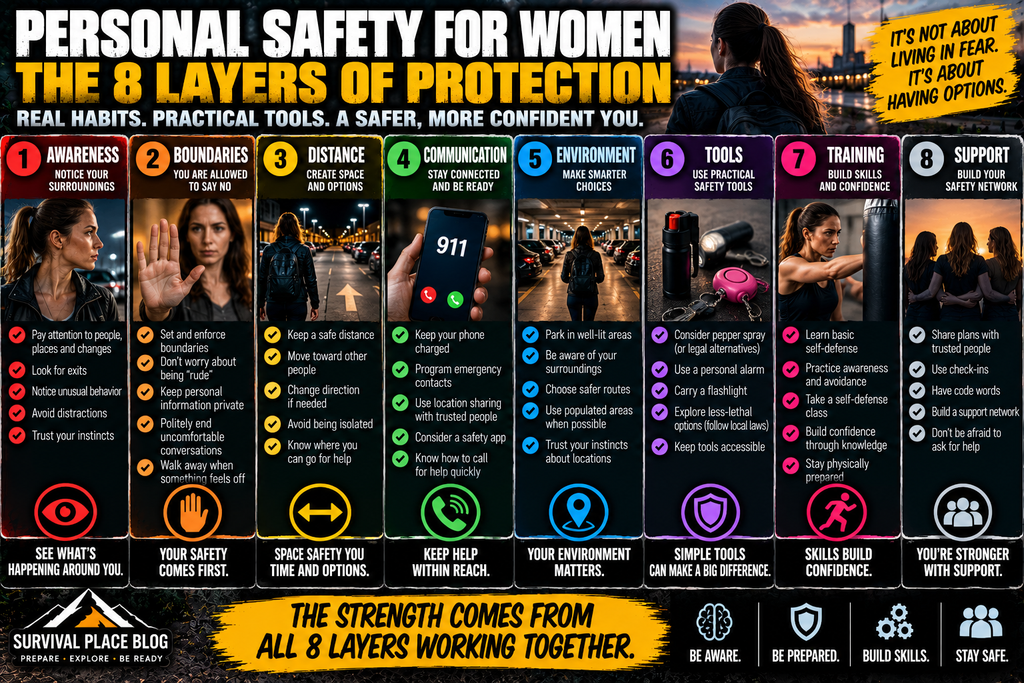
Build Layers Instead of Looking for One Solution
There is no single product, technique, app or habit that guarantees personal safety.
Think in layers.
Layer 1: Awareness
Recognize changes in your environment and unusual behavior.
Layer 2: Boundaries
Be willing to say no, move away and end interactions.
Layer 3: Distance
Create space and preserve exits.
Layer 4: Communication
Have a charged phone, emergency contacts and check-in plan.
Layer 5: Environment
Use locks, lighting, populated routes and secure locations.
Layer 6: Tools
Choose appropriate personal-safety equipment if desired and learn how to use it responsibly.
Layer 7: Training
Practice skills rather than merely reading about them.
Layer 8: Support
Know who you can contact before, during and after an emergency.
The strength comes from the layers working together.
For a practical look at the everyday items that can support several of these layers, see our Realistic Everyday Carry (EDC) guide, which covers communication, lighting, backup power, first aid, and other useful everyday essentials.
Create Your Personal Safety Plan
A useful personal safety plan should reflect your actual life, not somebody else’s checklist.
Think through the places you spend the most time.
Home
Who could I call nearby?
Are my doors and windows secure?
Can I identify someone before opening the door?
Where would I go if I needed to leave quickly?
Work
Who handles security concerns?
Can I request an escort to my vehicle?
Are there controlled-access areas?
Who should know if someone is repeatedly contacting or following me?
Commute
What alternate routes do I know?
Where are safe public places along my route?
What if my vehicle breaks down?
What if roads close?
Dating and Social Activities
Who knows where I’m going?
Do I control my transportation home?
Who is my check-in person?
What’s our code word?
Travel
Who has my itinerary?
Do I know local emergency numbers?
Where are my documents stored?
How will I communicate if my phone fails?
Digital
Who can see my location?
What devices are signed into my accounts?
Are important accounts protected with multi-factor authentication?
Have I reviewed privacy settings recently?
Emergency Communication
Who are my three most important contacts?
Do I know at least one number from memory?
What should my contact do if I send our code word?
Personal Safety Equipment
What do I actually carry?
Can I reach it?
Do I know how to use it?
Is it legal where I’m going?
Have I practiced?
Those questions turn vague concern into an actual plan.
Personal Safety Doesn’t Mean Living Afraid
Good preparedness should create confidence, not anxiety.
You don’t need to constantly imagine worst-case scenarios.
You don’t need a backpack full of defensive equipment.
You don’t need to treat every stranger as a threat.
And you don’t need to reorganize your entire life around fear.
Instead, build a few habits.
Look up from the phone.
Notice exits.
Maintain boundaries.
Keep communication available.
Know where you’d go.
Have people you can call.
Understand the tools you carry.
Practice skills that matter.
Then go live your life.
Final Personal Safety Checklist
Before you finish this guide, ask yourself:
- Do I have emergency contacts set up?
- Does someone know when I’m traveling or meeting someone new?
- Do I have a check-in system?
- Do I have a code word?
- Do I know what I’d do if followed?
- Do I know safe locations along my normal commute?
- Do I keep my phone reasonably charged?
- Do I have backup power?
- Have I reviewed location sharing?
- Do I know how unwanted-tracker alerts work?
- Are my home doors and windows secure?
- Do I understand the personal-safety tools I carry?
- Have I practiced using them?
- Have I taken a reputable self-defense course?
- Do I know where to find specialized help if stalking, sexual assault or domestic violence becomes part of the situation?
You don’t need to solve everything today.
Pick the weakest part of your plan and improve it.
Then improve the next one.
That’s how preparedness works.
Conclusion
Personal safety for women is much bigger than learning a few self-defense moves.
It’s awareness.
It’s boundaries.
It’s communication.
It’s technology.
It’s home security.
It’s knowing how to recognize patterns such as stalking.
It’s having people you trust.
It’s understanding defensive tools rather than simply buying them.
And yes, when avoidance and escape aren’t enough, physical self-defense may become necessary.
But the objective remains the same:
Get yourself to safety.
Preparation cannot eliminate risk, and no checklist can guarantee what will happen in an emergency.
What preparation can do is give you more options.
And when something goes wrong, options matter.