
Affiliate Disclosure: This post contains affiliate links. If you purchase through these links, Survival Place Blog may earn a commission at no additional cost to you. As an Amazon Associate I earn from qualifying purchases.
Rural living offers space, privacy, independence, and distance from many of the problems associated with densely populated areas.
But that distance creates its own security challenges.
A rural house, small farm, acreage property, or homestead may have a long driveway, detached buildings, expensive equipment, limited exterior lighting, large areas that cannot be seen from the house, and neighbors who aren’t close enough to immediately notice suspicious activity.
Emergency response may also take longer than it would in a densely populated neighborhood.
That makes rural home security less about turning your property into a fortress and more about creating layers.
A strong security plan should help you:
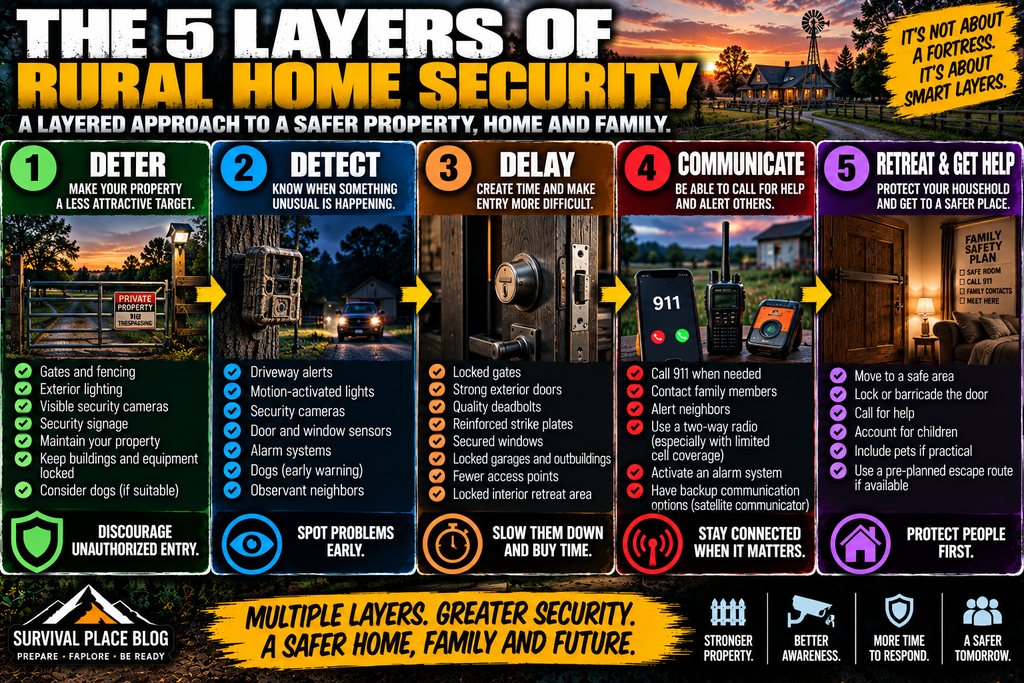
Deter → Detect → Delay → Communicate → Retreat and Get Help
No fence, camera, lock, alarm, dog, or other security measure can guarantee that someone won’t enter your property.
But several sensible layers working together can make unauthorized entry more difficult, make suspicious activity easier to notice, buy you time to respond safely, and improve your ability to contact help.
This guide will walk through those layers from the property line all the way to the inside of your home.
Home security works best as one part of a larger preparedness system. Our Five Pillars of Prepping guide explains how security fits alongside water, food, power, health, communication, transportation, and household planning.
Why Rural Home Security Is Different
Security advice designed for a suburban house doesn’t always translate perfectly to acreage or rural property.
A typical suburban home may have:
- Short driveway
- Nearby neighbors
- Street lighting
- Frequent vehicle traffic
- Small yard
- Municipal services nearby
- Houses within shouting distance
A rural property can be very different.
You might have:
- Hundreds of feet between the road and the house
- Multiple gates
- Woods or heavy vegetation
- Barns and sheds
- Livestock areas
- Fuel storage
- Trailers
- ATVs or tractors
- Tools and equipment
- Wells and pumps
- Generators
- Long fence lines
- Several possible approaches to the property
That changes how you think about security.
The objective isn’t to watch every square foot continuously.
It’s to identify the areas that matter most and make them easier to control and monitor.
The Five Layers of Rural Home Security
Before buying equipment, understand what each security layer is supposed to accomplish.
Layer 1: Deter
Deterrence makes the property appear difficult, visible, occupied, or simply not worth the trouble.
Examples include:
- Gates
- Fencing
- Lighting
- Visible cameras
- Maintained property
- Dogs
- Security signage
- Locked buildings
Layer 2: Detect
Detection tells you something unusual is happening.
Examples include:
- Driveway alerts
- Motion lights
- Cameras
- Door/window sensors
- Alarm systems
- Dogs
- Observant neighbors
Layer 3: Delay
Delay creates time.
Examples include:
- Locked gates
- Strong exterior doors
- Quality deadbolts
- Reinforced strike plates
- Locked garages
- Secured windows
- Locked interior retreat areas
Security isn’t necessarily about making entry impossible.
It’s often about making unauthorized entry slower, noisier, more difficult, and more noticeable.
Layer 4: Communicate
Once you identify a problem, you need a way to communicate.
That may mean:
- Calling 911
- Contacting family
- Alerting neighbors
- Activating an alarm
- Using a radio when cell coverage is unreliable
Layer 5: Retreat and Get Help
If someone actually enters your home, protecting property should become secondary to protecting people.
Your household should know:
- Where to move
- How to lock or barricade a door
- How to call for help
- How to account for children
- What to do with pets if practical
- Whether a safe exit exists
The goal is not to go looking for an intruder.
The goal is to create distance, protect household members, and get help.
Step 1: Conduct a Rural Property Security Assessment
Before installing cameras or buying alarms, walk your property.
Do it during daylight.
Then do it again after dark.
The property may look completely different at night.
Bring a notebook or use your phone to document what you find.
Map the Property
Make a basic map showing:
- House
- Garage
- Barns
- Workshops
- Sheds
- Driveways
- Gates
- Fences
- Trails
- Wells
- Fuel tanks
- Generators
- Livestock areas
- Equipment storage
- Wooded areas
- Creeks or drainage areas
You don’t need professional surveying software.
A simple sketch is enough.
Identify Normal Access Points
Ask yourself:
How would a legitimate visitor reach the house?
Ideally, most visitors naturally approach through one obvious route.
The more uncontrolled access points a property has, the more difficult it becomes to monitor.
Identify:
- Main driveway
- Secondary driveways
- Farm roads
- Trails
- Service entrances
- Gates
- Paths from neighboring land
You may discover entrances you rarely think about.
Look for Blind Spots
Stand at:
- Front door
- Back door
- Kitchen windows
- Bedroom windows
- Garage
- Porch
- Barn
What can’t you see?
Common blind spots include:
- Behind detached garages
- Sides of barns
- Dense vegetation
- Deep porches
- Equipment sheds
- Corners of the house
- Areas behind RVs or trailers
Those areas may deserve lighting, cameras, landscaping changes, or simply more awareness.
Walk the Property at Night
Nighttime reveals weaknesses daylight hides.
Look for:
- Completely dark approaches
- Glare from poorly aimed lights
- Shadows beside buildings
- Areas cameras cannot see
- Doors hidden from the house
- Paths that allow someone to approach unnoticed
You may find that one properly positioned light solves a problem better than several randomly placed lights.
Step 2: Control Vehicle Access
On many rural properties, the driveway is the most important access point.
Someone walking across several acres is possible.
But vehicles are often the more practical concern because stealing tools, fuel, equipment, or other property usually requires transportation.
Make the Main Entrance Obvious
Visitors should understand where they’re supposed to enter.
This can be accomplished with:
- Visible address numbers
- Clearly defined driveway
- Gate
- Fence
- Signage
- Lighting
A clearly defined entrance also makes unusual access easier to notice.
Use Gates Strategically
A gate doesn’t need to look like a prison entrance.
Its purpose is to establish a boundary and control vehicle access.
Depending on the property, that could be:
- Farm gate
- Swing gate
- Sliding gate
- Automatic driveway gate
When practical, secure gates when the property is unattended or overnight.
Avoid creating a gate system that interferes with emergency responders.
Your property address should remain clearly visible from the road.
Don’t Forget Secondary Access
A locked front gate accomplishes little if someone can simply drive around it using an old farm road.
Review:
- Service roads
- Utility access
- Field entrances
- Trailheads
- Open fence sections
Not every path needs an expensive gate.
But you should know where vehicles can enter.
Step 3: Fences and Property Boundaries
Fencing can serve several purposes:
- Define property boundaries
- Manage livestock
- Guide visitors
- Control vehicles
- Increase privacy
- Discourage casual trespassing
But fences shouldn’t create a false sense of security.
Most ordinary fences can be crossed by someone determined enough.
Think of fencing primarily as boundary control and deterrence.
Match the Fence to the Job
Different areas may require different fencing.
A livestock fence may be appropriate for a field.
Decorative fencing may work near the house.
A sturdy gate may matter most at the driveway.
The goal isn’t necessarily surrounding every acre with expensive security fencing.
Prioritize the places where controlling movement matters.
Inspect Fences Periodically
Look for:
- Broken wires
- Damaged posts
- Open gates
- Fallen trees
- Washouts
- Animal damage
- Cut sections
- Unusual vehicle tracks
On large properties, fence inspections can also reveal changes you might otherwise miss.
Step 4: Use Defensive Landscaping Without Creating Hiding Places
Landscaping can either improve security or accidentally make it worse.
The original version of this article emphasized using heavy vegetation as barriers.
That can work in certain places.
But dense shrubs close to doors and windows can also provide concealment.
The better strategy is selective landscaping.
Keep Visibility Near the House
Around important areas, maintain clear sight lines.
Pay particular attention to:
- Exterior doors
- Ground-floor windows
- Garage entrances
- Walkways
- Utility areas
Trim vegetation that creates obvious hiding places.
Use Thorny Plants Carefully
Certain thorny plants can discourage someone from casually approaching a window or crossing a particular area.
Depending on climate, examples may include:
- Roses
- Hawthorn
- Pyracantha
- Blackberry
But don’t plant anything that blocks your own visibility or creates maintenance problems.
Also consider children, pets, livestock, wildfire risk, and local growing conditions.
Gravel Can Improve Awareness
Gravel around certain paths or building approaches naturally makes noise when walked or driven across.
That’s not an alarm system.
But it can provide another environmental cue that someone or something is moving nearby.
Step 5: Secure Exterior Doors
Once someone reaches the house, doors become one of the most important security layers.
Start with the basics.
Use Solid Exterior Doors
Exterior doors should be in good condition and designed for exterior use.
Inspect:
- Door
- Frame
- Hinges
- Locks
- Strike plate
A strong lock attached to a weak frame still leaves a weak entry point.
Use Quality Deadbolts
Exterior doors should have reliable locking hardware appropriate for the door.
But don’t focus exclusively on the lock itself.
The door frame and strike area matter too.
Reinforce the Strike Area
Longer screws that properly anchor appropriate strike hardware into structural framing can strengthen some door installations.
Commercial door-reinforcement products are also available.
Whatever method you choose, it should not prevent household members from exiting quickly during a fire or other emergency.
Secure Sliding Doors
Sliding glass doors deserve attention.
Depending on the door design, additional security can include:
- Properly functioning lock
- Security bar
- Manufacturer-compatible secondary lock
Make sure emergency exits remain usable from inside.
Step 6: Improve Window Security
Windows create a balancing act.
You want to discourage unauthorized entry.
But bedroom and other required emergency-egress windows still need to function safely.
Start With Working Locks
Check every accessible window.
Make sure:
- Locks work
- Frames aren’t damaged
- Windows close completely
- Screens don’t conceal damage
Consider Security Film
Security film may help hold broken glass together and can make some forced entry attempts more difficult.
But film does not make glass unbreakable.
Installation quality and the window system matter.
Avoid Blocking Emergency Escape
Be cautious with permanent bars or modifications that could trap occupants during a fire.
Any security improvement should account for emergency egress.
A power outage can change normal security conditions by disabling exterior lighting, internet-connected cameras, alarms, and other systems. Our Home Security During a Power Outage guide covers practical ways to maintain security when the grid is down.
Step 7: Don’t Forget the Garage
Garages often contain thousands of dollars in:
- Tools
- Vehicles
- Outdoor equipment
- Bicycles
- Emergency supplies
- Fuel
- Sporting equipment
And an attached garage may provide another route into the house.
Keep Garage Doors Closed
This sounds obvious, but open garage doors advertise what’s inside.
Even when you’re home, consider closing the garage when it isn’t actively being used.
Secure the Interior Door
If your garage connects directly to the house, treat that connecting door as an important entry point.
It should close properly and use appropriate hardware.
Also maintain required fire separation between an attached garage and living space.
Secure Garage Remotes
A garage remote left inside a vehicle parked outside can potentially become a key to the house.
Consider how your opener and remote system are configured.
Step 8: Secure Barns, Workshops and Outbuildings
Rural security isn’t only about the house.
Detached buildings can contain expensive equipment and may be far enough away that activity goes unnoticed.
Prioritize High-Value Buildings
You may not need the same security level on every shed.
Start with buildings containing:
- Power tools
- Welders
- Generators
- Chainsaws
- ATVs
- Motorcycles
- Fuel
- Farm equipment
- Expensive supplies
Improve Doors and Locks
An expensive padlock attached to a weak latch won’t accomplish much.
Look at the entire assembly:
- Door
- Frame
- Hinges
- Hasp
- Lock
Security is only as strong as the weakest part.
Record Valuable Equipment
Maintain records of significant equipment.
Depending on the item, record:
- Make
- Model
- Serial number
- Purchase information
- Photographs
Store copies somewhere besides the building where the equipment is kept.
This can be useful for insurance and police reports if something is stolen.
Step 9: Build an Exterior Lighting Plan
Lighting is one of the simplest ways to improve nighttime awareness.
But more light isn’t always better.
The goal is useful light in useful locations.
Prioritize Important Areas
Consider lighting:
- Exterior doors
- Garage
- Driveway
- Gate
- Walkways
- Barn entrances
- Equipment storage areas
Motion Lighting
Motion-activated lighting can be useful because sudden illumination gets attention.
It can also reduce the need to keep large areas brightly illuminated all night.
But motion lights can be triggered by:
- Wildlife
- Wind-blown vegetation
- Pets
Placement and sensitivity matter.
Solar Lighting
Solar-powered lights can be useful in areas where running electrical wiring would be difficult.
Quality varies considerably.
Make sure the solar panel receives enough daylight and periodically test the unit.
Maintain Backup Lighting
Grid-powered exterior lighting may disappear during the exact emergency when you want it most.
Keep independent lighting available.
That can include:
- Headlamps
- Flashlights
- Rechargeable lanterns
- Battery-powered lights
A dependable headlamp is especially useful during outages because it keeps both hands free while checking gates, locks, equipment, animals, or other areas around the property after dark.
Step 10: Cameras and Video Surveillance
Modern cameras have made rural property monitoring much easier.
But camera placement matters more than simply buying a large number of cameras.
Prioritize Identification Areas
A camera showing someone walking across a field 150 feet away may not provide useful identification.
Higher-priority locations can include:
- Driveway entrance
- Front door
- Back door
- Garage
- Gate
- Workshop
- Barn entrance
These are places where people or vehicles naturally pass closer to the camera.
Think About Vehicles
At a rural entrance, capturing:
- Vehicle type
- Direction
- Time
- Other distinguishing information
may be valuable.
Camera capability varies widely, particularly at night, so test the actual view rather than trusting advertising claims.
Cameras Need Maintenance
Periodically check:
- Battery
- Charging
- Wi-Fi or network connection
- Storage
- Lens cleanliness
- Night image quality
- Time/date settings
- Notifications
A camera that hasn’t recorded for six months isn’t much help.
Consider Privacy
Point cameras toward your own property and legitimate security areas.
Avoid unnecessary surveillance of neighboring private spaces.
Step 11: Driveway Alerts and Early Warning
On a long rural driveway, knowing that a vehicle has entered the property can be extremely useful.
A driveway alert can provide notice before someone reaches the house.
Systems may use:
- Motion
- Infrared detection
- Magnetic vehicle detection
- Cameras
Different technologies have different strengths.
A motion sensor near a wooded driveway may detect wildlife.
A vehicle-specific sensor may reduce those alerts.
Choose based on your property rather than assuming one system works everywhere.
For a long driveway or multiple approaches, a wireless driveway alarm can provide early notice when someone enters the property. A system with multiple outdoor sensors can also monitor more than one access point, such as the main driveway and a secondary entrance.
Step 12: Alarm Systems
Alarm systems can add another detection layer.
Options range from basic standalone door sensors to professionally monitored systems.
Depending on internet and cellular reliability, rural households should consider what happens when normal connectivity fails.
Ask:
- Does the alarm have battery backup?
- Does it depend entirely on Wi-Fi?
- Is cellular backup available?
- How long will backup power last?
- Will exterior buildings connect reliably?
- What happens during an internet outage?
Test alarms periodically.
Step 13: Dogs and Animals as Awareness Layers
Dogs can provide excellent early warning.
They often notice:
- Vehicles
- People
- Wildlife
- Unusual sounds
before humans do.
But a dog shouldn’t be treated as a disposable security device.
Its primary role in a security plan should be awareness and deterrence, not confrontation.
Some rural animals, including geese and guinea fowl, can also be surprisingly noisy when something unfamiliar enters their area.
Consider that a bonus rather than a replacement for proper security.
Step 14: Protect Tools, Equipment, Fuel and Trailers
Rural properties often contain valuable items outside the main house.
That makes inventory control important.
Don’t Leave Equipment Conveniently Accessible
When practical:
- Lock toolboxes
- Secure workshops
- Remove keys from equipment
- Lock trailers
- Secure ATVs
- Store portable generators
- Keep fuel areas controlled
A little inconvenience for you may create substantial inconvenience for a thief.
Don’t Advertise Expensive Equipment
Be mindful about what can be seen from the road.
A new generator, tractor attachment, ATV, or expensive tool sitting beside the driveway advertises what’s available.
The same applies online.
Consider how much information social-media posts reveal about:
- Equipment
- Property layout
- Travel
- Vacations
- Whether the house is occupied
Step 15: Prepare for Security During Power Outages
Power outages change normal security conditions.
Exterior lighting may stop.
Internet cameras may go offline.
Alarm systems may eventually exhaust backup batteries.
Garage doors may operate differently.
Electronic gates may require manual operation.
Phones may become difficult to charge.
That’s why rural home security should include some systems that don’t depend entirely on grid electricity.
Useful backups can include:
- Battery lighting
- Power banks
- Emergency radio
- Backup power
- Mechanical locks
- Offline communication plan
A long outage affects much more than the lights. Refrigeration, communications, water systems, heating, security equipment, and other essentials can all be affected. Our Extended Power Outage guide walks through what can happen during the first 48 hours and how to prepare for it.
A battery-powered emergency radio provides another way to receive weather alerts and emergency information when internet service or normal communications are disrupted. The Midland ER310 is a practical option for keeping with your household emergency supplies.
Step 16: Create a Household Intrusion Plan
Equipment is only part of security.
Everyone in the household should know what to do if something actually happens.
The plan doesn’t need to be complicated.
If You Hear Something Outside
Avoid automatically going outside to investigate an unknown situation.
When appropriate:
- Turn on exterior lights
- Check cameras
- Secure doors
- Account for household members
- Contact authorities if circumstances warrant
Property can be replaced.
People can’t.
If Someone Attempts to Enter
Your priorities should generally be:
- Create distance.
- Get household members to a safer location.
- Lock or barricade an appropriate door if possible.
- Call 911.
- Provide dispatchers with useful information.
- Follow emergency instructions.
Avoid unnecessarily moving toward an unknown threat.
Teach Children Simple Instructions
Children don’t need frightening details.
They do need clear instructions.
For example:
- Go to the designated room.
- Stay with the designated adult.
- Don’t open exterior doors.
- Don’t leave until told it’s safe.
Simple plans are easier to remember under stress.
Step 17: Create a Retreat or Safe Area
A household retreat area doesn’t need to be a movie-style panic room.
It can simply be a room that gives family members somewhere to gather behind a locked door while contacting help.
Useful characteristics may include:
- Solid door
- Functional lock
- Charged phone
- Phone charger or power bank
- Flashlight
- First-aid supplies
- Emergency contacts
Depending on your home layout, a bedroom may already serve this function.
Don’t Create a Fire Trap
Security should never prevent emergency escape.
A room that cannot be exited during a fire may create more danger than it solves.
Balance intrusion security with:
- Smoke alarms
- Fire escape planning
- Accessible exits
- Appropriate window egress
Step 18: Communication When Cell Service Is Weak
Some rural properties have unreliable cellular coverage even during normal conditions.
Don’t discover your communication limitations during an emergency.
Know where on the property cell service works best.
Consider whether your household needs:
- Wi-Fi calling
- Backup internet
- Two-way radios
- Emergency radio
- Satellite communication for particularly remote locations
The appropriate solution depends heavily on where you live.
Two-Way Radios Around the Property
Two-way radios can be useful when family members are:
- Working in a field
- In a barn
- Cutting firewood
- Maintaining fences
- Away from the house
Understand the realistic range of your equipment.
Terrain, buildings, vegetation, and radio type can dramatically affect performance.
Step 19: Know Your Neighbors
On rural property, a trustworthy neighbor can be one of the most useful security resources available.
You don’t need to organize a formal neighborhood patrol.
Simply knowing each other helps.
A neighbor may notice:
- Unfamiliar vehicle
- Open gate
- Loose livestock
- Smoke
- Damaged fence
- Suspicious activity
And you may notice the same things at their property.
Exchange Contact Information
If appropriate, exchange phone numbers with nearby neighbors.
That becomes particularly useful when someone is traveling.
A simple message like:
“We’re away this weekend. If you see something unusual at the house, please call us.”
can be surprisingly effective.
Step 20: Prepare for Longer Emergency Response Times
One reality of rural living is distance.
Depending on location, emergency services may have farther to travel.
That makes early detection and communication especially important.
Make sure your address is visible.
If your house sits far from the road, responders need to know where to go.
Keep:
- Driveway reasonably accessible
- Address numbers visible
- Gates operable
- Emergency contact information current
If you have unusual access issues, learn what your local emergency services recommend.
For rural properties, clearly visible address numbers can help emergency responders locate the correct driveway and residence. Check with your local fire department, sheriff’s office, or 911 addressing authority for any specific recommendations or requirements in your area.
Step 21: Home Security While Traveling
An empty rural property can be noticeably empty.
Mail accumulates.
Trash cans don’t move.
Vehicles disappear.
Lights never change.
Routine activity stops.
Before traveling:
- Lock buildings
- Secure equipment
- Close garage doors
- Stop or collect deliveries
- Arrange mail
- Use lighting timers where appropriate
- Check camera notifications
- Ask a trusted neighbor to watch for unusual activity
Be careful about publicly announcing travel plans before returning home.
Step 22: Personal Safety Matters More Than Property
This is one of the most important principles in the entire guide.
Your tractor can be replaced.
Your tools can be replaced.
Your television can be replaced.
You cannot.
If you encounter suspicious activity, avoid escalating a property crime into a dangerous confrontation when safer alternatives exist.
Maintain distance.
Get to safety.
Contact authorities.
Provide useful information.
Let law enforcement handle situations that require law-enforcement intervention.
Home security and personal safety work together. Awareness, communication, emergency planning, and knowing how to respond when something feels wrong can matter just as much away from home as they do on your property. Our Personal Safety for Women guide goes deeper into those everyday safety strategies.
What About Defensive Tools?
People living in rural areas may choose to keep various legal defensive tools.
Those choices are personal and heavily affected by local law, training, household circumstances, and individual comfort.
Whatever you choose, avoid treating a defensive tool as your entire security plan.
A tool doesn’t replace:
- Locks
- Lighting
- Cameras
- Alarms
- Communication
- Household planning
- Situational awareness
If firearms are present in the home, follow safe-storage practices appropriate to your household and applicable laws, particularly where children or unauthorized users could gain access.
Training matters.
Safe handling matters.
Understanding the law matters.
Most importantly, your security plan should be designed to reduce the likelihood that a physical confrontation occurs at all.
Rural Security During Major Disruptions
Most security planning should focus on ordinary circumstances:
- Theft
- Trespassing
- Burglary
- Vandalism
- Suspicious vehicles
But broader emergencies can change the environment.
Examples include:
- Extended blackout
- Wildfire evacuation
- Severe winter storm
- Earthquake
- Communications outage
- Major transportation disruption
During these events, some normal security systems may stop functioning.
That’s where preparedness and home security overlap.
Maintain Basic Security Without Electricity
You should still be able to:
- Lock doors
- Secure gates
- Illuminate critical areas
- Communicate
- Receive emergency information
even if grid power is unavailable.
Don’t Abandon Situational Awareness
Emergencies can create distractions.
You’re thinking about:
- Food
- Water
- Heat
- Power
- Family
- Transportation
Security can become an afterthought.
Maintain normal habits:
- Lock doors
- Close garage
- Secure tools
- Keep vehicles locked
- Know what’s happening around the property
A security emergency can also become an evacuation emergency. Keeping essential supplies organized and ready to move gives your household another option if remaining at home becomes unsafe. Our 72-Hour Go-Bag Checklist covers the practical essentials to keep ready for a short-notice evacuation.
Common Rural Home Security Mistakes
Good security often comes down to fixing ordinary weaknesses.
Mistake 1: Buying Cameras Before Fixing Doors
A perfect recording of someone walking through an easily forced door isn’t ideal.
Address physical security first.
Then add detection.
Mistake 2: Installing Too Many Lights
Flooding an entire property with light can create glare and deep shadows.
Light important areas intentionally.
Mistake 3: Letting Vegetation Hide Entry Points
Privacy landscaping can become concealment.
Maintain visibility near the house.
Mistake 4: Ignoring Outbuildings
The workshop may contain more easily stolen property than the living room.
Secure it accordingly.
Mistake 5: Leaving Keys in Equipment
Convenience can become vulnerability.
Remove keys from tractors, ATVs, utility vehicles, and other equipment when appropriate.
Mistake 6: Depending Entirely on Wi-Fi
Internet-connected security is useful.
But internet and electricity can fail.
Maintain basic mechanical and battery-powered layers.
Mistake 7: Investigating Everything Personally
Not every unusual sound requires walking into the darkness.
Use lights, cameras, windows, alarms, and communication tools to gather information from a safer location when possible.
Mistake 8: Creating a Fortress Nobody Can Escape
Security bars, complicated locks, blocked windows, and improvised barricades can create fire hazards.
Always maintain emergency escape capability.
Mistake 9: Advertising Your Property Online
Posting photographs of expensive equipment or announcing that you’re away can reveal more than intended.
Think about what your posts tell strangers.
The Rural Home Security Audit
Walk through this list at least once or twice each year.
Property
Do we know every practical vehicle and foot access point?
Are property boundaries reasonably clear?
Are unused gates secured?
Have new blind spots developed?
House
Do exterior doors close and lock correctly?
Are strike areas and frames in good condition?
Do accessible windows lock?
Is the garage secured?
Exterior
Are important approaches adequately lit?
Do cameras still provide useful views?
Are motion sensors functioning?
Has vegetation created hiding places?
Outbuildings
Are high-value buildings secured?
Are tools and equipment inventoried?
Are serial numbers recorded?
Are keys removed from equipment?
Power Failure
What stops working when electricity fails?
How long will alarm and camera backup batteries last?
Do we have independent lighting?
Can we still communicate?
Household
Does everyone know what to do if someone attempts to enter?
Where does the household retreat?
Can we call for help from that location?
Does our security plan preserve fire escape routes?
Community
Do we know nearby neighbors?
Do we have contact information for at least one trusted neighbor?
Can emergency responders clearly identify our property?
Want to find the weak spots around your property? Download the free Rural Home Security Audit and work through your property, house, outbuildings, security systems, emergency planning, and communication setup one section at a time.
A Practical 30-Day Rural Home Security Plan
You don’t need to overhaul the entire property this weekend.
Spread improvements across a month.
Week 1: Assess
Walk the property during daylight and darkness.
Map entrances.
Identify blind spots.
Check fences.
Inspect exterior doors and windows.
Week 2: Strengthen
Fix damaged locks.
Repair gates.
Improve door hardware where needed.
Secure garages and outbuildings.
Remove keys from unattended equipment.
Week 3: Detect
Improve exterior lighting.
Adjust cameras.
Test motion alerts.
Consider driveway detection.
Trim vegetation blocking visibility.
Week 4: Plan
Create a household intrusion plan.
Choose a retreat location.
Test communications.
Exchange contact information with trusted neighbors.
Review how the property functions during a power outage.
Then repeat the assessment periodically.
Security Should Create Peace of Mind, Not Fear
It’s easy for home-security planning to become driven by worst-case scenarios.
That’s not the objective.
Good security should allow you to feel more comfortable on your property because you’ve reduced obvious vulnerabilities.
You know the gates work.
You know the doors lock.
You know when someone enters the driveway.
You can see important areas at night.
Your family knows what to do.
You can contact help.
That’s practical security.
Final Thoughts: Build Layers, Not a Fortress
Effective rural home security isn’t about surrounding your property with extreme barriers or preparing to confront everyone who crosses the property line.
It’s about layers.
Deter unnecessary access.
Detect unusual activity.
Delay unauthorized entry.
Communicate when something is wrong.
Retreat and get help when personal safety is threatened.
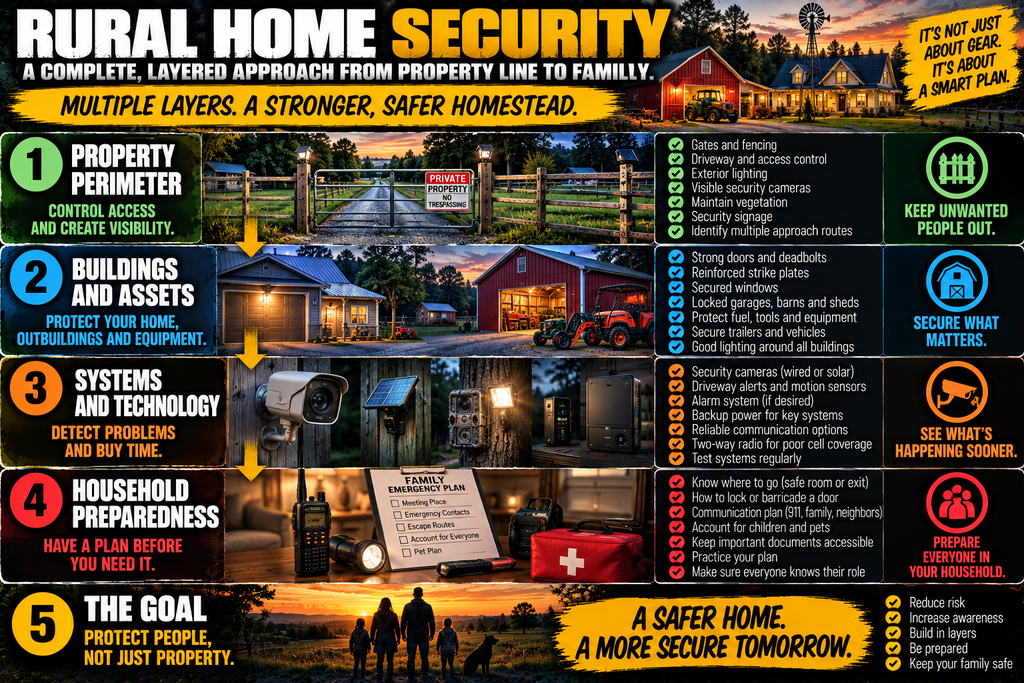
Start at the property line and work inward.
Control obvious access points.
Maintain visibility.
Secure the house.
Protect outbuildings.
Use lighting and cameras intelligently.
Prepare for power failures.
Know your neighbors.
And make sure everyone in the household understands the plan.
You don’t have to turn your homestead into a fortress.
You just need to make it a harder target, a more observable property, and a safer place for the people who live there.
Protect the property—but prioritize the people.