
Affiliate Disclosure: This post contains affiliate links. If you purchase through these links, Survival Place Blog may earn a commission at no additional cost to you. As an Amazon Associate I earn from qualifying purchases.
EMP preparedness has a reputation problem.
Search for information about electromagnetic pulses and you’ll quickly encounter claims that every modern vehicle will stop running, every phone will be destroyed, the electrical grid will disappear for years, and society will immediately collapse.
The reality is more complicated.
An electromagnetic pulse is a real phenomenon, and the potential effects on electrical infrastructure are serious enough that government agencies and the energy industry study EMP vulnerabilities and ways to improve the resilience of critical infrastructure.
But that doesn’t mean every electronic device will automatically fail—or that preparing for an EMP requires building an underground bunker.
For most households, the smarter approach is much simpler:
Prepare for the consequences of a prolonged loss of electricity, communications, water, fuel distribution, refrigeration, and other essential services while taking reasonable steps to protect a small amount of useful backup electronics.
That kind of preparation helps whether the cause is an EMP, severe weather, equipment failure, wildfire, cyber incident, or another major grid disruption.
Here’s what an electromagnetic pulse could actually mean for your household—and how to prepare without getting caught up in the Hollywood version.
What Is an Electromagnetic Pulse?
An electromagnetic pulse, or EMP, is a burst of electromagnetic energy capable of inducing electrical currents and voltages in electronic equipment and electrical systems.
What happens during an EMP depends on numerous factors, including the type and strength of the electromagnetic disturbance, distance from the event, equipment design, shielding, connected cables and power lines, and the characteristics of the infrastructure exposed to it.
That’s why there isn’t one simple answer to the question:
What would survive an EMP?
Some systems could be vulnerable. Others might experience temporary disruption. Some equipment may continue operating normally.
For households, however, the larger problem might not be whether an individual device survives.
It may be whether the infrastructure that device depends on still works.
A functioning smartphone isn’t particularly useful if cellular networks, internet connections and commercial power are unavailable.
Nuclear EMP and Solar Storms Are Not the Same Thing
EMP discussions often lump nuclear EMPs and solar storms together, but they aren’t the same event.
High-Altitude Nuclear EMP
A high-altitude electromagnetic pulse, commonly called HEMP, can result from a nuclear detonation high above Earth’s surface.
The electromagnetic effects are commonly discussed as three components: E1, E2 and E3.
You don’t need an electrical-engineering degree to understand the basic differences.
E1 is an extremely fast pulse capable of affecting susceptible electronics and electrical equipment.
E2 has some characteristics similar to electromagnetic effects associated with lightning, although existing lightning protection doesn’t necessarily address every EMP vulnerability.
E3 is a much slower electromagnetic effect capable of inducing currents in long conductors such as transmission lines and potentially affecting portions of the electrical grid.
Different components can therefore create different challenges for electronics and infrastructure.
Geomagnetic Storms
A severe solar event presents a different kind of problem.
Coronal mass ejections from the sun can interact with Earth’s magnetic field and create geomagnetic disturbances. Those disturbances can induce currents in long electrical conductors and potentially affect power systems, satellites, navigation and some radio communications.
Although solar storms and nuclear EMPs both belong in a discussion about electromagnetic threats, they shouldn’t be treated as though they produce identical effects.
We’ve Experienced Major Geomagnetic Storms Before
One of the most famous examples occurred in 1859.
The Carrington Event produced an extraordinarily intense geomagnetic storm and electrical effects in telegraph systems. Because modern society depends on vastly more electrical infrastructure today, researchers continue to study what an extreme event could mean for modern systems.
There are more recent examples as well.
In May 2024, Earth experienced a G5—Extreme—geomagnetic storm. The event affected GPS-dependent activities, satellites and other systems, but it did not produce the worldwide technological collapse sometimes associated with extreme space-weather scenarios.
That’s an important lesson for preparedness:
A serious hazard doesn’t require exaggeration to deserve preparation.
What Could an EMP Actually Affect?
The consequences of a major EMP would depend on the characteristics of the event and the systems exposed to it.
Several areas deserve particular attention.
The Electrical Grid
For most households, the electrical grid should be near the top of the concern list.
Modern life depends on electricity for much more than lights and televisions.
Electric power supports communications, banking, refrigeration, water and wastewater systems, healthcare, fuel distribution, transportation, businesses and supply chains.
A sufficiently severe electromagnetic event could create a complicated infrastructure emergency.
That doesn’t mean one EMP automatically destroys the entire national grid.
It means households should be prepared for the possibility of an extended power outage and the cascading problems that follow it.
Communications
Cell towers, network equipment, data centers, internet infrastructure and communications systems all depend on electrical power and interconnected electronic equipment.
Even if your phone survives, the network may not.
Some communications infrastructure has backup power, but capability and duration vary.
During a widespread outage, communications may become less reliable. That’s why an emergency radio and a family communication plan can be more valuable than simply keeping several charged smartphones around the house.
Water and Wastewater
Turn on a faucet and it’s easy to forget how much infrastructure stands behind that water.
Treatment facilities, pumps, control systems and distribution networks depend to varying degrees on electrical power.
A prolonged electrical disruption could therefore eventually become a water emergency.
Stored water should rank considerably higher on your preparedness list than exotic EMP equipment.
A practical household should have stored drinking water along with a reliable method for treating additional water if the disruption lasts longer than expected.
Food and Refrigeration
A major outage creates two different food problems.
First, refrigerated and frozen foods eventually become unsafe if safe temperatures can’t be maintained.
Second, stores and supply chains depend on refrigeration, transportation, electronic payment systems, warehouses, communications and fuel.
You don’t need years of freeze-dried food to address this.
Start with foods your household already eats and build a supply that can be prepared with minimal electricity and water.
Then gradually expand from there.
Fuel
Gas stations need electricity to operate pumps and payment systems.
Fuel distribution itself depends on transportation, communications and functioning infrastructure.
That makes the fuel already in your vehicle—and your habit of keeping the tank from getting dangerously low—part of your preparedness plan.
A major outage is not the ideal time to discover that your vehicle has almost no range remaining.
Healthcare
Healthcare facilities have emergency plans and backup systems, but widespread infrastructure disruption can still create significant challenges.
Households should pay particular attention to prescription medications, electrically powered medical devices and medications requiring refrigeration.
Anyone who depends on powered medical equipment should have an emergency plan specifically appropriate to that equipment rather than relying on a generic preparedness checklist.
Would an EMP Really Kill Every Car?
This is one of the most repeated EMP claims:
“After an EMP, every modern vehicle will be dead.”
There isn’t sufficient evidence to state that as fact.
Modern vehicles contain numerous electronic control systems, so electromagnetic vulnerability is a legitimate engineering concern. But susceptibility can depend on the vehicle, its electronics, exposure and characteristics of the electromagnetic environment.
The limited vehicle testing frequently cited in EMP discussions does not justify confidently saying that every modern car would stop working.
But the opposite assumption—that every vehicle would be unaffected—isn’t something to build an emergency plan around either.
The practical solution is less dramatic.
Maintain your vehicle.
Keep a reasonable amount of fuel in it.
Keep emergency supplies inside it.
Have paper maps available.
And don’t create an emergency plan that depends entirely on your ability to drive somewhere after a major disruption.
If your vehicle works, great.
If transportation is disrupted, you haven’t built your entire survival plan around one assumption.
What About Phones, Laptops and Household Electronics?
Another common misconception is that an EMP acts like a universal electronic eraser.
Actual susceptibility is much more complicated.
Whether equipment is affected can depend on the characteristics of the electromagnetic pulse, equipment design, shielding, attached cables, antennas, power connections and other factors.
Long conductors can be particularly important because electromagnetic energy can induce currents and voltages in them.
For household preparedness, that means you probably don’t need to attempt to shield every electronic device you own.
Protecting a small collection of useful backup electronics makes considerably more sense.
We’ll return to that shortly.
The Bigger Problem: Life Without the Grid
Suppose your television survives.
So does your laptop.
Maybe your car starts.
That’s good.
But what happens if your neighborhood doesn’t have electricity?
What if cellular service is intermittent?
What if stores can’t process cards?
What if gas pumps don’t work?
What if your refrigerator warms up?
What if municipal services become limited?
Those are the problems worth preparing for.
A widespread grid failure could affect everyday life long before anyone needs to worry about dramatic post-apocalyptic scenarios.
How to Prepare for an EMP Without Going Overboard
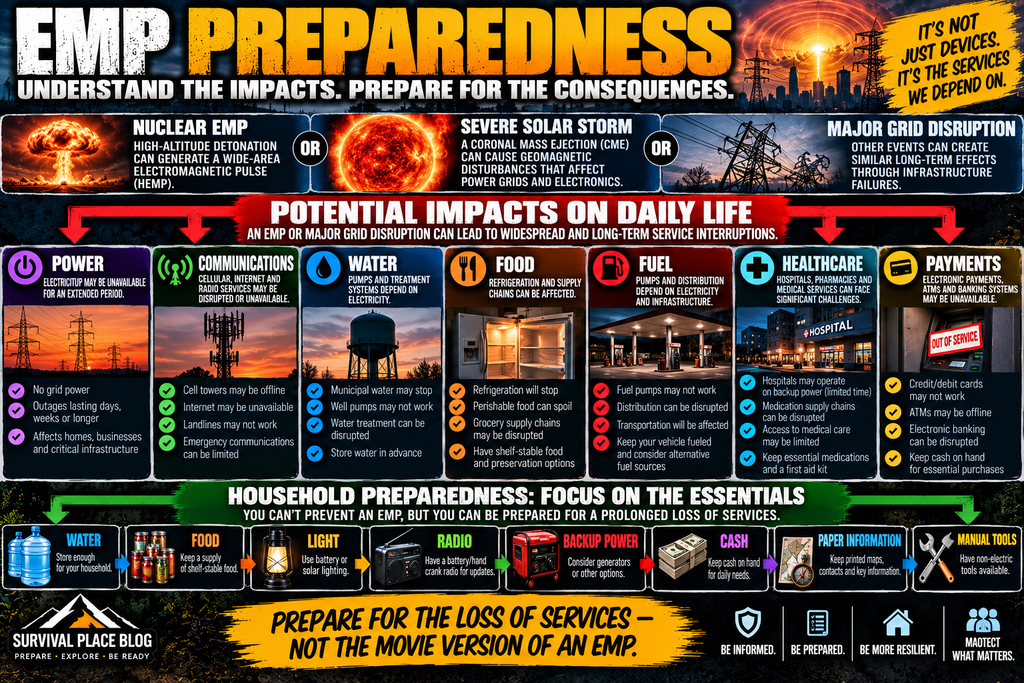
A practical EMP preparedness plan begins with the same fundamentals that prepare your household for almost any extended power outage.
1. Store Water First
Water should be one of your first priorities.
A commonly used emergency-planning baseline is at least one gallon of water per person per day for drinking and sanitation, with additional water potentially needed because of heat, activity, health needs, children and pets.
Rather than trying to store an enormous amount immediately, build your supply gradually.
Start with several days.
Then work toward two weeks or longer as space, budget and circumstances allow.
Add a reliable filtration or purification method so stored water isn’t your only option.
2. Build a Practical Food Supply
Focus on foods that:
- Store well
- Require little or no refrigeration
- Can be prepared without normal kitchen appliances
- Don’t require excessive amounts of water
- Are foods your household will actually eat
Good options can include canned meats, vegetables and soups; rice; beans; pasta; oats; shelf-stable foods; dehydrated foods; and selected freeze-dried meals.
Rotate food into normal meals instead of creating a forgotten pile of “survival food” in the garage.
And keep a manual can opener with your supplies.
It’s one of the cheapest preparedness tools you can own.
3. Have Multiple Sources of Light
Flashlights and headlamps should be your primary emergency lighting rather than open flames.
Keep extra batteries available and consider rechargeable lights that can be powered from your backup-energy system.
LED lanterns are especially useful for lighting rooms without consuming large amounts of energy.
Candles may seem like the obvious blackout solution, but they introduce additional fire risk—particularly when people are tired, stressed or moving through a dark home.
4. Have More Than One Way to Receive Information
Your smartphone shouldn’t be your only connection to the outside world.
A battery-powered emergency radio provides another way to receive official information when internet and cellular networks are disrupted.
Solar or hand-crank charging can provide additional options, although those features shouldn’t replace keeping appropriate batteries and maintaining your equipment.
Most importantly, learn how your radio works before the emergency.
A radio sitting unopened in its packaging isn’t much of a communication plan.
5. Keep Backup Power Realistic
Portable battery power stations and solar charging systems have become useful preparedness tools.
Depending on capacity, they can help maintain:
- Phones
- Radios
- Rechargeable lights
- Small electronics
- Some medical equipment
- Other essential low-to-moderate power needs
But understand their limits.
A portable power station isn’t the same thing as unlimited household electricity.
Know the capacity of your equipment and decide in advance which devices actually need power.
If you use a fuel-powered generator, operate it outdoors and well away from occupied structures, doors, windows and vents because generators produce deadly carbon monoxide.
Never operate a generator inside a home, garage, basement or enclosed space.
6. Keep Some Cash Available
Electronic payments depend on communications and power.
During a prolonged outage, ATMs and card-processing systems may be unavailable even if a store is physically open.
A modest amount of emergency cash in small denominations gives your household another option.
You don’t need a suitcase full of money.
You need enough flexibility to handle ordinary necessities when electronic payments aren’t working.
7. Keep Important Information Offline
Phones have made us surprisingly dependent on information that disappears when the battery dies.
Keep printed or written copies of important information such as:
- Family contact numbers
- Emergency contacts
- Medication information
- Important addresses
- Insurance information
- Evacuation routes
- Local maps
Paper doesn’t need a charger.
8. Maintain Basic Manual Tools
An extended outage quickly reminds people how many tools now depend on batteries.
A basic manual toolkit can include:
- Adjustable wrench
- Screwdrivers
- Pliers
- Hammer
- Utility knife
- Manual can opener
- Work gloves
- Duct tape
- Basic repair supplies
You don’t need to recreate an 1800s homestead.
You simply need enough capability to handle ordinary problems without relying entirely on powered equipment.
Should You Own a Faraday Cage?
This is where EMP preparedness gets interesting.
A Faraday enclosure uses conductive material to reduce electromagnetic energy reaching equipment inside it.
The underlying principle is legitimate. Electromagnetic shielding is used in professional applications to protect sensitive systems and equipment.
But there’s an important distinction:
A metal container isn’t automatically “EMP-proof.”
Shielding effectiveness depends on enclosure construction, seams, openings, conductive continuity, frequency and other factors.
Professional electromagnetic protection can involve shielding, surge suppression, cable protection, grounding and bonding engineered together as a system.
That doesn’t mean a household can’t take reasonable shielding precautions.
It means we shouldn’t promise that a homemade container provides a particular level of EMP protection without appropriate testing.
What About the “Radio Test”?
You’ll often see advice telling people to put a radio or phone inside a homemade Faraday enclosure.
If the signal disappears, the cage supposedly works.
That can demonstrate that an enclosure attenuates that particular radio-frequency signal.
It does not prove that the enclosure provides a specific level of protection across the electromagnetic conditions associated with a nuclear EMP.
That’s an important distinction.
What Should You Put in a Faraday Cage?
You don’t need to fill an entire room with electronics.
Think in terms of backup capability.
Potential candidates could include:
- A spare emergency radio
- Backup two-way radios where appropriate
- Small power banks
- Spare charging cables and adapters
- A backup flashlight or rechargeable headlamp
- Electronic storage containing copies of useful reference material
The goal isn’t preserving entertainment electronics.
It’s preserving a small amount of equipment that could improve communication, information access or basic capability after a major disruption.
And remember:
An emergency radio that survives isn’t useful if you’ve never learned how to operate it.
Preparation still matters more than equipment.
What Should You Do After a Suspected EMP or Major Grid Failure?
At the household level, you may not immediately know what caused an outage.
Don’t assume EMP just because the lights went out.
Start with what you can observe.
Check for Immediate Hazards
Look for fire, smoke, electrical hazards, damaged power lines or other immediate dangers.
Stay away from downed electrical lines and anything they may be touching.
Determine the Scope
Check whether neighboring homes have power.
Try your phone.
Check your emergency radio.
If communications aren’t functioning normally, continue gathering information rather than immediately jumping to conclusions.
Conserve Battery Power
If communications are disrupted, don’t burn through your phone battery repeatedly attempting the same connection.
Reduce screen brightness, disable unnecessary functions and use the device strategically.
Avoid Unnecessary Travel
Traffic signals may be out.
Fuel may become difficult to obtain.
Roads may be congested.
Unless you need to evacuate because of an immediate hazard or authorities advise otherwise, remaining at a prepared home may be safer than immediately joining everyone else on the road.
Protect Your Food
Keep refrigerator and freezer doors closed.
During an extended outage, food safety becomes a priority surprisingly quickly.
Use perishable food strategically and follow established food-safety guidance rather than relying on smell or appearance alone.
Check on People
Check family members and, when safe and practical, neighbors who may need assistance—particularly older adults and people who depend on powered medical equipment.
A prepared neighborhood can often solve problems that an isolated household cannot.
EMP Preparedness Checklist
You don’t need to accomplish everything this weekend.
Build your preparedness in stages.
Water
☐ Several days of stored drinking water
☐ Longer-term water-storage plan
☐ Water filter or other treatment method
☐ Additional water for pets and special needs
Food
☐ Shelf-stable foods your household actually eats
☐ Foods requiring minimal cooking
☐ Manual can opener
☐ Safe alternative cooking method
☐ Plan for refrigerated and frozen food during outages
Lighting
☐ LED flashlights
☐ Headlamps
☐ LED lanterns
☐ Spare batteries
☐ Rechargeable lighting options
Communications
☐ Battery-powered emergency radio
☐ Spare batteries
☐ Family communication plan
☐ Written contact numbers
☐ Two-way radios if useful for your household
Power
☐ Charged power banks
☐ Portable power station if appropriate
☐ Solar charging option if practical
☐ Generator and safely stored fuel if appropriate
☐ Carbon-monoxide alarms with battery backup
Medical
☐ First-aid kit
☐ Necessary prescription medications
☐ Backup plan for electrically powered medical equipment
☐ Printed medical information
Transportation
☐ Vehicle maintained
☐ Reasonable fuel level
☐ Vehicle emergency kit
☐ Paper maps
☐ Alternative plan if driving isn’t possible
Information
☐ Emergency contacts on paper
☐ Local maps
☐ Important documents backed up
☐ Emergency plans printed
☐ Useful reference material available offline
EMP-Specific Backup
☐ Identify the electronics actually worth protecting
☐ Consider appropriate shielding for backup electronics
☐ Keep spare charging cables and adapters with backup equipment
☐ Learn how to use emergency communications equipment before storing it
Prepare for the Consequences, Not the Movie Scenario
EMP preparedness doesn’t require assuming that civilization will disappear overnight.
It requires recognizing how dependent modern households are on electricity and the infrastructure electricity supports.
At the household level, the answer isn’t panic.
It’s resilience.
Store water.
Build a practical food supply.
Have safe lighting.
Create backup ways to receive information.
Maintain basic medical supplies.
Keep your vehicle prepared.
Develop realistic backup power.
Protect a small amount of useful electronic equipment if you choose.
And know what you’ll do when the normal systems you depend on aren’t available.
Do those things and you’ll be considerably better prepared not only for an electromagnetic pulse, but also for severe storms, earthquakes, wildfires, extended blackouts and many of the other disruptions that can affect a household.
You don’t have to predict the emergency correctly to prepare for its consequences.