Affiliate Disclosure: This post contains affiliate links. If you purchase through these links, Survival Place Blog may earn a commission at no additional cost to you. As an Amazon Associate I earn from qualifying purchases.
When a major storm closes roads, electricity goes out for several days, or local pharmacies become difficult to reach, even routine medical needs can become challenging. A minor cut may require supplies you cannot easily purchase, a prescription may be running low, or someone in your household may depend on medical equipment that requires electricity.
Preparing for these situations is an important part of household emergency planning.
A practical home emergency first aid plan goes beyond keeping a box of bandages in a cabinet. It includes the right supplies, access to essential medications, important medical information, and a clear understanding of when professional help is necessary.
This guide explains how to prepare for common household medical needs during disasters without turning your home into a medical facility or expecting family members to perform procedures beyond their training.
For the broader household preparedness framework, start with our guide, Start Here: Your 72-Hour Preparedness Plan.
1. Why Home Emergency First Aid Matters During a Disaster
Most households can handle a minor scrape or small cut when stores, pharmacies, and medical services are operating normally.
During a disaster, those familiar resources may become harder to access.
You could face:
- Delayed ambulance response because of hazardous conditions.
- Closed pharmacies or interrupted prescription deliveries.
- Power outages affecting refrigerated medications or medical devices.
- Minor injuries during cleanup or evacuation.
- Limited access to clean water and sanitation.
- Disrupted appointments, home healthcare visits, or routine treatments.
These situations do not mean you should attempt advanced medical care yourself.
Instead, preparedness helps you manage appropriate minor problems, protect essential supplies, recognize serious symptoms, and seek professional assistance as soon as necessary.
The goal is to reduce avoidable complications while maintaining access to the care your household needs.
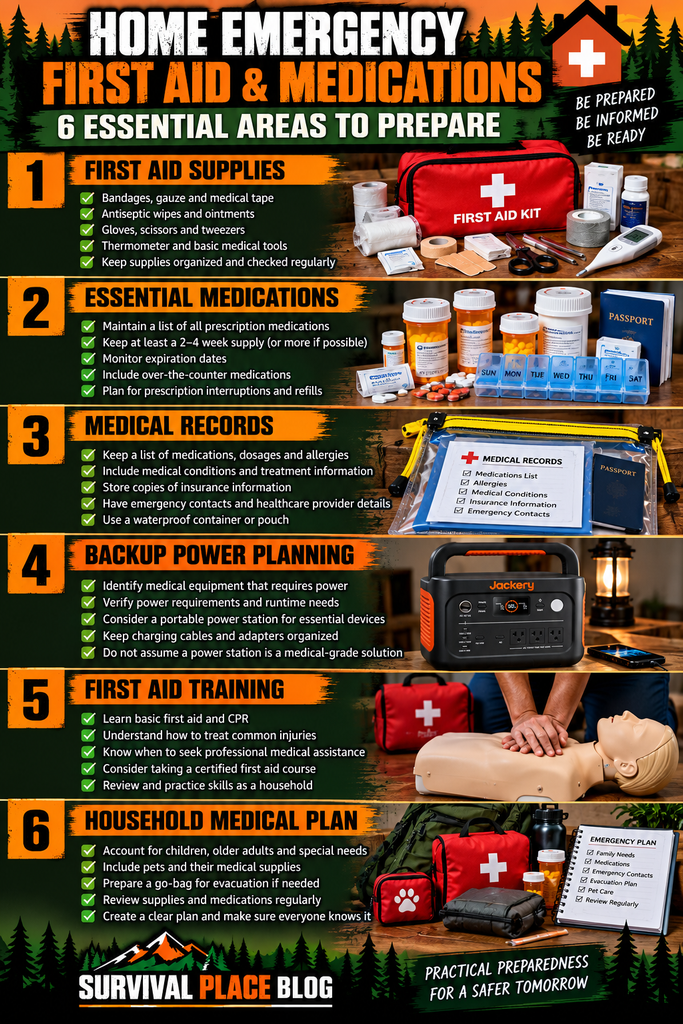
2. Build a Practical Household First Aid Kit
A dependable first aid kit is one of the foundations of home emergency preparedness.
You can assemble your own kit, purchase a prepared one, or combine both approaches.
The important question is not how many pieces the package contains. It is whether the supplies are appropriate for your household and whether you know how to use them.
Basic Wound Care Supplies
Consider stocking:
- Adhesive bandages in several sizes.
- Sterile gauze pads and absorbent dressings.
- Gauze rolls and medical tape.
- Nonlatex disposable gloves.
- Antiseptic wipes suitable for their intended use.
- Saline solution for appropriate wound or eye rinsing.
- A clean cloth or other suitable material for applying pressure.
- A small supply of wound dressings for larger minor injuries.
Keep supplies clean, dry, and protected in their original packaging until needed.
Useful First Aid Tools
A household kit may also include:
- Blunt-tip scissors or medical shears.
- Tweezers.
- Digital thermometer.
- Instant cold packs.
- Emergency blanket.
- CPR breathing barrier.
- First aid instruction booklet.
- Flashlight or headlamp.
A digital thermometer is a useful addition to a household first aid kit. The Goodbaby No-Touch Thermometer for Adults and Kids offers non-contact forehead temperature readings, making it convenient for routine temperature checks. Follow the manufacturer’s instructions for accurate use, and remember that thermometer readings are only one part of evaluating someone’s condition.
Choose tools that are practical and familiar rather than filling your kit with specialized equipment you have never learned to use.
Over-the-Counter Medications
Depending on your household’s needs, you might maintain appropriately labeled supplies of:
- Pain and fever medications.
- Antihistamines.
- Oral rehydration products.
- Medications for occasional digestive symptoms.
- Other nonprescription products recommended by your healthcare professional.
These products are not appropriate for everyone. Age restrictions, allergies, existing conditions, and interactions with prescription medications all matter.
Ask a pharmacist or healthcare professional which options are suitable for your household. Follow product labels and never give adult medication to a child unless the product and dose are appropriate for that child.
For a detailed reference on recommended first aid kit contents, review the American Red Cross first aid kit guidance.
A Ready-Made Kit as a Starting Point
A commercially assembled kit can be convenient because it keeps many common supplies organized in one location.
The EVERLIT 250-Piece Survival First Aid Kit is one option for households looking for a portable collection of basic emergency supplies.
However, no prepackaged kit should be assumed to contain every item your family needs. Review its contents, replace unsuitable or missing supplies, and add any household-specific items recommended by your healthcare providers.
3. Organize Your First Aid Supplies for Easy Access
A first aid kit is much less useful if nobody knows where it is.
Choose a location that is easy for responsible household members to reach but appropriately secured against access by young children.
Avoid areas exposed to excessive heat, moisture, or flooding.
For larger households, consider separating supplies into three groups.
Main Household Kit
Keep your most complete collection of first aid supplies in a designated location at home.
Use labeled compartments or clear internal organizers so essential items can be found quickly.
Portable Emergency Kit
Maintain a smaller kit with your evacuation supplies.
Include basic dressings, gloves, emergency information, and other items appropriate to your household.
Vehicle Kit
A vehicle first aid kit can be useful during travel or evacuation.
Check it regularly because vehicle temperatures can damage medications, adhesives, and other temperature-sensitive supplies.
For guidance on preparing a portable evacuation kit, see our article, Bugging Out: How to Build an Emergency Evacuation Plan.
4. Prepare for Prescription Medication Interruptions
For many households, prescription medications are more important than any item in a commercial first aid kit.
An interruption that is merely inconvenient for one person could become dangerous for someone who depends on medication to manage a serious medical condition.
Keep an Updated Medication List
Prepare a written record containing:
- Medication names, including generic names when known.
- Strength and prescribed dosage.
- When each medication is taken.
- The condition or purpose for which it is prescribed.
- Prescribing healthcare professional.
- Pharmacy name and contact information.
- Important medication allergies.
- Medical supplies needed to administer the medication.
Store a copy with your emergency records and another in an appropriate portable location.
Protect personal medical information from unnecessary exposure.
Discuss an Emergency Supply
Ask your pharmacist or prescribing healthcare professional whether an emergency supply is possible.
Availability depends on the medication, prescription rules, insurance coverage, and applicable state laws.
Some medications have strict refill limitations, and additional quantities may not be available.
Do not change your prescribed dosage or skip medication to build a reserve.
Instead, discuss a realistic plan for interruptions before an emergency occurs.
The Centers for Disease Control and Prevention provides guidance on preparing prescriptions for emergencies, including medication lists, refill planning, and necessary medical supplies.
Rotate Medications Appropriately
If you maintain an approved emergency supply, track expiration dates and use a rotation system that follows your pharmacist’s instructions.
Keep medications in properly labeled containers and avoid mixing different drugs into unmarked bottles.
Review your supply whenever prescriptions change.
5. Store Medications Safely During Power Outages
Emergency medication planning must account for storage conditions.
Some medicines tolerate normal room temperatures, while others require refrigeration or have more restrictive temperature limits.
Always follow the specific product labeling and guidance from your pharmacist.
Protect Medications From Heat and Moisture
Store medications away from direct sunlight, excessive heat, and moisture.
If flooding is possible, keep containers elevated and protected from water damage.
A watertight outer container may help protect sealed medication packages, but it does not replace appropriate temperature control.
Prepare for Refrigerated Medications
If someone in your household uses a refrigerated medication, develop a specific plan before a power outage.
Depending on the medication and its requirements, this may involve:
- An insulated cooler.
- Frozen gel packs.
- A thermometer suitable for monitoring storage temperature.
- An appropriate backup refrigeration source.
- A prearranged alternative storage location.
- Written instructions from the pharmacist or manufacturer.
Avoid direct contact between medications and ice packs when freezing would damage the product.
Different medications have different permitted temperature ranges and exposure limits. A cooler alone does not guarantee safe storage.
If refrigeration fails, contact your pharmacist, prescribing clinician, or manufacturer for product-specific advice. Do not guess whether an exposed medication remains safe.
After Flooding or Extreme Temperatures
Medications exposed to contaminated floodwater or damaging temperatures may no longer be safe or effective.
Follow the U.S. Food and Drug Administration’s guidance on safe medication use after a natural disaster.
If a potentially compromised medication is essential to sustaining life and no replacement is immediately available, seek urgent professional guidance rather than independently stopping treatment or assuming the medication is safe.
6. Keep Important Medical Information Accessible
During an emergency, you may need to explain someone’s medical needs to a healthcare professional who has never treated them before.
Having organized information can save valuable time.
Create a Household Medical Information Sheet
For each person, consider including:
- Full name and date of birth.
- Emergency contacts.
- Significant medical conditions.
- Medication list and allergies.
- Relevant medical equipment.
- Healthcare providers.
- Insurance information.
- Important care instructions provided by a clinician.
Keep the information accurate and limited to what is useful.
Protect Your Records
Consider maintaining:
- A paper copy in a secure household emergency binder.
- A protected portable copy for evacuation.
- An encrypted digital backup, if practical.
- Copies of important prescriptions or treatment instructions.
For added protection during evacuation or wet conditions, the YUMQUA Waterproof Document Pouches, 3-Pack can help organize copies of prescriptions, emergency contacts, insurance information, and other important records. Keep documents in an additional protective container when necessary, and test the pouches before relying on them to protect irreplaceable paperwork.
Medical records contain sensitive personal information, so avoid leaving them in unsecured public locations or unnecessarily sharing them.
Tell appropriate household members where the records are kept and who may access them in an emergency.
7. Plan for Medical Equipment That Requires Electricity
A power outage can become a medical emergency when someone relies on electrically powered equipment.
Examples include certain respiratory devices, oxygen concentrators, powered mobility equipment, feeding pumps, and other essential devices.
Each type of equipment has different power requirements.
Identify Essential Equipment
Create a list of:
- Equipment name and model.
- Manufacturer and service provider.
- Electrical requirements.
- Battery runtime, if applicable.
- Charging or backup power options.
- Replacement supplies.
- Emergency support contacts.
Develop a Backup Power Plan
Work with the equipment supplier and healthcare team to determine appropriate backup options.
Some devices may support external batteries or compatible backup power systems. Others require more specialized arrangements.
Do not assume a small phone power bank can operate medical equipment.
For general household backup power, the Jackery Explorer 1000 v2 Portable Power Station offers a 1,070Wh battery and multiple power outputs for compatible devices. It can be useful during extended outages, but households relying on powered medical equipment must verify the device’s electrical requirements, compatibility, and expected runtime with the equipment manufacturer or healthcare provider. A consumer power station should never be assumed to be an approved or sufficient medical backup system
Test approved backup systems according to manufacturer instructions and maintain batteries as recommended.
If your household depends on essential powered equipment, arrange an alternative safe location where care and electricity can be maintained if your backup system is insufficient.
For additional household power outage preparation, see our guide, 48 Hours Without Power.
Do Not Rely Solely on Utility Restoration
Contact your electric utility about any available medical-needs registration or notification programs.
These programs may provide useful communication, but they do not guarantee uninterrupted service or priority restoration.
Your emergency plan should account for an outage lasting longer than expected.
8. Learn Basic First Aid Before an Emergency
Owning supplies and knowing how to use them are two different things.
A basic first aid course can help household members respond more effectively and recognize when a situation requires professional treatment.
Useful training topics include:
- Assessing scene safety.
- Recognizing medical emergencies.
- Responding to choking.
- CPR and automated external defibrillator awareness.
- Controlling external bleeding.
- Caring for appropriate minor wounds.
- Recognizing possible fractures and serious injuries.
- Identifying symptoms that require urgent medical evaluation.
Training should be obtained from qualified instructors and refreshed according to the training provider’s recommendations.
Practice Simple Skills
Household members can practice locating supplies, putting on disposable gloves, identifying emergency contacts, and following a basic emergency response plan.
Do not practice invasive procedures or advanced medical techniques without appropriate professional instruction.
For additional outdoor emergency considerations, see our guide, Wilderness First Aid: Essential Skills for Outdoor Emergencies.
9. Know When to Seek Professional Medical Help
A home first aid kit is intended to support appropriate initial care. It is not a substitute for emergency medical services.
Call 911 or your local emergency number for serious or potentially life-threatening situations, including:
- Difficulty breathing or severe respiratory distress.
- Chest pain or symptoms suggesting a heart attack.
- Sudden facial drooping, arm weakness, or speech difficulties.
- Severe or uncontrolled bleeding.
- Loss of consciousness or inability to respond normally.
- A serious head, neck, or spinal injury.
- A severe allergic reaction.
- Seizures lasting unusually long or repeated seizures without recovery.
- Severe burns or other major injuries.
This is not a complete list.
If a person’s condition appears serious, is worsening rapidly, or you are uncertain about an immediate threat, seek professional emergency guidance.
Follow instructions from emergency dispatchers and provide only the assistance you are trained to perform.
When Emergency Services Are Delayed
During major disasters, response times may increase.
Keep the person in a safe location when possible, follow dispatcher instructions if communication is available, and avoid unnecessary movement of someone with a suspected serious injury.
Do not delay seeking help because you believe your household supplies are sufficient.
10. Prepare for Children, Older Adults, and Special Household Needs
Medical preparedness should reflect the people who actually live in your home.
A generic first aid kit cannot account for every household.
Infants and Children
Consider:
- Age-appropriate medical supplies.
- Necessary prescribed medications.
- Pediatric healthcare contact information.
- Feeding supplies and special dietary needs.
- Appropriate thermometers and other recommended equipment.
- Written instructions for caregivers.
Keep medications and potentially hazardous supplies securely stored.
Older Adults
Some older adults may need additional planning for:
- Multiple prescriptions.
- Mobility aids.
- Hearing aids and replacement batteries.
- Vision supplies.
- Routine medical appointments.
- Assistance with medication management.
- Transportation during an evacuation.
People With Disabilities or Chronic Medical Needs
Discuss emergency planning with healthcare professionals and support providers.
Consider communication needs, backup caregivers, accessible transportation, medical devices, and essential daily supplies.
If a person receives regular treatment at a clinic or hospital, ask the provider about emergency operating procedures and alternative treatment arrangements.
Pets
Pets may require prescription medications, veterinary records, and specialized supplies.
Keep these items organized separately from human medications to avoid confusion.
11. Create a Household Medical Emergency Action Plan
A short written plan helps household members respond without having to make every decision under pressure.
Include the following.
Who to Contact
Identify emergency services, medical providers, pharmacies, trusted relatives, and backup caregivers.
Make sure contact information is available on paper.
Where Supplies Are Stored
List the locations of first aid kits, medications, medical records, and backup equipment.
Who Needs Assistance
Identify household members who may require help with medication, mobility, communication, or transportation.
Assign responsibilities when appropriate, but establish backups in case a designated person is unavailable.
What to Do During an Evacuation
Determine which medical items must accompany each person.
Keep critical items accessible rather than buried beneath less important supplies.
What Happens if Communication Fails
Use the household contact and meeting procedures established in your emergency communications plan.
For detailed guidance, see Emergency Communications Plan: How to Stay Informed and Keep Your Family Connected.
12. Maintain Your First Aid Kit and Medical Supplies
Emergency preparedness requires occasional maintenance.
Supplies can expire, packaging can become damaged, batteries can lose charge, and prescriptions can change.
A practical inspection routine should include:
- Checking expiration dates.
- Replacing used or damaged dressings.
- Inspecting packaging for moisture or contamination.
- Reviewing medication lists.
- Confirming prescription refill arrangements.
- Testing approved backup power equipment.
- Updating emergency contacts.
- Checking that household members know where supplies are located.
Review supplies at least twice a year and whenever medical needs change.
Do not keep expired or damaged medications simply because they might be useful during a disaster. Ask a pharmacist about safe disposal and replacement.
13. Common Home Emergency First Aid Mistakes
Buying a Large Kit Without Checking the Contents
A high piece count does not guarantee that a kit includes the supplies your household needs.
Inspect the contents and supplement them appropriately.
Forgetting Prescription Planning
Bandages and dressings cannot replace medications that someone depends on every day.
Discuss refill arrangements and backup access with healthcare professionals.
Storing Supplies in Poor Conditions
Excessive heat, moisture, and flooding can damage medical supplies and medications.
Choose storage locations carefully.
Assuming Backup Power Will Run Medical Equipment
Medical devices can require significantly more power than phones or small electronics.
Confirm compatibility and runtime before relying on a backup system.
Keeping Medical Information Only on a Phone
A discharged, damaged, or inaccessible phone can leave important records unavailable.
Maintain a secure paper backup.
Attempting Treatment Beyond Your Training
Emergency supplies do not make someone a medical professional.
Recognize your limitations and seek qualified assistance when necessary.
14. Home Emergency First Aid & Medications Checklist
Use this checklist to evaluate your household’s medical preparedness.
First Aid Supplies
- Assemble or inspect the main household first aid kit.
- Include bandages, gauze, gloves, dressings, and basic tools.
- Add household-specific supplies.
- Keep a portable kit with evacuation supplies.
- Replace damaged or expired items.
Medications
- Create an updated medication list.
- Confirm pharmacy and prescriber contact information.
- Discuss emergency refills with healthcare professionals.
- Protect medications from heat, moisture, and flooding.
- Develop a plan for refrigerated medications, if applicable.
Medical Information
- Prepare household medical information sheets.
- Record important allergies and medical needs.
- Keep copies of essential prescriptions.
- Store records securely.
- Make appropriate information accessible during evacuation.
Equipment and Special Needs
- Identify equipment requiring electricity.
- Confirm approved backup power arrangements.
- Prepare necessary medical supplies and accessories.
- Arrange backup caregivers or transportation if needed.
- Include children, older adults, and household-specific needs.
Training and Maintenance
- Identify available first aid and CPR training.
- Review emergency warning signs.
- Confirm household members know where supplies are stored.
- Practice locating important medical information.
- Inspect supplies and update the plan regularly.
Print this two-page checklist to organize your household’s first aid supplies, essential medications, medical records, backup power arrangements, and emergency medical preparedness plan.
15. Final Thoughts: Prepare for the Medical Needs You Actually Have
A useful home emergency first aid plan is not about accumulating the largest collection of medical equipment.
It is about understanding your household’s needs and preparing for realistic disruptions.
Start with a dependable first aid kit, an accurate medication list, and a conversation with your pharmacist or healthcare provider about essential prescriptions.
Then address safe storage, medical records, equipment power requirements, and special household needs.
Finally, make sure the people in your home know where supplies are located, how to contact emergency services, and when professional care is necessary.
A well-organized plan cannot eliminate every medical risk during a disaster, but it can help your household avoid preventable problems and respond more effectively when normal services are disrupted.