
Affiliate Disclosure: This post contains affiliate links. If you purchase through these links, Survival Place Blog may earn a commission at no additional cost to you. As an Amazon Associate I earn from qualifying purchases.
A 90 day emergency preparedness checklist goes well beyond the food, water and flashlights you might keep for a weekend power outage. Preparing for three months means thinking about how your household would handle an extended disruption to utilities, transportation, stores, pharmacies, communications or other services you normally depend on.
That doesn’t mean you need 90 days of absolutely everything or a garage packed from floor to ceiling with survival gear. A practical three-month plan combines stored supplies, backup systems, reusable equipment and the ability to adapt as conditions change.
The objective is simple: give your household more options and more time to make good decisions when normal systems aren’t operating normally.
Federal emergency guidance also recommends building household supplies in advance so you can manage essential needs when normal services are disrupted.
What Does 90 Days of Preparedness Actually Mean?
A three-month preparedness plan isn’t based on the assumption that you’ll be completely isolated for 90 days.
Instead, you’re building enough resilience that a disruption doesn’t immediately force your household into a crisis.
Think about the systems you use every week:
- Municipal water or a private well
- Grocery stores
- Electricity
- Natural gas
- Pharmacies
- Fuel stations
- Banks and electronic payments
- Internet and cellular service
- Trash collection
- Medical services
- Roads and transportation
A severe storm might affect only a few of these.
A major earthquake, wildfire, prolonged power failure, regional infrastructure problem or widespread supply disruption could affect several at once.
A strong 90-day plan prepares for overlapping problems rather than one specific disaster.
Build Your 90-Day Supply in Stages
Trying to purchase three months of supplies in one weekend is expensive and usually unnecessary.
Build gradually.
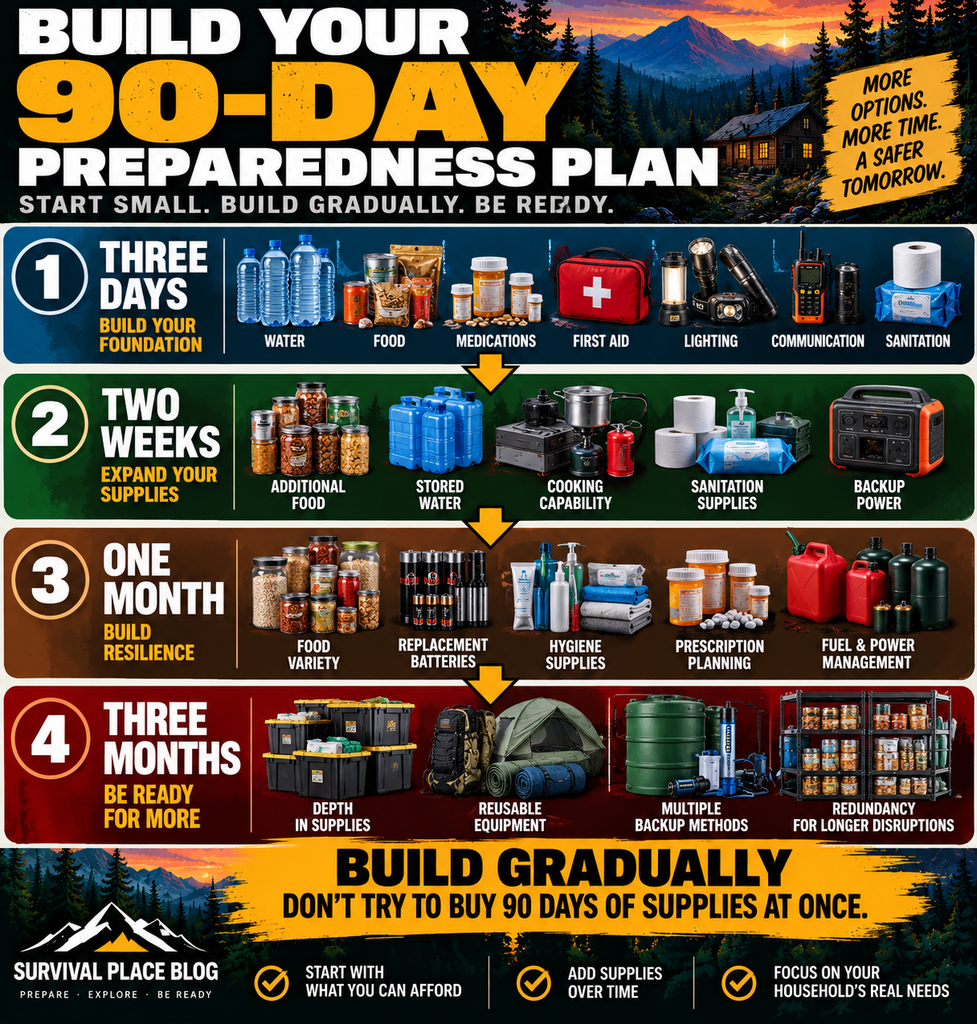
Stage 1: Three Days
Start with enough essential supplies to get through the first 72 hours.
Focus on:
- Water
- Ready-to-eat food
- Medications
- First aid
- Lighting
- Communication
- Basic sanitation
Stage 2: Two Weeks
Once your 72-hour foundation is solid, extend it to approximately two weeks.
This is where additional food, stored water, cooking capability, sanitation supplies and backup power become more important.
Stage 3: One Month
At 30 days, you begin thinking less like you’re assembling an emergency kit and more like you’re creating a resilient household supply.
Food variety matters.
Replacement batteries matter.
Hygiene matters.
Prescription planning matters.
Fuel and power management matter.
Stage 4: Three Months
A 90-day plan adds depth and redundancy.
Instead of simply buying more of everything, identify which supplies can be stored, which can be reused and which require a backup method.
Our Five Pillars of Prepping guide provides the broader framework for building those layers into a complete household preparedness plan.
90-Day Water Plan
Water is one of the hardest parts of long-term preparedness because it is heavy, bulky and essential.
A commonly used emergency-planning baseline is one gallon of water per person per day for drinking and basic sanitation.
At that rate:
1 person for 90 days = 90 gallons
2 people for 90 days = 180 gallons
4 people for 90 days = 360 gallons
For most households, storing the entire 90-day amount isn’t practical.
That’s why a better long-term water plan uses several layers.
Layer 1: Stored Drinking Water
Start by building a meaningful supply of immediately available drinking water.
Two weeks is a useful initial target if you have adequate storage space.
For four people, one gallon per person per day for 14 days equals 56 gallons.
Store water in appropriate containers and keep it protected from contamination, chemicals and excessive heat.
Stackable or portable water containers can make it easier to build your stored supply gradually while keeping individual containers manageable.
Layer 2: Larger Emergency Water Storage
Larger containers can increase capacity without relying entirely on cases of disposable water bottles.
Your available space will determine what works.
A house with a garage may have considerably more storage flexibility than a small apartment.
A bathtub water-storage bladder can also provide temporary emergency capacity when you have advance warning and the municipal water supply is still safe.
Layer 3: Water Filtration
Stored water eventually runs out.
A gravity-fed filtration system can provide another layer of preparedness when you have access to a suitable water source but need to improve its quality before use.
I’ve personally used a Big Berkey for years, and a gravity-fed system is a convenient option for treating larger amounts of water without relying on electricity.
No filter removes every possible contaminant.
Know what your specific system is designed to reduce, maintain it correctly and don’t assume visibly clear water is automatically safe.
Layer 4: Backup Water Treatment
A second treatment method gives you redundancy if your primary filter breaks, clogs or reaches the end of its service life.
Water purification tablets are compact and easy to store as an additional emergency treatment option when used according to the product directions.
Follow the instructions for whatever treatment method you’re using. Water treatment depends on the source, the potential contaminants and the capabilities of the product.
Layer 5: Know Your Local Water Options
Identify potential emergency water sources before you need them.
Depending on where you live, those might include stored household water, rainwater, nearby surface water or another approved community source.
Water collected from an uncertain source should not automatically be considered safe to drink.
For a deeper look at calculating household water needs, choosing containers and storing water safely, see our complete home water storage guide.
90-Day Food Supply
A three-month food supply should look more like a pantry than a box of survival rations.
The easiest system is built around foods your household already eats.
That makes rotation easier and reduces waste.
Start With Normal Shelf-Stable Foods
Useful staples can include:
- Rice
- Beans
- Lentils
- Pasta
- Oats
- Flour
- Cereal
- Peanut butter
- Cooking oil
- Canned meat
- Canned fish
- Canned vegetables
- Canned fruit
- Soup
- Shelf-stable milk
- Sauces
- Spices
- Salt
- Sugar
- Coffee or tea
- Snacks
Don’t build your entire supply around one food simply because it has a long shelf life.
Variety matters during a long disruption.
Calculate Meals Instead of Buying Random Food
Ninety days represents approximately 270 meals per person if you’re planning around three meals per day.
You don’t necessarily need 270 completely different meals.
Instead, create repeatable meal combinations.
For example:
Breakfast: oatmeal, cereal, shelf-stable milk, dried fruit
Lunch: soup, crackers, tuna, peanut butter
Dinner: rice and beans, pasta, canned meat, vegetables
Then calculate how many servings your household actually uses.
This gives you a much more realistic shopping target than simply filling shelves with random cans.
Store Foods You Can Prepare With Limited Utilities
Some foods require considerable water, cooking time or fuel.
Others can be eaten directly from the package.
Your supply should contain both.
If the grid is down, you may want to conserve fuel rather than simmer dried beans for hours.
Keep some meals that require:
- No cooking
- Minimal water
- Short cooking times
A manual can opener is easy to overlook until the electricity is out and much of your emergency food is canned.
Add Dehydrated and Freeze-Dried Food Strategically
Freeze-dried food can add long storage life and variety to a deep pantry, but you don’t need to build your entire emergency supply around expensive packaged meals.
Home-dehydrated foods can also expand your options.
Fruits, vegetables and other appropriate foods can be dehydrated and rotated through normal meals.
Our complete food-dehydration guide covers preparation, dehydration and storage for anyone who wants to add home-dehydrated foods to a longer-term pantry.
The best long-term food system usually combines ordinary pantry foods with selected long-storage foods rather than relying entirely on one category.
Rotate Your Emergency Food
A 90-day pantry shouldn’t become a food museum.
Use a first in, first out approach.
Eat older items and replace them with newer ones.
Periodically check:
- Expiration or best-quality dates
- Damaged cans
- Leaking containers
- Moisture
- Pest activity
- Packaging damage
- Changes in household dietary needs
Keep a simple inventory if your supply becomes large.
A notebook, spreadsheet or printed pantry list is enough.
Plan How You’ll Cook Without Electricity
Stored food isn’t particularly useful if your only way to prepare it depends on an electric stove.
Your backup cooking method depends on your home, climate and available outdoor space.
Possible options may include equipment specifically designed for appropriate outdoor or emergency use.
Never move outdoor cooking equipment indoors because the weather is bad.
Charcoal grills, camp stoves and other combustion appliances can produce dangerous carbon monoxide.
Use equipment only in locations permitted by its manufacturer.
Store Fuel Safely
If your backup cooking method requires fuel, include appropriate fuel in your plan.
Store fuels according to manufacturer instructions and applicable local requirements.
Don’t accumulate more combustible material than you can safely store.
90-Day Medical and First-Aid Plan
Long-term preparedness doesn’t mean trying to replace professional medical care.
The goal is to handle routine first aid, maintain necessary personal supplies and reduce avoidable problems.
Your household first-aid supplies might include items for:
- Minor cuts
- Scrapes
- Minor burns
- Blisters
- Sprains
- Basic wound care
For a ready-made option, the EVERLIT 250-Piece Survival First Aid Kit combines basic first-aid supplies with additional emergency items in a portable organized bag.
Check your kit periodically.
Replace expired, damaged or used supplies instead of assuming the kit is complete because the bag still looks full.
Prescription Medications
Prescription planning deserves special attention.
Don’t ration necessary medication or change how you take it without appropriate medical guidance.
Instead, talk with your healthcare provider, pharmacist and insurer about what refill options may be available to you.
Also keep an updated list of:
- Medications
- Dosages
- Allergies
- Medical conditions
- Prescribers
- Pharmacy contact information
- Important medical contacts
Keep this information accessible during an evacuation while protecting sensitive information appropriately.
Hygiene and Sanitation for 90 Days
Sanitation is easy to underestimate because most of it disappears into the background of normal life.
Running water, toilets, trash pickup and stores make hygiene simple.
When those systems are interrupted, basic supplies become much more important.
Consider storing:
- Toilet paper
- Soap
- Hand sanitizer
- Toothpaste
- Feminine hygiene products
- Diapers if needed
- Trash bags
- Disinfecting supplies
- Paper towels
- Disposable gloves
- Laundry supplies
- Personal hygiene items
Buy what your household actually uses.
Three months of supplies for one adult looks very different from three months for a family with young children.
Have a Backup Sanitation Plan
If water or sewer service is disrupted, normal toilets may not always be usable.
Research an appropriate emergency sanitation method for your home before that happens.
The plan should address:
- Human waste
- Handwashing
- Trash
- Cleaning
- Odor control
- Pets
Improvised sanitation needs to protect both household members and the environment.
Lighting for a Long Power Outage
One flashlight isn’t a lighting plan.
A three-month preparedness setup should have several independent light sources.
Useful options include:
- Flashlights
- Headlamps
- LED lanterns
- Battery-operated motion lights
- Solar lighting
A rechargeable LED lantern provides useful area lighting for kitchens, common rooms and other spaces where a flashlight alone isn’t enough.
Put lights where they’re actually needed.
Bedrooms should have an easily accessible light.
The kitchen should have usable area lighting.
Keep another light near emergency supplies.
Headlamps are particularly useful because they leave both hands available for cooking, repairs, first aid and moving around safely.
Backup Power
You don’t need to power your entire house to benefit from backup electricity.
Start by identifying critical devices.
These might include:
- Phones
- Emergency radios
- Rechargeable lights
- Medical equipment
- Communication devices
- Small electronics
A portable power bank can handle smaller USB-powered devices.
Larger battery power stations, solar systems and generators can provide additional capability, but their usefulness depends on what you’re trying to operate.
For higher power needs, a portable power station such as the Jackery Explorer 1000 v2 can provide battery backup for compatible electronics and small appliances during an outage without running a gasoline generator.
Calculate your actual power needs before purchasing an expensive system.
Generator Safety
Portable generators require careful placement and operation because they produce carbon monoxide.
Never operate one inside a house, garage, basement, crawlspace, shed or other enclosed area.
Follow current safety guidance and the manufacturer’s instructions regarding distance from structures, exhaust direction, electrical connections, weather protection and fuel storage.
Review current generator safety guidance before an outage so everyone in the household understands the risks of carbon monoxide and improper generator placement.
Emergency Communications
During a prolonged disruption, accurate information can influence nearly every decision you make.
Your phone may provide emergency alerts, weather information and communication, but it shouldn’t be your only source.
A battery-powered or hand-crank emergency radio gives your household another way to receive official information when internet or cellular service is unavailable or unreliable.
Also keep important phone numbers written down.
Few people memorize phone numbers anymore.
If your phone is damaged, lost or dead, a printed contact list can become surprisingly valuable.
Keep Some Emergency Cash
Electronic payment systems depend on electricity and communications.
During a local outage, stores may temporarily be unable to process cards or digital payments.
Keep a reasonable amount of emergency cash in a secure location.
Small denominations can be more practical than large bills.
The amount is a personal decision based on your household, budget and likely needs.
Protect Important Documents
An extended emergency may involve evacuation, property damage, insurance claims or temporary relocation.
Organize important records before you need them.
Consider copies of:
- Identification
- Insurance information
- Medical information
- Emergency contacts
- Property records
- Vehicle information
- Important household records
A fire-resistant document bag provides one convenient place to keep copies of important household records together and ready to grab during an evacuation.
Store sensitive documents securely and consider maintaining protected digital backups.
Tools and Basic Repair Supplies
Extended disruptions often create small problems that you normally solve with a trip to the hardware store.
Keep a reasonable collection of basic tools.
Depending on your home, that might include:
- Screwdrivers
- Pliers
- Adjustable wrench
- Hammer
- Utility knife
- Duct tape
- Work gloves
- Rope or cordage
- Fasteners
- Basic repair materials
Don’t attempt electrical, structural, gas or other hazardous repairs beyond your training.
Sometimes the safest tool is the phone you use to call a qualified professional.
Plan for Heating and Cooling
Temperature can become a serious problem during an extended outage.
Cold Weather
Your first strategy should be conserving body heat rather than trying to heat an entire powerless house.
Use:
- Layered clothing
- Warm socks
- Hats
- Sleeping bags
- Wool or insulated blankets
- Emergency blankets
You may be able to concentrate household activity in a smaller area to reduce heat loss.
Never use outdoor grills or other unapproved combustion equipment indoors for heat.
If indoor temperatures become unsafe, particularly for infants, older adults or people with medical needs, relocation may be safer than trying to remain home.
Hot Weather
Extreme heat can also make a powerless home unsafe.
Use shade, ventilation when conditions permit, hydration and reduced physical activity.
Have a plan for reaching a cooling center, hotel, family member’s home or another safe location if necessary.
Home Security During a Long Disruption
Security preparation should focus on practical measures rather than assuming widespread disorder.
Strong doors, working locks, exterior awareness, backup lighting and good communication remain useful whether the outage lasts two hours or two weeks.
For a more detailed security plan, see our guide to securing your home when a grid failure takes out normal lighting, communications and security systems.
Avoid publicly advertising your emergency supplies or posting that your home is empty.
Maintain contact with trusted neighbors.
If you observe suspicious activity, prioritize distance and contacting authorities rather than confrontation.
Plan for Pets
Pets increase the amount of food, water and medication your household needs.
Include:
- Pet food
- Stored water
- Medications
- Leash or harness
- Carrier
- Waste supplies
- Identification
- Vaccination information
- Comfort items
Don’t assume you’ll be able to purchase a specific brand of pet food during a disruption.
Rotate pet supplies just as you rotate your own food.
Consider Household-Specific Needs
A generic checklist can only take you so far.
Your 90-day plan should reflect the people actually living in your home.
Consider additional supplies for:
- Infants
- Young children
- Older adults
- People with disabilities
- People with medical conditions
- People who depend on powered medical equipment
- Pets
If someone depends on electricity for medical needs, create a specific backup-power and relocation plan with appropriate professional guidance.
Transportation and Fuel
Your vehicle can become an important part of your preparedness plan.
Keep up with routine maintenance and avoid allowing the fuel level to remain extremely low when severe weather or another foreseeable disruption is approaching.
Keep basic vehicle emergency supplies available.
If fuel stations lose electricity or communications, pumping fuel and processing payments may temporarily become difficult.
Your evacuation plan should also include more than one route whenever practical.
Maintain Printed Maps
GPS is extremely useful, but phones can fail, batteries die and road closures can force you onto unfamiliar routes.
Keep appropriate printed maps with your emergency supplies or vehicle equipment.
If you want to strengthen your map-and-compass skills as a backup to GPS, our wilderness navigation guide covers the fundamentals step by step.
For evacuation planning, mark important locations such as:
- Hospitals
- Shelters
- Family meeting locations
- Alternate routes
- Nearby communities
Update your plan as roads and household circumstances change.
Don’t Forget Morale
Three months is a long time.
Preparedness isn’t only about calories, batteries and equipment.
Extended disruptions can be stressful and monotonous, particularly for children.
Keep simple entertainment available that doesn’t depend entirely on electricity.
Examples include:
- Books
- Playing cards
- Board games
- Children’s activities
- Notebooks
- Art supplies
- Puzzles
Maintaining normal routines where possible can make a difficult situation more manageable.
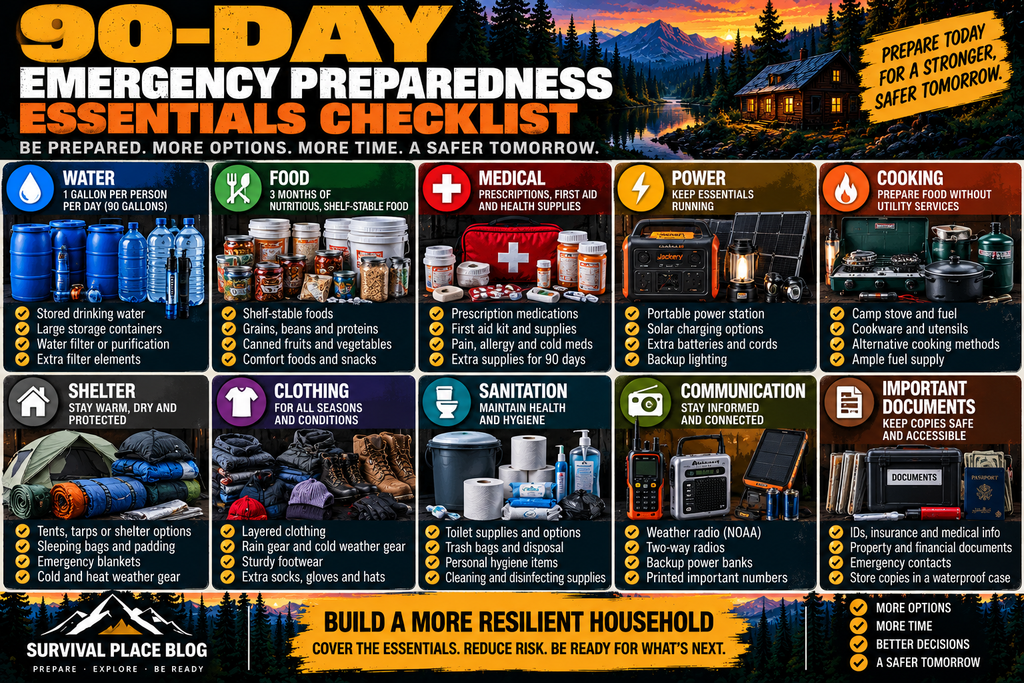
A Practical 90-Day Household Checklist
Use this as a final review rather than treating it as a one-size-fits-all shopping list.
Water
- Stored drinking water
- Appropriate water containers
- Primary filtration method
- Backup treatment method
- Knowledge of potential local water sources
Food
- Shelf-stable staples
- Canned foods
- Ready-to-eat meals
- Dehydrated or freeze-dried foods
- Cooking oil
- Seasonings
- Comfort foods
- Manual can opener
- Food inventory and rotation system
Cooking
- Appropriate backup cooking method
- Safely stored compatible fuel
- Matches or ignition method if required
- Meals requiring little or no cooking
Medical
- First-aid kit
- Personal medications
- Medical information
- Spare glasses or other essential personal items
- Necessary medical equipment
Hygiene and Sanitation
- Soap
- Toilet paper
- Trash bags
- Disinfecting supplies
- Personal hygiene products
- Emergency sanitation plan
- Pet sanitation supplies
Lighting and Power
- Flashlights
- Headlamps
- Lanterns
- Spare batteries
- Power banks
- Charging cables
- Appropriate backup power for critical devices
Communication
- Emergency radio
- Written contact list
- Emergency alert access
- Household communication plan
Home and Safety
- Working smoke alarms
- Working carbon monoxide alarms
- Fire extinguisher
- Basic tools
- Work gloves
- Secure doors and windows
- Important documents
- Emergency cash
Warmth and Weather
- Warm clothing
- Blankets
- Sleeping bags
- Emergency blankets
- Seasonal supplies appropriate to your climate
- Safe relocation plan for extreme temperatures
Transportation
- Maintained vehicle
- Emergency vehicle supplies
- Fuel strategy
- Printed maps
- Primary and alternate evacuation routes
Household-Specific Supplies
- Infant supplies
- Children’s needs
- Older-adult needs
- Disability-related equipment
- Medical-device backup plan
- Pet food and supplies
How to Build a 90-Day Supply Without Breaking Your Budget
You don’t need to purchase everything at once.
Start with the supplies that solve the most immediate problems.
First: water, food, medication, lighting and first aid.
Next: sanitation, communications and backup cooking.
Then: deeper food reserves, additional water capability and backup power.
Finally: improve redundancy and replace weak equipment.
Add a few shelf-stable foods to normal grocery trips.
Buy supplies when they’re genuinely useful and affordable rather than because a preparedness list says you must own them.
Use what you store.
Replace what you use.
Over time, your emergency supply becomes part of your normal household inventory rather than an expensive pile of gear you never touch.
When you’re ready to build your supplies gradually, our emergency preparedness shopping list organizes practical items you can pick up during normal grocery and warehouse-store trips.
Review Your 90-Day Plan Twice a Year
Preparedness isn’t finished when the shelves are full.
Households change.
Food expires.
Batteries age.
Children grow.
Medications change.
Pets change.
Equipment gets used.
At least periodically, review:
- Food inventory
- Stored water
- Medications
- First-aid supplies
- Batteries
- Power banks
- Fuel
- Seasonal clothing
- Emergency contacts
- Important documents
- Pet supplies
- Evacuation plans
Use the review to rotate older supplies into everyday use and replace what you’ve consumed.
Final Thoughts: Build Resilience, Not a Stockpile
A 90-day preparedness plan isn’t about predicting exactly what emergency will happen next.
It’s about reducing how quickly an interruption becomes a crisis.
Water gives you time.
Food gives you stability.
Backup lighting and power keep basic equipment operating.
Medical and sanitation supplies help you manage everyday needs.
Communication helps you understand what’s happening.
And a household plan helps everyone know what to do next.
You don’t need to complete your entire 90 day emergency preparedness checklist this weekend.
Start with three days.
Build to two weeks.
Extend that to a month.
Then work toward three months as your space, budget and household needs allow.
The goal isn’t to own the most survival gear.
It’s to build a household that can absorb a disruption, adapt to changing conditions and continue taking care of the people who depend on it.