
Affiliate Disclosure: This post contains affiliate links. If you purchase through these links, Survival Place Blog may earn a commission at no additional cost to you. As an Amazon Associate I earn from qualifying purchases.
A home security during power outage plan should account for more than keeping a few flashlights handy.
When electricity fails, exterior lighting may disappear, internet-dependent cameras can go offline, garage-door openers may stop working, and some alarms, locks and communication systems may operate differently depending on their backup power.
At the same time, your household may be dealing with darkness, severe weather, extreme temperatures, damaged roads or an outage that lasts much longer than expected.
The goal isn’t to turn your house into a fortress.
It’s to make your home harder to enter, easier to monitor and safer to live in while normal services are disrupted.
Start With the Most Likely Power-Outage Problems
A widespread blackout can feel dramatic, but your preparation should begin with ordinary problems.
Ask yourself what happens at your house if the electricity disappears tonight.
Can you lock the garage door manually?
Do your exterior doors have solid locks and strike plates?
Will your security cameras continue recording without electricity or internet?
Does your alarm system have battery or cellular backup?
Can everyone find flashlights in the dark?
Can you charge phones?
Do your smoke and carbon monoxide alarms have battery backup?
Can you safely stay warm or cool?
Do you know where everyone should go if someone tries to enter the house?
These questions are more useful than planning around an imagined collapse of public order.
A good blackout security plan focuses first on the things you can control.
The Four Layers of Home Security During a Power Outage
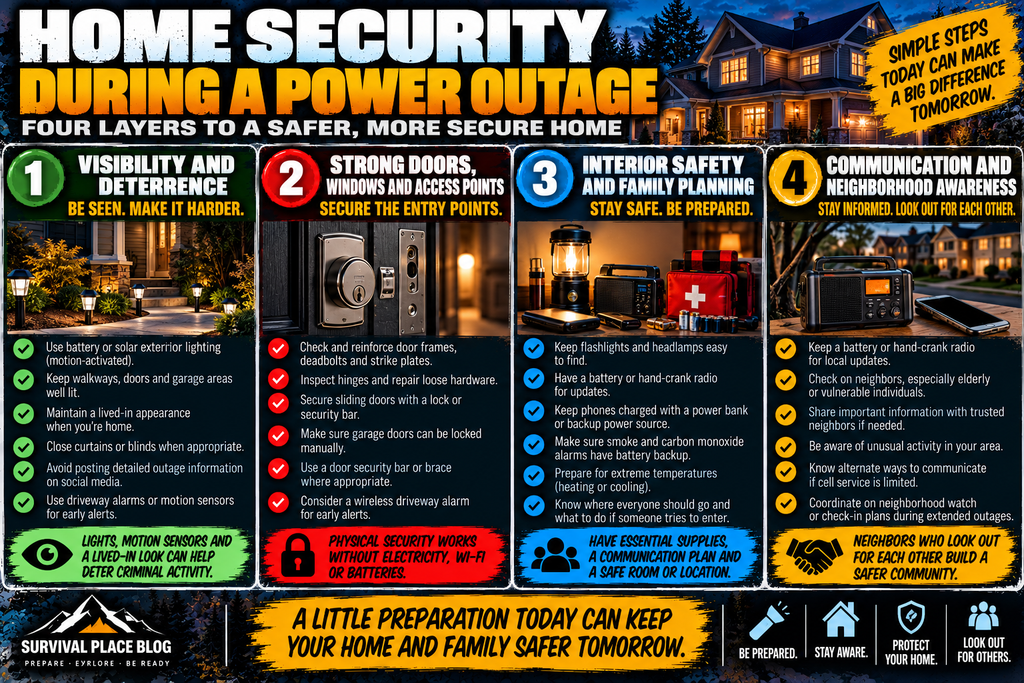
Think of home security during power outage conditions as four overlapping layers:
- Visibility and deterrence
- Strong doors, windows and access points
- Interior safety and family planning
- Communication and neighborhood awareness
No single layer makes a home secure.
The advantage comes from combining several simple measures so that one failure doesn’t leave you completely exposed.
Layer 1: Visibility and Deterrence
A power outage changes the appearance of your neighborhood.
Streetlights may be dark. Porch lights disappear. Security cameras may lose connectivity. Familiar routines become less obvious from outside.
That makes basic exterior awareness more important.
Use Battery or Solar Exterior Lighting
Motion-activated solar lighting can provide useful illumination around:
- Front and back doors
- Walkways
- Side yards
- Garage doors
- Gates
- Other frequently used entrances
Solar lights aren’t a substitute for a security system, and performance varies with weather, placement and battery condition.
But they can make it easier for you to see what’s happening outside without relying on utility power.
Don’t Advertise That Your Home Is Unoccupied
If you remain home during an outage, normal signs of occupancy can help.
That doesn’t mean lighting every room like nothing happened. It simply means avoiding unnecessarily broadcasting that a house is empty.
Close curtains or blinds when appropriate, especially after dark.
Avoid posting detailed information publicly about whether your home is empty, what emergency supplies you have or how long you’ll be away.
Layer 2: Strengthen Doors, Windows and the Garage
Physical security becomes especially valuable during an outage because it doesn’t depend on electricity, Wi-Fi or batteries.
You don’t need extreme modifications.
Start with the ordinary entry points someone would actually use.
Check Exterior Doors
Inspect:
- Door frames
- Hinges
- Deadbolts
- Strike plates
- Sliding doors
- Garage entry doors
Loose hardware and weak frames should be repaired before an emergency.
Longer screws and properly installed reinforced strike plates may strengthen some door-frame installations, but hardware should be appropriate for the specific door and frame.
A door security bar or brace can provide another layer where appropriate.
Another useful option is a wireless driveway alarm, which can provide an early alert when a vehicle or person enters a monitored area around your property.
Don’t Forget Sliding Doors
Sliding patio doors deserve special attention.
Check whether the existing lock works properly. Depending on the door design, a correctly sized security bar or dowel in the track can provide an additional physical barrier.
Never block a required emergency exit in a way that prevents occupants from getting out quickly.
Manually Secure the Garage
Garage doors are easy to overlook.
When power fails, automatic openers may not function normally. Learn how your opener’s emergency release works before an outage and understand how to secure the door manually.
Also check the door connecting an attached garage to the house.
Treat it like any other exterior entry point.
Layer 3: Create an Interior Safety Plan
Home security isn’t only about preventing entry.
Your family should know what to do if something unusual happens outside—or if someone attempts to enter.
Choose a room or location where household members can gather if necessary.
Ideally, it should have:
- A locking or securable door
- A charged phone or backup communication option
- Flashlights
- Basic first-aid supplies
- An alternate escape route when possible
This isn’t about creating a bunker.
It’s about avoiding confusion when people are tired, frightened and operating in the dark.
Keep Critical Equipment Easy to Reach
Don’t scatter emergency equipment throughout the house without a plan.
Keep frequently needed items in predictable locations.
A compact rechargeable flashlight is worth keeping in an easy-to-reach location so you aren’t searching through emergency supplies when the lights suddenly go out.
A bedside flashlight is particularly useful because an outage can begin while everyone is asleep.
Headlamps are useful when you need both hands free to check doors, move supplies, help children or perform basic repairs.
Use Interior Motion Lighting Carefully
Battery-operated motion lights can be useful in:
- Hallways
- Stairways
- Bathrooms
- Utility areas
- Near important exits
They reduce the need to search for switches or carry a flashlight every time someone moves through the house.
Layer 4: Stay Connected With Your Neighborhood
A neighborhood can become more useful during an outage when people communicate instead of operating independently.
That doesn’t mean organizing armed patrols or confronting strangers.
A safer approach is straightforward neighborhood awareness.
Exchange contact information with neighbors you trust.
Share useful information about:
- Downed power lines
- Fallen trees
- Road closures
- Fires
- Suspicious activity
- Utility restoration information
- Neighbors who may need assistance
Check on older adults, people with disabilities and anyone who depends on electrically powered medical equipment when it is safe to do so.
For immediate threats or emergencies, contact emergency services rather than attempting a confrontation.
Build a Blackout Lighting Plan
Lighting is one of the easiest outage problems to solve in advance.
The best approach is redundancy.
Don’t depend on one flashlight sitting in a kitchen drawer.
Have several independent light sources.
Good options include:
- LED lanterns
- Headlamps
- Flashlights
- Battery-operated motion lights
- Solar lights
A rechargeable LED lantern can provide broader room lighting than a flashlight and is useful for kitchens, living areas and other shared spaces during an outage.
Place lighting where you are likely to need it instead of storing everything in one emergency bin.
For example:
Bedroom: flashlight or headlamp
Kitchen: lantern
Main living area: lantern
Garage: flashlight or work light
Emergency supplies: backup lights and batteries
That way, losing one light doesn’t leave the entire household in darkness.
Flashlights and Lanterns Are Better Than Candles
Candles create an unnecessary fire risk during an outage.
People may already be moving around unfamiliar dark spaces, dealing with children, pets, extension cords or emergency equipment.
Battery-powered lighting removes an open flame from that situation.
Keep spare batteries available for equipment that uses replaceable cells, and periodically recharge rechargeable lights.
Know What Happens to Your Security System When Power Fails
Modern security equipment varies considerably.
Some systems include backup batteries. Some cameras store footage locally. Others depend on Wi-Fi, cloud services or continuous household power.
Find out how your equipment actually behaves before an outage.
Test:
- Alarm backup battery
- Camera backup power
- Local recording
- Cellular backup
- Smart locks
- Video doorbells
- Wi-Fi equipment
- Garage-door opener
- Exterior lighting
Don’t assume a device will work simply because its app still appears on your phone.
Consider Backup Power for Critical Electronics
A small power bank can keep phones and other USB devices running when wall outlets are unavailable.
Reserve limited battery capacity for important communication rather than entertainment.
For longer outages, larger battery power stations or properly installed backup-power systems may be useful, but determine what you actually need to power before buying expensive equipment.
Communications Matter as Much as Security
During a blackout, your phone becomes even more important.
It may provide:
- Emergency alerts
- Weather information
- Utility updates
- Maps
- Family communication
- Emergency calling
But cellular service can become congested, and home internet equipment generally stops working unless it has backup power.
Keep important phone numbers written down as well as stored digitally.
A battery-powered or hand-crank emergency radio provides another way to receive information when internet service or cellular networks are unreliable.
Prepare for Fire and Carbon Monoxide
Some of the most serious hazards during a blackout originate inside the home.
People begin improvising with generators, grills, candles, stoves and heating equipment.
That’s where a manageable outage can become dangerous.
Check Smoke and Carbon Monoxide Alarms
Make sure your home has working smoke and carbon monoxide alarms with appropriate battery backup.
Test them regularly and replace batteries or units according to manufacturer instructions.
Portable Generator Safety Is Non-Negotiable
Never operate a portable generator inside:
- A house
- Garage
- Basement
- Crawlspace
- Shed
- Other enclosed space
Opening a garage door or window does not make indoor generator operation safe.
Current U.S. Consumer Product Safety Commission guidance says portable generators should be operated outdoors, at least 20 feet from the home, with exhaust directed away from the house and other occupied buildings. U.S. Consumer Product Safety Commission
Keep exhaust away from doors, windows and vents.
Follow the manufacturer’s instructions for operation, weather protection, electrical connections, maintenance and fuel storage.
Never Use Outdoor Cooking Equipment Indoors
Do not bring charcoal grills or other outdoor combustion equipment inside your home because the power is out.
Carbon monoxide can accumulate without obvious warning.
Cooking and heating equipment should only be used in locations and conditions specifically permitted by the manufacturer.
If you aren’t certain that an appliance is approved for a particular indoor use, don’t improvise.
Plan for Cold-Weather Outages
A winter blackout creates additional problems because household temperatures may begin falling.
Instead of trying to heat the entire house, concentrate on keeping people warm.
Use:
- Layered clothing
- Hats and warm socks
- Sleeping bags
- Wool or insulated blankets
- Emergency blankets
- Draft reduction
- One smaller living area when practical
Close off unused rooms if doing so is safe and practical.
If indoor temperatures become unsafe—especially for infants, older adults or people with medical conditions—relocating to a heated location may be safer than trying to remain home.
Plan for Hot-Weather Outages Too
Security isn’t useful if the house itself becomes unsafe.
During extreme heat, indoor temperatures can rise rapidly when air conditioning stops.
Use shade, reduce unnecessary activity and move to a cooler location if the home becomes dangerously hot.
Know in advance where you could go if your house cannot safely maintain temperature.
Secure Emergency Supplies Without Hiding From the World
Preparedness supplies don’t need to be displayed where anyone walking past can see them.
Store emergency equipment in accessible but sensible locations.
That includes:
- Food
- Water
- Batteries
- Medical supplies
- Backup power
- Tools
- Fuel
- Emergency documents
This is basic household organization—not secrecy.
If you’re still building your household supplies, our emergency preparedness shopping list provides a practical breakdown of what to stock for longer disruptions.
Family members who may need the supplies should know where they are.
Protect Important Documents
A blackout may accompany a storm, wildfire, flood or evacuation.
Keep important documents organized so you aren’t searching through drawers during an emergency.
Consider maintaining copies of:
- Identification
- Insurance information
- Emergency contacts
- Medical information
- Property records
- Important account information
Store sensitive information securely.
Digital copies can provide another layer of redundancy when stored securely.
A fire-resistant document bag can help keep important paperwork organized and provide an additional layer of protection when you may need to evacuate quickly.
Keep Basic First Aid Accessible
Minor injuries become more difficult to manage when rooms are dark and normal services are disrupted.
Keep a first-aid kit somewhere everyone can locate.
Know what’s inside it before an emergency.
A large kit isn’t particularly useful if nobody knows where basic supplies are stored.
Keep Work Gloves With Your Emergency Equipment
Storm-related outages may leave broken branches, shattered glass, damaged fencing or debris around the property.
A sturdy pair of work gloves can help protect your hands during basic cleanup and inspection around the property.
Gloves are useful for basic cleanup and inspection, but don’t approach downed power lines or electrical equipment.
Treat any downed line as energized and keep people and pets away.
Water Can Become a Secondary Problem
A power outage doesn’t automatically mean your water supply is unsafe.
However, some emergencies that cause outages can also affect municipal water systems, private wells or pumping equipment.
Keep stored drinking water available and follow local advisories.
Our home water storage guide explains how much emergency water to keep and how to store it safely for longer outages.
If officials issue a boil-water or do-not-use advisory, follow the specific instructions provided for your area.
Food Safety Becomes More Important as the Outage Continues
Keep refrigerator and freezer doors closed as much as possible.
Opening them repeatedly allows cold air to escape.
According to federal emergency guidance, an unopened refrigerator generally keeps food cold for about four hours, while a full unopened freezer may maintain temperature for about 48 hours under appropriate conditions.
Use appliance thermometers rather than guessing whether perishable food is safe.
When food safety is uncertain, follow current USDA or local public-health guidance.
Think About Your Vehicle Before You Need It
If severe weather or another event could cause an outage, avoid letting your vehicle sit nearly empty.
Gas stations may be unable to pump fuel during a power failure, and payment systems may also be affected.
Keep your vehicle reasonably fueled and maintain a basic emergency kit.
Your car can also provide temporary charging capability, but never run a vehicle inside an attached garage or other enclosed area.
Know When Staying Home Is No Longer the Safest Choice
Preparedness doesn’t mean refusing to leave your house.
There are situations where evacuation or temporary relocation is safer.
Examples include:
- Fire
- Flooding
- Structural damage
- Gas leak
- Dangerous indoor temperatures
- Carbon monoxide alarm
- Mandatory evacuation
- Medical needs you cannot support without electricity
Have at least two possible destinations in mind.
That could include family, friends, a hotel, warming or cooling center, shelter or another safe location appropriate to the emergency.
Keep a small evacuation bag ready enough that you aren’t starting from zero when something happens.
Our bug out bag guide covers the essential gear to keep ready for the first 72 hours if you need to leave home quickly.
What to Do When the Power First Goes Out
The first few minutes don’t need to be chaotic.
Start with a quick assessment.
1. Determine whether the outage is limited to your home
Check whether neighboring homes and streetlights are also without power.
If the problem appears limited to your house and you can safely do so, check your electrical panel.
Don’t touch damaged electrical equipment, standing water near electrical equipment or anything you don’t understand.
2. Check for immediate hazards
Look and listen for:
- Smoke
- Fire
- Gas odors
- Downed lines
- Electrical damage
- Severe weather warnings
- Flooding
- Other immediate threats
Address life-safety issues before worrying about security.
3. Get your lighting running
Put flashlights, lanterns and headlamps where people need them.
Avoid creating trip hazards with equipment or cords.
4. Secure normal entry points
Check exterior doors, accessible windows and the garage.
There’s no need to barricade the house because the lights went out.
Simply confirm that normal security measures are functioning.
5. Check communications
Confirm that phones are charged and determine whether cellular service and internet are working.
Check utility information and local emergency alerts.
6. Account for everyone
Make sure household members know what happened and what the plan is.
Children should know where flashlights are and where to meet if the family needs to leave.
7. Check vulnerable neighbors when appropriate
A short conversation may identify someone who needs medical assistance, warmth, cooling or another form of help.
What Changes After Several Hours Without Power?
A short outage and an extended outage are different situations.
As the hours pass, priorities shift toward:
- Battery conservation
- Food temperature
- Indoor temperature
- Water
- Medical equipment
- Communication
- Fuel
- Sanitation
- Sleep
- Household routines
This is why a broader outage plan matters.
Our extended power outage guide walks through the additional problems that develop as an outage continues beyond the first several hours.
Home security is only one piece of the problem.
Keep Nighttime Routines Simple
Darkness can make an outage feel more threatening than it actually is.
Avoid letting everyone wander around the house with separate improvised lighting.
Establish a simple routine.
Before bed:
- Check doors and windows
- Confirm the garage is secure
- Put flashlights beside beds
- Check phone battery levels
- Verify smoke and CO alarms are operating
- Make sure everyone knows where to go if there is an emergency
Keep hallways and exits clear.
Pets should remain somewhere secure where they aren’t likely to escape through an open door.
Don’t Create Unnecessary Confrontations
If you see suspicious activity, prioritize distance, observation and contacting authorities when possible.
Don’t leave a secure home simply to investigate something outside.
Don’t confront strangers because you believe they may be suspicious.
Don’t organize armed patrols.
Don’t advertise that you’re protecting valuable supplies.
Your objective is to keep your household safe—not to police the neighborhood.
Practice Before the Next Outage
One of the best ways to discover weaknesses is to simulate a power failure for an evening.
Turn off normal lighting and pretend household power is unavailable.
Then test whether you can:
- Find emergency lights
- Lock the garage manually
- Charge a phone
- Locate the first-aid kit
- Access stored water
- Prepare food safely
- Communicate with family
- Find important documents
- Navigate stairs and hallways
- Secure doors and windows
You’ll quickly discover what works and what doesn’t.
Fix those problems while stores are open and the lights are on.
Home Security During Power Outage Checklist
Before an outage:
- Inspect doors, locks and strike plates
- Test alarm and camera backup systems
- Learn how to secure the garage manually
- Install useful battery or solar lighting
- Test smoke and carbon monoxide alarms
- Charge power banks
- Store emergency water and food
- Maintain flashlights and headlamps
- Organize first-aid supplies
- Protect important documents
- Write down emergency contacts
- Talk with trusted neighbors
- Make an evacuation plan
When the power fails:
- Check for immediate hazards
- Confirm the scope of the outage
- Secure doors, windows and garage access
- Set up safe lighting
- Check phones and communications
- Monitor official information
- Keep refrigerator and freezer doors closed
- Watch indoor temperatures
- Conserve batteries
- Keep generators and combustion equipment safely outside
- Check on vulnerable household members and neighbors
- Be ready to leave if conditions become unsafe
Build Security Into Your Larger Preparedness Plan
A blackout doesn’t require turning your house into a fortress.
Most useful preparations are ordinary household improvements that continue helping you even when the electricity is working: stronger doors, reliable lighting, organized supplies, working alarms, good communication and a family that knows what to do.
For a broader preparedness strategy, our Five Pillars of Prepping guide shows how these individual steps fit into a complete emergency plan.
The strongest approach is redundancy.
If your camera loses power, you still have good locks.
If your internet goes down, you still have a radio.
If one flashlight dies, you have another.
If the house becomes unsafe, you have somewhere else to go.
That’s practical preparedness: not assuming the worst will happen, but making sure a manageable problem doesn’t become a bigger emergency.